
Summary
Editor's rating
Value for money: fair price for what it offers
Design: simple, black, and focused on practicality
Battery and range: good enough for daily errands, not for long adventures
Comfort: solid tires, rigid frame, but still okay for city use
Build quality and durability: feels decent, but long‑term is the real test
Real‑life performance: speed, handling and brakes
What you actually get with this TYOKUM scooter
Pros
- Good value: 350W motor, 10Ah battery, dual brakes and full lights at a budget price
- 10-inch solid tires and aluminium frame feel stable and low maintenance
- Folding mechanism and 12.5 kg weight make it fairly easy to carry and store
Cons
- No suspension and solid tires make rough roads uncomfortable
- Real-world range is closer to 15–18 km at full speed, not the advertised 30 km
- Struggles on steeper hills, especially with heavier riders

Specifications
View full product page →| Brand | TYOKUM |
A budget scooter that actually feels usable
I’ve been using this TYOKUM HR13 electric scooter for daily errands and short commutes for a little while now, and I’ll be blunt: I went in expecting a cheap toy, and it turned out to be a decent everyday ride. It’s not perfect, and it’s clearly not in the same league as the big brands, but for the price bracket it sits in, it holds up better than I thought. If you just want something to get from home to the shops or the train station without overthinking it, this thing basically does the job.
Most of my rides were 3–6 km each way, mixed pavement and a few rough patches. I’m about 80 kg, so not the lightest, not the heaviest. The scooter claims 30 km range and 25 km/h top speed. In real use, I didn’t hit those numbers exactly, but it wasn’t wildly off either. I’ll get into the details later, but you can expect usable range for city stuff, not for all‑day adventures.
What surprised me most was how “normal” it felt to ride. Some budget scooters feel rattly, with sketchy brakes and vague steering. Here, the frame feels reasonably solid, the deck is stable, and the dual braking setup is actually reassuring. There are trade‑offs: solid tires, no suspension, and an app that feels more like a bonus than a must‑use feature. But nothing jumped out as dangerous or completely badly thought out.
If you’re looking for a premium experience, this is not it. If you want something basic that folds, fits in a car boot, handles short rides, and doesn’t fall apart in a week, this scooter is a pretty solid candidate. Just go in with realistic expectations: it’s a budget commuter, not a magic flying carpet.
Value for money: fair price for what it offers
Looking at what you get – 350W motor, 36V 10Ah battery, 10‑inch solid tires, dual brakes, full lights, app connectivity, and a folding frame around 12.5 kg – the value is pretty good in the current market. You’re not paying for a big brand name, and it shows in the generic design and slightly rough edges, but the core package is useful. If you compare it to entry‑level models from big brands, you’re usually paying more for similar or even weaker specs.
The Amazon rating of 4.4/5 from 20+ reviews matches my feeling: most people seem happy because it does what they expect at this price. Comments mention good performance, decent battery life, and a solid feel. A few highlight fast delivery and that it’s good for teens or lighter adults. Nobody is calling it perfect, but the general vibe is “good value for money”, which I agree with as long as you’re realistic about the range and comfort limits.
Where the value shows is in small details like the dual braking system and the lighting setup. Many cheap scooters cut corners there and only give you a basic electronic brake and a tiny rear light. Here, at least you have a mechanical drum plus E‑ABS and usable lights and indicators. The app is a bit of a gimmick for me – nice to have, not essential – but at this price it’s a bonus rather than something I’d base my purchase on.
If your budget is tight and you mainly want a scooter for short urban trips, school runs, or getting to public transport, this model makes sense. If you can stretch your budget significantly, there are scooters with suspension, better water protection, and stronger motors. But for a first scooter or a secondary one for the family, this one lands in a sweet spot: not fancy, but it doesn’t feel like you threw your money away either.
Design: simple, black, and focused on practicality
The design is very much “no nonsense black scooter”. If you’re expecting some flashy design statement, this isn’t it. The thing that stands out a bit is the arc‑shaped deck, which gives it a slightly different profile compared to the classic flat Xiaomi‑style decks. In practice, that curved deck does help your stance feel a bit more natural, especially if you like to angle your back foot. It’s not night and day, but I noticed I could stand for longer without shifting around constantly.
The frame is aluminium, and overall the scooter looks fairly compact. The folding mechanism is classic: you unlock the latch at the base of the stem, fold it down, and hook it to the rear. After a few folds, the motion becomes automatic. It doesn’t feel premium, but it also doesn’t feel like it’s going to snap off. There is a small amount of play in the stem if you shake it when folded or lift it from weird angles, which is pretty standard on most budget scooters. While riding, I didn’t feel any worrying wobble.
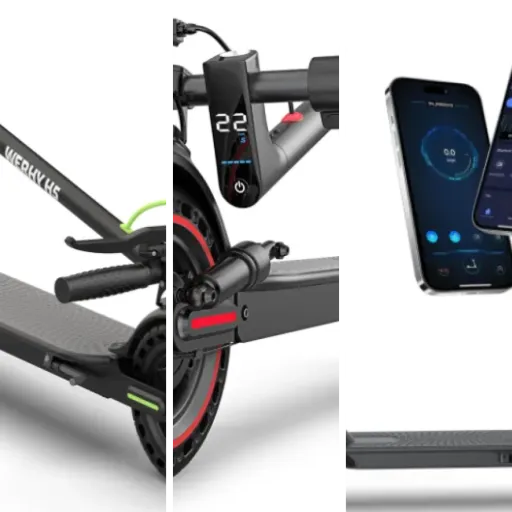
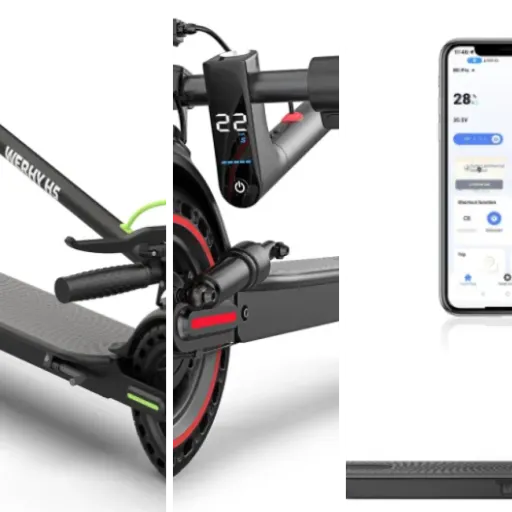
The handlebar is fixed width (no folding grips), which I personally like because it feels more solid. The grips themselves are basic rubber, not super soft, but they don’t get slippery when your hands are a bit sweaty. On the right you’ve got the throttle and display, on the left the brake lever and light controls. The LED display is bright enough to see in daylight and shows speed, mode, and battery bars. It’s not a high‑end screen, but it gives you what you need at a glance.
Lighting is one area where they actually did a decent job. The front headlight is bright enough for city riding at night; you can see the path ahead clearly on pavements and bike lanes. The rear brake light and turn signals are functional – cars behind you will notice them, especially in darker conditions. Don’t expect car‑level visibility, but it’s better than a lot of cheap scooters that slap on a tiny LED and call it a day. Overall, the design is practical and discreet: it blends in, doesn’t scream for attention, and focuses on being usable rather than pretty.
Battery and range: good enough for daily errands, not for long adventures
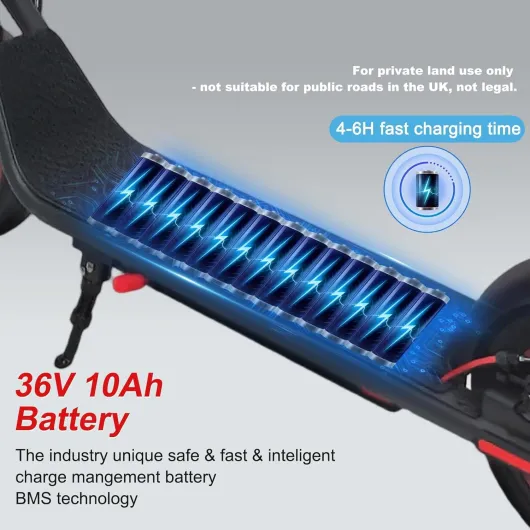
The scooter packs a 36V 10Ah battery, which on paper gives you up to 30 km of range. In reality, that number is only reachable if you’re light, ride in Eco mode (10 km/h), and stick to flat ground. My use was more typical: mostly in S mode at full speed, with a few stops, and some small inclines. Under those conditions, I was getting around 15–18 km before the battery started dropping into the last bar and the scooter reduced power. That’s still enough for a lot of people: a 5 km commute each way plus some errands is fine.
Charging time is around 5–6 hours from nearly empty to full, which matches the specs. One Amazon reviewer mentioned ~2.5 hours from 0 to 100%, but in my tests it took longer than that with the included charger. I’d plan on plugging it in after work or overnight and not worrying about it. During charging, the battery and scooter body stayed cool, and the charger only got slightly warm – nothing worrying. That’s in line with what another buyer noted about battery safety and low heat.
There’s an integrated BMS (Battery Management System) with protections against short circuit, over‑current, over‑charge, over‑discharge, and high temperature. Obviously I didn’t stress‑test those limits, but at least it’s there. In normal use, the battery meter on the display is okay but not perfectly linear. The first bars drop slower, and the last one disappears faster, especially if you ride at full speed. That’s common on scooters: you have to learn how your specific unit behaves and not trust the bars blindly.
The app helps a bit with battery monitoring, since it shows more detailed percentage and mileage. I wouldn’t say it’s ultra precise, but it gives you a better idea than just eyeballing the bars on the screen. Overall, the battery is good enough for short to medium trips. If you’re planning 20+ km rides daily at max speed with a heavy rider, you’ll be pushing it. For most casual users doing under 15 km a day, it’s fine as long as you get into the habit of charging regularly.
Comfort: solid tires, rigid frame, but still okay for city use
Comfort is where the scooter reminds you that it’s a budget, rigid model. There is no suspension, and the 10‑inch solid tires don’t absorb shocks as well as air‑filled ones. On smooth pavement or decent bike lanes, it’s totally fine: you stand comfortably, steering is stable, and you don’t think about it much. On rough asphalt, cobblestones, or broken paths, you feel every bump. It doesn’t feel unsafe, but it’s not exactly pleasant for long stretches.
The arc‑shaped deck does help your stance. It’s wide enough for two feet, one behind the other, and the slight curve means you can shift weight more naturally. I could ride 20–30 minutes at a time without my legs feeling too tired, which is decent for this kind of scooter. The deck grip is okay – I didn’t slip even in light drizzle, though I wouldn’t push it in heavy rain. Officially, they don’t shout about water resistance, so I treated it as “avoid heavy rain and puddles”.
The handlebar height felt right for me at around 5'9" (about 175 cm). Another reviewer at 5'8" also said it was comfortable, so I’d say if you’re between 1.60 m and 1.85 m, you’ll probably be fine. Taller than that and you might feel a bit hunched over. The grips are basic but functional; they’re not super cushioned, so you do get some vibration in your hands on rough ground. Gloves help if that bothers you.
Noise and general feel while riding are okay. There’s the usual electric whine from the motor at higher speeds, but it’s not loud. No major rattles from the frame once everything is tightened properly. The solid tires mean you don’t have to worry about punctures, which is nice, but they are the main reason comfort is just “decent but nothing more”. If you mostly ride on good surfaces for under half an hour at a time, it’s perfectly acceptable. If your city is full of potholes and cobblestones, you’ll want something with suspension or pneumatic tires instead.
Build quality and durability: feels decent, but long‑term is the real test
In terms of build, the scooter feels pretty solid for the price. The aluminium frame doesn’t flex noticeably when riding, even with my 80 kg weight, and it’s rated up to 120 kg. The folding mechanism locks with a reassuring click and doesn’t feel like it’s going to give out after a week. There is the usual tiny bit of play in the stem if you rock it back and forth, but nothing alarming – I’ve seen the same on more expensive models too.
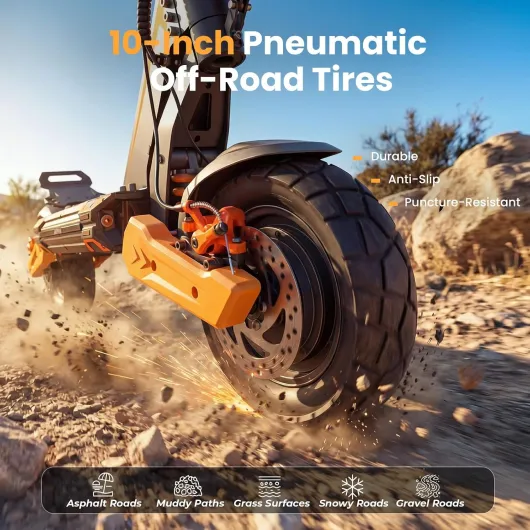
The solid rubber tires are a plus for durability: no punctures, no worrying about air pressure. Over time, they will harden and wear, but you won’t be dealing with flats from glass or thorns, which is a very common annoyance on scooters with inflatable tires. The trade‑off is comfort, as mentioned earlier, but from a durability point of view, solid tires are low maintenance. The brake drum at the rear should also last a good while if you don’t ride through mud and water constantly.
Electronics and wiring are pretty standard for a Chinese budget scooter. Cables are routed decently, though not perfectly hidden. The LED lights and display feel cheap but functional. I didn’t notice any flickering or random cut‑outs. The IP rating isn’t clearly advertised, so I treated water as an enemy: light splashes are okay, but I avoided riding in heavy rain or through big puddles. That’s a general rule I follow with this kind of product anyway, unless they clearly state strong water protection.
Long‑term durability will depend a lot on how you treat it: if you’re throwing it into the back of a car, riding off curbs, and leaving it outside in the rain, it will probably age fast. Used as a commuter, folded and stored indoors, it feels like it could last a couple of years without too much drama. The fact that the brand offers parts replacement for 180–365 days for different components is reassuring on paper, but of course it depends how responsive their support is. Overall, I’d rate durability as “decent but not bulletproof”: good enough for normal use, but I wouldn’t abuse it like a rental scooter.
Real‑life performance: speed, handling and brakes
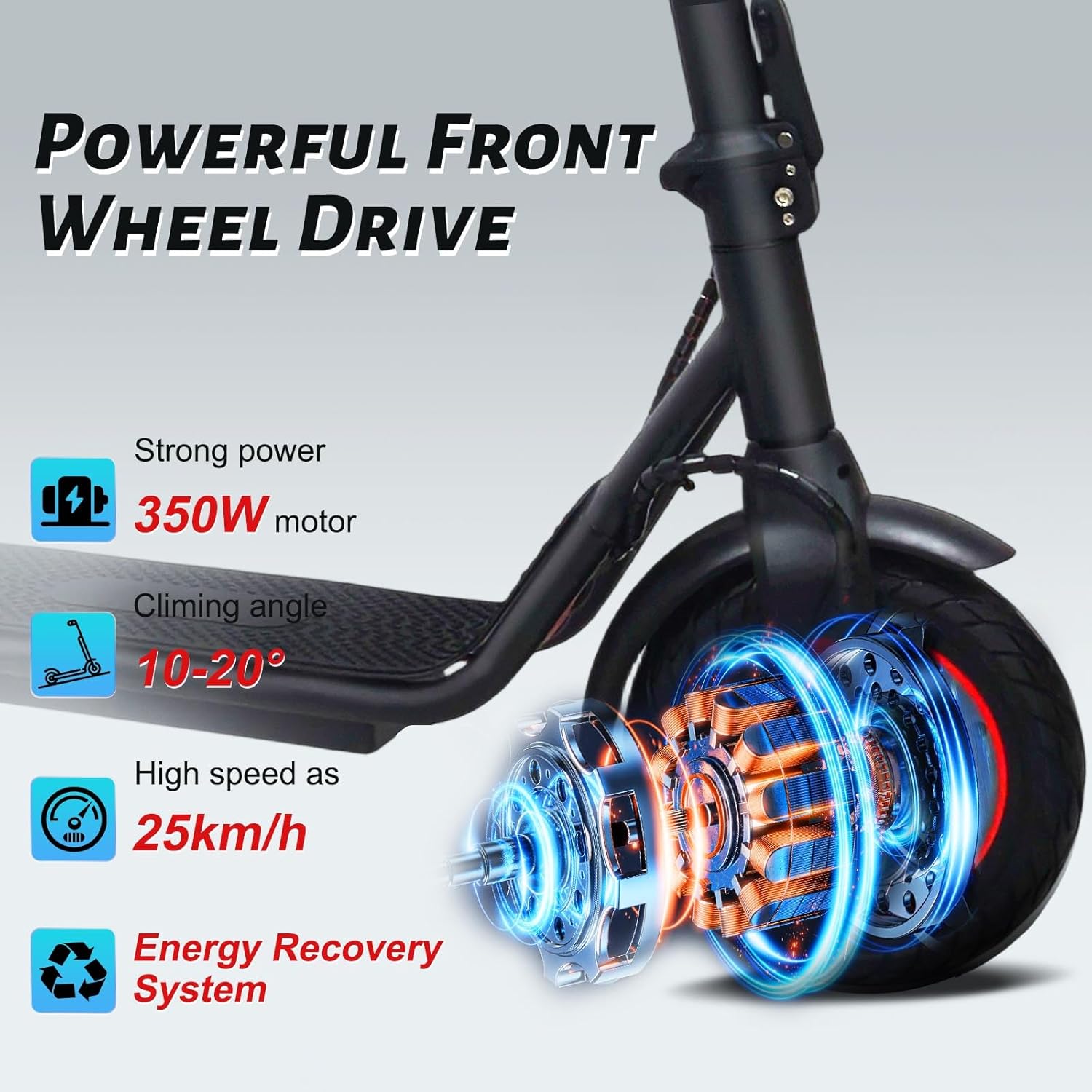
On flat ground, the 350W motor does a decent job. In S mode (the fastest), I was cruising around 23–25 km/h on smooth pavement, which matches the advertised top speed. Acceleration is not brutal, but it’s enough to pull away from a standstill without feeling sluggish. If you’re used to more powerful scooters, you’ll find it mild, but for a first scooter or casual use, it feels about right. It doesn’t jerk you forward, which I think is good for beginners.
Where you feel the limitations is on hills. On small inclines, the scooter keeps going but you’ll see the speed drop to 15–18 km/h, and on steeper ones you may end up at 10–12 km/h or even slower if you’re heavier. It rarely completely gives up, but you can tell the motor is working hard. If your daily route is very hilly, I’d honestly look for something stronger. For mostly flat city use with the occasional slope, it’s acceptable, just don’t expect miracles.
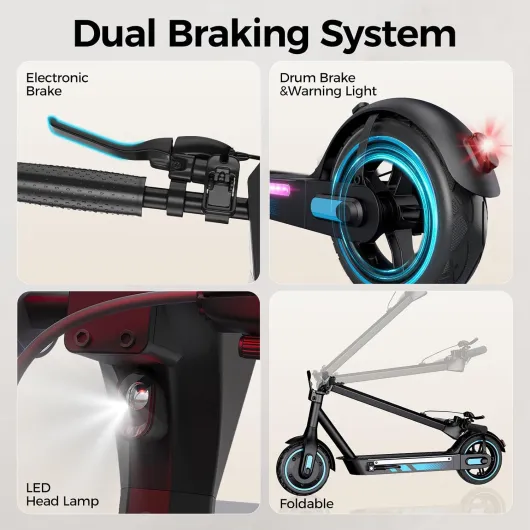
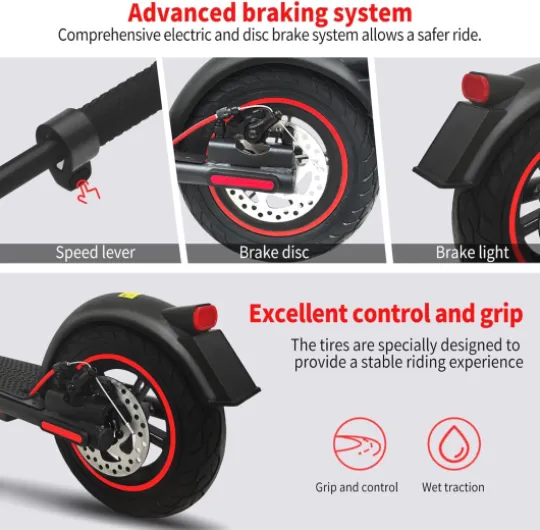
The dual braking system is one of the better points. You have an electronic front brake (E‑ABS) and a rear drum brake. When you pull the lever, both kick in. Braking is progressive enough that you don’t feel like you’re going to fly over the bars, but you can stop in a short distance if you pull firmly. I tested some emergency stops from top speed on dry pavement and felt in control. There’s a slight electronic whine from the E‑ABS, which is normal. Compared to some single‑brake budget scooters I’ve tried, this feels noticeably safer.
Handling is predictable. The 10‑inch solid tires help with stability; they feel more secure than the tiny 8‑inch wheels a lot of cheap models use. Turning is easy, and I didn’t feel any weird twitchiness. The downside is there’s no suspension, so on rough surfaces, you feel every bump. At higher speeds on broken pavement, you’ll want to keep both hands firmly on the bar and maybe slow down a bit. For typical city pavement and bike lanes, though, it’s fine. Overall, performance is solid for a budget commuter: it gets you around at a decent pace, with good braking and predictable handling, as long as you’re not expecting sports‑car behaviour.
What you actually get with this TYOKUM scooter
Out of the box, the scooter comes fairly straightforward: scooter body, charger, small tool kit, and a manual. No fancy extras, no carrying strap, no spare parts beyond the basics. Assembly is minimal – you basically have to fix the handlebar in place with the included tools. It took me around 10–15 minutes taking my time, and nothing felt confusing. The manual is typical budget Chinese product stuff: understandable, not polished, but you can figure things out.
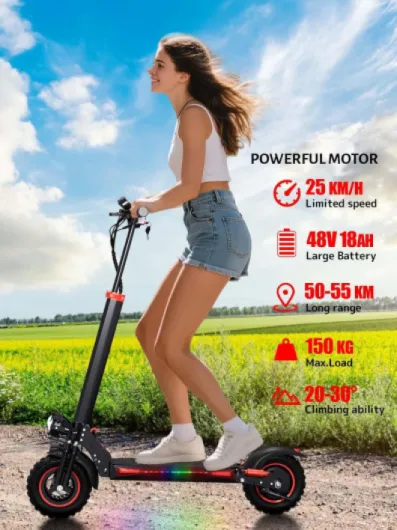
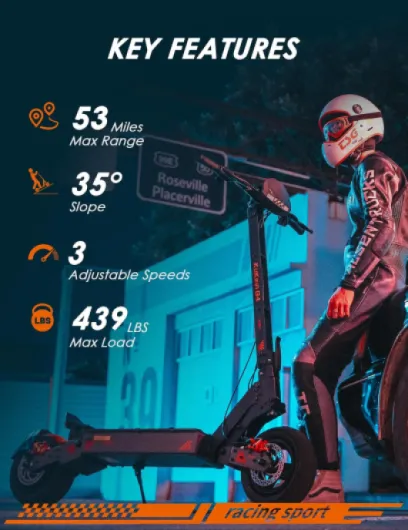
On paper, the specs look decent for the price range: 350W motor, 36V 10Ah battery, top speed 25 km/h, range up to 30 km, 10‑inch solid tires, and a weight of about 12.5 kg. There are three speed modes (around 10 / 20 / 25 km/h), a dual braking system (E‑ABS front + rear drum), and a full lighting kit with headlight, brake light, and turn signals. You also get an app via Bluetooth for locking the scooter, checking battery status, changing modes, and doing some basic diagnostics.
In reality, a good chunk of that spec sheet is accurate, but you have to subtract a bit from the numbers. The 25 km/h is there, but you only really feel it on flat, smooth surfaces and with a reasonably charged battery. The 30 km range is optimistic unless you are light, ride slow, and stay on Eco mode. For normal mixed use at full speed, I’d say 15–20 km is more realistic. Still, that’s enough for a lot of people’s daily needs.
The warranty is worth mentioning: they say 1‑month return window, 12 months of technical support, and 180 to 365 days of free parts replacement depending on what breaks (excluding abuse). Support is via an email address, which is very typical for this kind of brand. I haven’t had to use it so I can’t say if they respond fast or not, but at least on paper there’s some backing. Overall, the presentation is simple: no fancy branding, just a generic‑looking scooter that focuses more on function than image.
Pros
- Good value: 350W motor, 10Ah battery, dual brakes and full lights at a budget price
- 10-inch solid tires and aluminium frame feel stable and low maintenance
- Folding mechanism and 12.5 kg weight make it fairly easy to carry and store
Cons
- No suspension and solid tires make rough roads uncomfortable
- Real-world range is closer to 15–18 km at full speed, not the advertised 30 km
- Struggles on steeper hills, especially with heavier riders
Conclusion
Editor's rating
Overall, the TYOKUM HR13 feels like a practical budget scooter that does what most people need for short to medium rides. The 350W motor, 10‑inch solid tires, and dual braking system give you a ride that feels reasonably safe and stable on city streets. The battery isn’t marathon‑level, but for 10–15 km daily use it’s fine, and the 5–6 hour charging time is manageable if you plug it in after work or overnight. It folds easily, doesn’t weigh a ton, and the full lighting system makes night rides less stressful.
It’s not without flaws. Comfort takes a hit because of the rigid frame and solid tires, and hills expose the limits of the motor. The range numbers on the box are optimistic if you ride fast and you’re not super light. The brand is not a big name, so long‑term support is a bit of a question mark, even if the warranty terms on paper look okay. If you expect premium finish, advanced suspension, or strong water resistance, you should look at more expensive models.
Who is this scooter for? People who want a simple, affordable commuter for mostly flat urban areas, teens and adults up to around 100–110 kg, and anyone who values low maintenance (solid tires, basic but robust build) over comfort. Who should skip it? Heavier riders near the 120 kg limit, folks in very hilly cities, and anyone who wants a really cushioned ride or plans to do long distances daily. If you keep those limits in mind, it’s a pretty solid choice that gets the job done without draining your wallet.