Why electric scooter weight limits mislead taller and heavier riders
Spec sheets make every scooter look strong, but the way manufacturers present maximum load ratings often hides how poorly many models fit taller and heavier riders. A typical commuter electric scooter rated for 100 kilograms will still roll with 110 kilograms on board, yet the riding experience changes in ways most people only notice once they are already committed to the ride. For older tall riders and heavier riders, that gap between the printed weight limit and the real 200 pound reality can mean slower performance, longer stopping distances and more fatigue.
Manufacturers usually quote a maximum rider weight in pounds or lbs, but they almost never explain how that number was tested. A scooter might carry 100 kilograms on a smooth indoor track, while the same electric scooter feels underpowered when a tall rider at 95 kilograms climbs a mild hill with a backpack and groceries. When you add real world variables like rough asphalt, headwinds and repeated stops, the effective weight limit for comfortable ride quality can drop well below the official figure.
For a senior rider using a scooter as a mobility tool rather than a toy, that difference matters. A heavier rider at 200 pounds on a compact scooter with a single small motor and basic suspension system will often see range fall by roughly 20 to 30 percent compared with a lighter person. Taller riders also shift the center of gravity higher, which makes the braking system work harder and exposes weak front rear balance in cheap scooters that rely on a single rear drum or low grade disc brakes.
Think of the published weight number as a structural ceiling, not a comfort target. If a scooter claims a 100 kilogram limit, older riders who value stability should treat 80 to 85 kilograms as the zone where performance, range and control still feel predictable. Once you push past that comfort band, acceleration softens, the motor runs hotter and the suspension has less travel left to absorb bumps, especially when the scooter uses small 8.5 inch tires instead of larger wheels.
Dual motor models complicate the picture further, because their higher torque can mask the strain of heavier riders until something fails. A dual motor electric scooter with 2 × 500 watt nominal motors might still launch briskly with 110 kilograms on board, but the extra stress shows up in shorter brake pad life, more stem wobble and quicker battery sag. For tall riders who want a comfortable ride rather than a drag race, a conservative match between body weight and scooter rating is safer than chasing headline performance numbers.
Deck width, stance and why two miles can feel like ten
Deck width is the most underrated part of scooter fit and comfort, especially for older riders. Many slim scooters force a narrow tandem stance, with one foot directly behind the other on a deck barely wider than a shoe, which twists knees and ankles during every ride. After only three kilometers, that awkward riding position can leave a tall rider more tired than the actual distance suggests.
For taller riders and heavier riders, a deck at least 18 centimeters wide changes the riding experience dramatically. A wider deck lets both feet sit side by side or at a relaxed angle, spreading weight more evenly across the scooter and giving the suspension system a better chance to work. When your stance is stable, you can let the suspension and larger wheels handle cracks instead of bracing every bump with tense muscles.
On models like the Segway Ninebot Max G30 or the Xiaomi Pro 2, the deck is just wide enough for a semi staggered stance, which suits medium height riders but can feel cramped for tall riders over 1.85 meters. A senior rider at 90 kilograms standing sideways on a narrow deck tends to hang toes or heels off the edge, which reduces control when the scooter hits a pothole or when the rear brakes engage suddenly. That overhang also shifts weight toward one side, making the front rear balance less predictable on wet paint or metal grates.
Heavier riders benefit even more from a generous deck, because their extra weight compresses the tires and any spring suspension more deeply. With a narrow deck, that compression happens under a smaller footprint, which amplifies every vibration that reaches ankles, knees and hips. A wide, grippy deck combined with large wheels and a competent suspension system spreads impact forces and keeps the scooter tracking straight when the road surface changes mid corner.
If you are evaluating electric scooters online, look for real deck measurements rather than marketing photos. Anything under 15 centimeters wide is a red flag for a senior rider who wants a comfortable ride for daily errands, while 18 to 20 centimeters gives enough room for a natural stance. For heavier riders near 200 pounds, pairing that wider deck with a scooter rated for at least 120 kilograms provides a margin that keeps performance, range and control consistent over time.
For more detail on how frame strength, deck design and rated capacity interact, a dedicated guide to choosing the right electric scooter for heavier riders can help you interpret those specs beyond the sales copy. When you combine that kind of focused advice with your own height, weight and mobility needs, the deck stops being an afterthought and becomes a central part of your buying decision. In practice, the right deck width often matters more to your joints than an extra five kilometers of claimed range.
Handlebar height, posture and the tall rider reality
Handlebar height is where load ratings, scooter geometry and real bodies collide most painfully. Most commuter scooters ship with handlebars fixed between 102 and 112 centimeters from the deck, which works for average height riders but forces tall riders to hunch. For a senior tall rider with a history of back or shoulder pain, that hunched posture can turn a short ride into a strain.
When handlebars sit too low, taller riders bend at the waist and lock their elbows, which shifts weight forward and overloads the front wheel. That forward bias makes the scooter more nervous over bumps, because the front suspension or spring suspension has less room to move before bottoming out. It also means the braking system has to manage more weight over the front tire, which can cause skids if the front rear balance is not tuned carefully.
Ideally, handlebar height should sit roughly at hip bone to navel level for a relaxed stance, with a slight bend in the elbows. For a rider around 1.90 meters tall, that often means handlebars closer to 115 or even 120 centimeters, which many budget scooters simply do not offer. Adjustable stems or riser bars become essential for tall riders who want a comfortable ride rather than a constant forward lean.
Some premium models, including certain Inmotion electric scooters, address this with taller stems and more ergonomic grips. On these scooters, the combination of higher handlebars, a long deck and a well tuned suspension system lets heavier riders stand upright, keep their head up and react calmly to traffic. That upright posture also improves control when the dual motor setup delivers strong acceleration, because your weight stays centered instead of hanging over the front wheel.
Older riders should also consider how handlebar height interacts with step on height and deck clearance. A scooter with a tall stem but a very high deck can still feel awkward, because you must lift your leg higher to mount and then stand on a platform that reduces stability at low speed. For seniors weighing close to 300 lbs, specialized guides on choosing the right electric scooter for adults weighing 300 lbs can highlight models that balance handlebar height, deck height and structural strength more carefully.
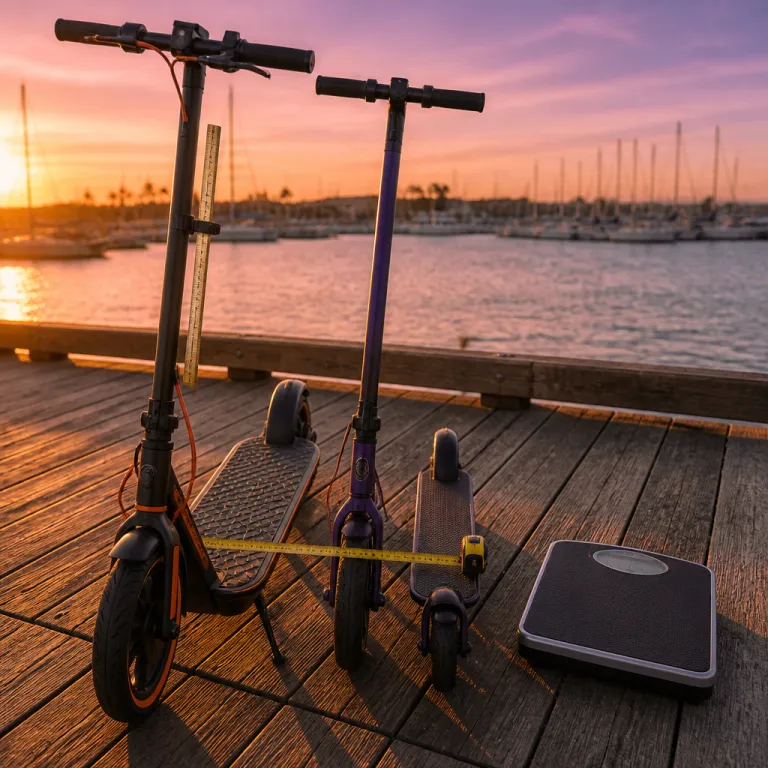
In practice, if you are over 1.80 meters, treat fixed handlebar scooters with stems under 105 centimeters as youth sized, no matter how they are marketed. Look for either adjustable handlebars or published stem heights, and do not hesitate to measure your own comfortable reach at home with a broom handle and tape measure. That simple test often reveals that the scooter you thought would fit your tall rider frame would actually force you into a posture your back will resent after only a few kilometers.
Suspension, wheels and how 200 pounds changes every bump
Suspension and wheel size decide whether a scooter feels like a mobility aid or a punishment device for a 200 pound rider. A light teenager on a basic scooter with no suspension and 8.5 inch tires might glide over cracks that feel brutal to heavier riders with aging joints. Once you cross about 90 kilograms, every missing millimeter of suspension travel becomes obvious on real streets.
There are three main approaches to smoothing the ride on electric scooters for taller riders and heavier riders. First, pneumatic tires act as the simplest suspension system, flexing around small obstacles and softening sharp edges, especially when combined with larger wheels of 10 inches or more. Second, mechanical suspension such as spring suspension or swing arm designs at the front rear can add travel, though cheap versions often bounce rather than absorb.
Third, full suspension setups that combine front and rear spring suspension with large wheels can transform the riding experience for a senior tall rider. On a well tuned scooter, the suspension lets the deck float while the wheels track the ground, so your knees and hips do not have to act as the only shock absorbers. For heavier riders near the stated weight capacity, that extra compliance also protects the frame and folding mechanism from repeated high impact loads.
Weight changes how all of this behaves. A 60 kilogram rider might barely compress the front suspension on a budget scooter, while a 95 kilogram rider uses up half the travel just standing still, leaving little margin for potholes. That preload effect means heavier riders should prioritize scooters with stronger suspension components, higher quality bushings and, ideally, adjustable damping rather than only soft springs.
Larger wheels help too, because they roll over obstacles that small wheels must fall into. A 10 inch tire under a 200 pound rider keeps more ground clearance when compressed than an 8.5 inch tire under the same weight, which reduces pedal strikes and deck scrapes on uneven pavement. For seniors who value a comfortable ride more than a tiny folded package, choosing large wheels and a robust suspension system is usually a better trade than shaving one kilogram from the scooter weight.
When you compare models like the Segway Ninebot Max G30, GoTrax XR Ultra and various Inmotion electric scooters, pay attention not just to whether they claim suspension, but where and how it is implemented. A token front spring suspension with no rear support often feels worse for heavier riders than no suspension at all, because it pitches the scooter under braking and upsets control. The best setups for older tall riders combine large wheels, real front rear suspension and a stiff stem that keeps steering precise even when the road surface is anything but smooth.
Brakes, motors and stopping power for older, heavier riders
Braking and motor power are where scooter weight limits, rider height and safety intersect most directly. A scooter that feels lively and easy to stop under a 70 kilogram rider can feel sluggish and slow to respond under a 95 kilogram senior with a shopping bag. When you add taller riders with a higher center of gravity, the demands on the braking system and motor control electronics only increase.
For motors, the key is not just peak wattage but how that power is delivered and cooled. A single 350 watt motor might move a light rider briskly, but heavier riders near 200 pounds will see slower launches, weaker hill climbing and more heat buildup in the rear hub. Dual motor setups with two 500 watt hubs provide stronger acceleration and better control on inclines, yet they also demand more from the brakes and frame.
On the braking side, disc brakes offer stronger stopping power and better modulation than simple drum or foot brakes, especially when combined with electronic braking that recovers energy. A well designed braking system with front rear balance lets a tall rider shift weight slightly back while both wheels share the work, shortening stopping distances even under a full 100 kilogram load. For seniors, that margin can be the difference between a controlled stop and a slow slide on wet pavement.
However, not all disc brakes are equal. Cheap mechanical discs with thin rotors can glaze or warp quickly under heavier riders, especially on long downhill sections where the motor also adds drag. Higher quality hydraulic disc brakes or larger diameter mechanical discs handle heat better and maintain consistent lever feel, which is crucial when your grip strength is not what it used to be.
Electronic motor braking also behaves differently at higher weights. Regenerative systems rely on the motor acting as a generator, which is more effective at medium speeds than at a crawl, so a 200 pound rider may feel strong initial deceleration that fades near walking pace. That is why physical brakes remain essential, and why older riders should test how the scooter feels when coming to a complete stop rather than trusting only the spec sheet.
When you read reviews, look for real stopping distance measurements with riders close to your own weight, not just generic praise for powerful brakes. For example, in one simple garage test with a 95 kilogram rider, a mid range commuter scooter needed about 5.5 meters to stop from 25 kilometers per hour on dry asphalt, compared with roughly 4 meters for a 70 kilogram rider on the same model. For seniors using scooters as daily transport, prioritizing a robust braking system and predictable motor control is far more important than chasing a higher top speed number.
Portability, folding mechanisms and the real cost of weight
Portability is the last piece of scooter ergonomics that spec sheets tend to oversimplify. A scooter that weighs 18 kilograms on paper might sound manageable, but carrying that mass up three flights of stairs with a 200 pound body is a different story. For older riders, the combination of scooter weight, folding mechanism design and handlebar height when folded can decide whether the scooter is a daily tool or an unused gadget.
Folding mechanisms vary widely in both strength and usability. Some commuter scooters use a single lever at the base of the stem, which can be quick but may develop play over time, especially under heavier riders who load the joint with every bump. More robust designs use dual locking systems or secondary safety latches, which add a few seconds to the folding process but keep the stem rigid and the riding experience more precise.
Handlebar height when folded also matters, because it determines how you roll or carry the scooter through tight spaces. A tall rider might prefer a longer folded package that rolls on the rear wheel like a suitcase, while a shorter senior may need a compact fold that fits easily into a car trunk. In both cases, the balance point of the folded scooter should sit near the center, so you are not fighting the weight of the motor or battery at one end.
There is also the financial side of weight and portability. Heavier, more powerful scooters with dual motor setups and large wheels often cost more upfront but may replace car trips or ride sharing over time, while lighter scooters are easier to carry but may not handle a 200 pound rider comfortably. A detailed analysis of the real cost of owning a commuter scooter versus renting shared scooters for a year can help you decide whether investing in a heavier, more capable model makes sense for your budget and lifestyle.
For seniors, the safest approach is to match scooter weight to your strongest realistic lifting or rolling capacity, not your aspirational one. If you can comfortably lift 10 kilograms but struggle at 15, a 20 kilogram scooter will quickly become a barrier, no matter how good the suspension or brakes feel on the road. In that case, prioritizing a lighter scooter with a solid folding mechanism and moderate performance may keep you riding more often than a heavy, overpowered machine that lives in the hallway.
Ultimately, the right balance between portability and performance depends on how often you need to fold and carry the scooter versus how far and how fast you want to ride. For a tall rider commuting by train, a slightly underpowered but compact scooter might be ideal, while a heavier rider using the scooter for neighborhood errands could accept more weight in exchange for a comfortable ride and strong stopping power. The key is to see the scooter not just as a vehicle, but as an object you must live with, lift and store every day.
Ergonomics first: why fit beats speed for senior riders
For older adults, scooter fit and rider ergonomics should outrank almost every other spec. Top speed looks impressive on a product page, yet in daily use, comfort, control and confidence matter far more than an extra five kilometers per hour. A scooter that fits your body well will quietly extend your mobility, while a poorly fitted one will sit unused after a few painful rides.
Start by matching the scooter weight rating to your own weight with a generous buffer. If you weigh 90 kilograms, look for electric scooters rated for at least 120 kilograms, especially if you are a tall rider whose higher center of gravity adds leverage to every bump and brake. That buffer keeps performance, range and braking distances more consistent over time, even as components wear and tires lose a little pressure between checks.
Next, prioritize deck width, handlebar height and suspension quality over raw motor power. A wide, stable deck and a comfortable handlebar height reduce fatigue and joint stress, which is crucial for seniors who may already manage arthritis or balance concerns. A well tuned suspension system with large wheels then completes the package, turning rough sidewalks into manageable terrain rather than a series of jolts.
Motor and braking choices should support that ergonomic foundation, not define it. Dual motor setups and high wattage ratings are only helpful if you can stand comfortably, reach the controls easily and trust the braking system to provide predictable stopping power under your full weight. For many older riders, a single strong rear motor with quality disc brakes and electronic assist offers a better balance than a high strung dual motor racer with twitchy control.
Finally, consider how the scooter fits into your daily routines off the road. The folding mechanism, total weight and folded handlebar height all affect whether you can store the scooter safely, bring it onto public transport or lift it into a car without strain. When those practical details align with a comfortable ride and a stable stance, the scooter becomes a genuine mobility aid rather than a risky experiment.
Ergonomics may not be the flashiest part of the spec sheet, but for senior tall riders and heavier riders, it is the part that decides whether the scooter extends your world or shrinks it. Choose the scooter that fits your body first, then let speed, range and styling follow. The best riding experience is not the fastest on paper, but the one you are still happy to repeat on a cold, wet morning when your joints are stiff and the pavement is less forgiving.
Key figures on rider weight, ergonomics and scooter safety
The figures below are based on a mix of manufacturer data, independent reviewer tests and practical estimates from real world use. Treat them as realistic guidelines rather than strict laboratory measurements.
- Many mainstream commuter scooters list maximum loads around 100 to 120 kilograms, yet real world testing by independent reviewers often shows noticeable performance loss once riders exceed about 80 to 85 percent of that rating, especially in hill climbing and braking distance.
- Stopping distance from 25 kilometers per hour can increase by roughly 20 to 30 percent when rider weight rises from 70 to 100 kilograms on the same scooter, highlighting the importance of strong disc brakes and balanced front rear braking systems for heavier riders.
- Range claims are typically measured with riders around 70 kilograms on flat courses, while heavier riders near 95 kilograms frequently report real ranges that are about 20 to 40 percent lower, depending on terrain, temperature and riding style.
- Wheel diameter has a measurable impact on comfort, with comparative tests suggesting that 10 inch pneumatic tires can reduce perceived vibration and shock by roughly one third compared with 8.5 inch tires over the same rough surface for riders above 85 kilograms.
- Handlebar heights on popular commuter scooters cluster between 102 and 112 centimeters, which suits riders roughly 1.60 to 1.80 meters tall, leaving many taller riders over 1.85 meters in a forward flexed posture that increases lower back load during longer rides.
| Model example | Rated max load | Deck width (approx.) | Stem height from deck | Wheel size |
|---|---|---|---|---|
| Segway Ninebot Max G30 | 100 kg | ~17–18 cm | ~107 cm | 10 inch pneumatic |
| Xiaomi Pro 2 | 100 kg | ~15–16 cm | ~106 cm | 8.5 inch pneumatic |
| GoTrax XR Ultra | 100–120 kg | ~15 cm | ~104 cm | 8.5 inch pneumatic |
| Typical Inmotion commuter | 120 kg | ~18–20 cm | ~110–115 cm | 10 inch pneumatic |
FAQ
How much buffer should I leave below the stated scooter weight limit ?
A practical rule is to stay at or below about 80 to 85 percent of the stated maximum weight if you want consistent performance and range. That means a rider at 90 kilograms should look for a scooter rated for at least 110 to 120 kilograms. This buffer also helps the suspension, folding mechanism and braking components last longer under daily use.
What handlebar height works best for tall riders over six feet ?
For riders around 1.85 to 1.95 meters, handlebars usually feel most natural when they sit roughly between hip bone and navel height. In practice, that often means stem heights closer to 115 to 120 centimeters from the deck, which many budget scooters do not reach. Adjustable handlebars or models specifically designed for adults are safer choices for tall riders.
Are dual motor scooters necessary for a 200 pound rider ?
Dual motor scooters are not strictly necessary, but they can improve hill climbing and acceleration for heavier riders, especially on steep routes. A single strong rear motor around 500 to 700 watts nominal can still serve many 200 pound riders well on flatter terrain. The key is to pair motor power with a robust braking system and stable chassis rather than chasing peak wattage alone.
How important is deck width for senior riders with balance issues ?
Deck width is critical for seniors, because a wider platform allows a more natural stance and reduces the need for constant micro adjustments to maintain balance. A deck around 18 to 20 centimeters wide lets most adults place both feet comfortably, which lowers fatigue and improves control at low speeds. Narrow decks are more likely to cause foot strain and wobbly starts, especially for riders with reduced ankle strength.
Should I prioritize suspension or larger wheels for comfort ?
If you must choose, larger pneumatic wheels usually provide the biggest comfort gain for the simplest maintenance. Ten inch air filled tires smooth out many common bumps and cracks even without complex suspension. Ideally, combine those large wheels with a well tuned front rear suspension system for the most comfortable ride, especially if you weigh close to the scooter’s rated limit.