
Summary
Editor's rating
Value: good price for short commutes, weaker if you need real range
Design: looks decent, fairly practical, a bit generic
Battery and range: the weak point if you trust the marketing
Comfort: solid tyres and no suspension, you feel the road
Durability and build: feels decent, but long-term is a question mark
Performance: fine on flat, limited on hills, feels safe-ish at 25 km/h
What you actually get with the Riceel R50
Pros
- Decent 25 km/h performance with 350W motor for flat city commuting
- Solid honeycomb tyres: no punctures and low maintenance
- Quick one-step folding and relatively light, easy to carry and store
- App control with lock, lights, speed modes and cruise control
Cons
- Real-world range closer to 10–15 km, far from the advertised 25–35 km
- No suspension and solid tyres make the ride quite harsh on rough roads
- Mixed feedback on braking confidence and locking mechanism security
- After-sales support via third-party sellers can be slow and frustrating

Specifications
View full product page →| Brand | Riceel |
A budget commuter scooter with some clear trade-offs
I’ve been using this Riceel R50 350W electric scooter for a few weeks for short commutes and errands, basically 5–8 km round trips in the city. I didn’t baby it: light rain, rough pavements, a couple of small hills, and a backpack on most rides. I’m around 80 kg, so well below the stated 120 kg limit. I went in with realistic expectations for the price, not expecting a premium Xiaomi or Ninebot, but at least something reliable for daily use.
Right away, it feels like a typical budget commuter scooter: simple folding system, basic rigid frame, 8.5" solid tyres, and an app that lets you tweak a few things. The first rides were pretty smooth on flat roads, and the 25 km/h top speed is enough for city use. If you’ve never used an e-scooter before, it feels quite fun and practical. But once you start paying attention to details like range, braking, and build quality, you notice where they’ve cut corners to keep the price down.
The big gap is between the advertised specs and what you actually get. They claim up to 25–35 km range, but in real life, you’re looking at more like 10–15 km if you ride at normal speed and you’re not super light. That’s a huge difference, and it changes how you can use it. Instead of being a full day commuter, it becomes more of a short-trip or last-mile scooter. The Amazon reviews confirm this: some people are happy, others complain heavily about the battery and safety feeling.
Overall, my impression is: it’s not trash, but it’s not magic either. It gets the job done for short distances if you know what you’re buying and don’t fully trust the marketing numbers. If you expect a long-range daily workhorse, you’ll probably be annoyed pretty fast. So I’ll break down what works, what doesn’t, and who it actually suits in day-to-day use.
Value: good price for short commutes, weaker if you need real range
In terms of value, it really depends on what you expect. For the price level this scooter usually sells at, you get: 350W motor, app control, lights, dual braking, solid tyres, and a foldable aluminium frame. For simple city commuting over short distances, that’s actually pretty solid. If your daily use is something like 3–5 km each way, and you just want a tool to replace short car or bus trips, it does the job without costing as much as the big-name brands. Several Amazon reviews are very positive, calling it great value and saying they’re happy with the performance and build for the money.
Where the value drops is if you believed the 25–35 km range and bought it expecting a long-distance machine. When you realise you’re only getting 10–15 km realistically, it suddenly feels less like a bargain. Same if you hit any issues with brakes, locking, or battery, and you end up dealing with slow third-party seller support. That 1-star review about a two-month refund process is exactly the kind of headache that kills the sense of a good deal, even if the hardware itself is acceptable when it works.
Compared to better-known scooters (Xiaomi, Ninebot), you’re basically trading: lower price and puncture-proof tyres against less proven support, more optimistic specs, and a bit less refinement in build and ride quality. If you’re okay with that trade-off and your expectations are realistic, it can be good value for money. If you want something you can really depend on daily with strong after-sales and honest range numbers, it may be worth paying more upfront.
So my view: it’s decent value if you stay within its limits and mainly ride short distances on reasonably good roads. If you try to use it beyond that (long range, heavy hills, intensive daily use), the savings may not feel worth it in the long run.
Design: looks decent, fairly practical, a bit generic
Design-wise, this scooter is pretty standard for its category. Straight handlebar, narrow deck, front stem with a simple folding latch, and the usual LED display in the middle. The yellow-gray color combo is a bit more visible than the classic all-black models, which I actually like in traffic, because cars see you a bit better. It doesn’t feel premium, but it doesn’t look cheap toy-level either. It’s in that middle zone: functional and decent, nothing that will impress, but nothing embarrassing.
The folding mechanism is straightforward: you unlock the latch at the front of the deck, fold the stem down, and hook it on the rear mudguard. It’s a one-step style system and works quickly. After a few days, I got used to doing it in a couple of seconds. I didn’t notice excessive play in the hinge at first, but like with many budget scooters, you can feel a tiny bit of flex if you grab the handlebar and rock it. It doesn’t feel like it will snap, but it also doesn’t give the tank-like feeling of more expensive models.
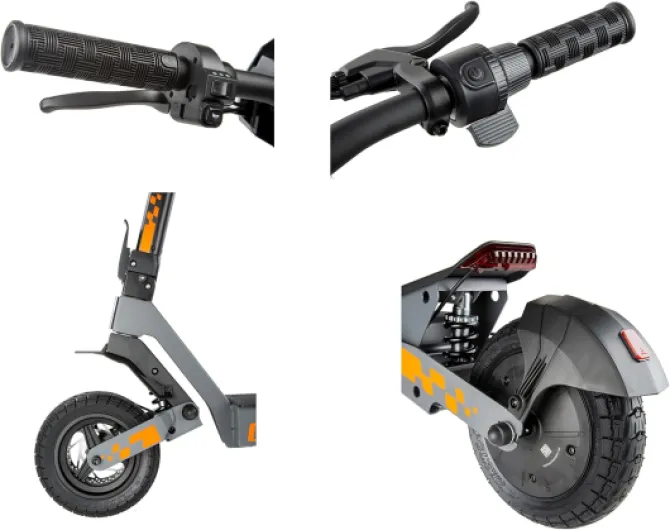
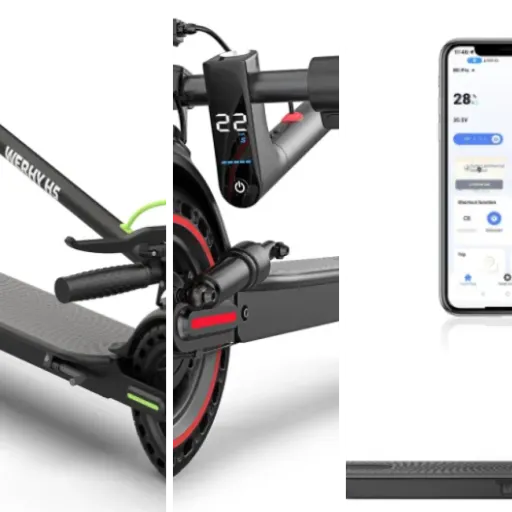
The handlebar layout is simple: throttle on the right, brake lever on the left, and a single multi-function button on the display for power, lights, and mode changes. No turn signals or fancy stuff. The cables are mostly external, running along the stem, which looks a bit messy compared to internal routing but makes maintenance simpler if something goes wrong. The deck is long enough for an adult to stand comfortably sideways, but it’s not particularly wide, so big feet will be a bit cramped on longer rides.
One thing I did like: the LED front light is placed high enough on the stem to actually light the road ahead, not just your front wheel. It’s not super bright like a bike headlamp, but for city use at night, it’s okay. The rear light is built into the mudguard and also works as a brake light. So overall, design is practical and fairly thought-through, but you can tell it’s built to hit a price point, not to impress design nerds.
Battery and range: the weak point if you trust the marketing
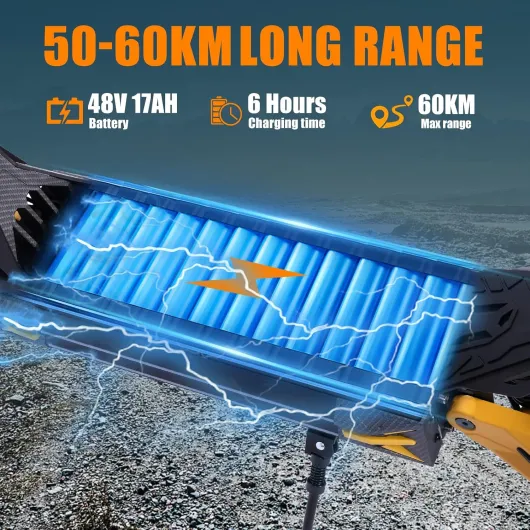
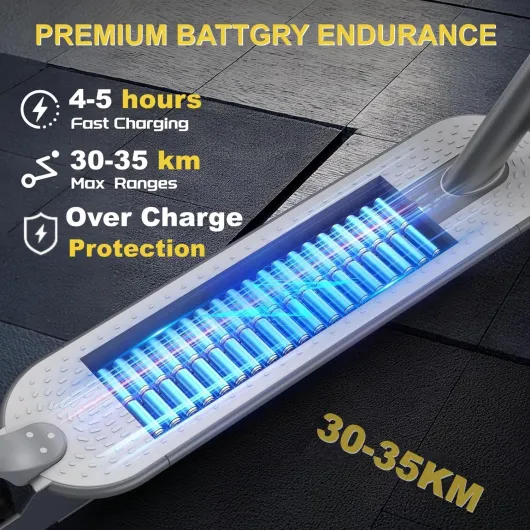
This is the part where things get a bit disappointing: the real-world range. The brand claims up to 25–35 km on a charge with the 36V 10.5Ah battery. On paper, that looks great for the price. In practice, like some Amazon reviewers said, you’re not getting anywhere close to 30+ km unless you’re extremely light, riding very slowly, on perfect flat ground, and probably with a tailwind. With my 80 kg and mixed riding (mostly full speed, a bit of eco mode in crowded areas), I was getting around 10–15 km before the battery bar started dropping fast and the scooter reduced power.
One user mentioned only getting about 10.3 km even in eco mode, which lines up with my experience on colder days or slightly hillier routes. Another review went even harder on the battery, saying it dropped very quickly and felt unreliable. I wouldn’t say it’s unusable, but clearly, the advertised 25–35 km is optimistic. For daily planning, I’d treat this as a 10–15 km max comfortable range if you want to avoid crawling home at reduced speed. If you really push it, maybe you can squeeze a bit more, but it’s not something I’d rely on.
The charging time is fairly standard for this type of scooter (around 4–6 hours from empty, depending on how low you go). The charger is basic but does the job. The Smart Battery Management System (protection against short circuit, overcharge, overheating, etc.) is good to have, at least on paper, and I didn’t run into any overheating issues. Still, I’d avoid fully draining it every time if you want the battery to last more than a season or two.
So yeah, if you’re buying this mainly for range, you’ll probably be annoyed. For short commutes and errands, the battery is acceptable, but you have to be honest with yourself: this is not a 30 km machine. It’s more of a 10–15 km scooter with a safety margin. If your daily route is 5–6 km total, you’re fine. If it’s 15–20 km, you’ll be charging constantly and riding with range anxiety.
Comfort: solid tyres and no suspension, you feel the road
Comfort is where the compromises show clearly. The scooter has rigid suspension (basically none) and 8.5" solid honeycomb tyres. The good news: you don’t have to worry about punctures. The bad news: you feel every bump, crack, and pothole. On smooth bike lanes, it’s fine and even quite pleasant. As soon as the ground gets rough, the ride becomes harsh. After about 20–30 minutes on bad pavement, my knees and wrists were a bit tired. Not unbearable, but definitely not cushy.
The honeycomb tyre design is supposed to offer some shock absorption, and to be fair, it does a bit compared to completely solid rubber. But don’t expect it to feel like air-filled tyres with suspension. It’s still a very direct, firm ride. If your city is full of cobblestones or broken roads, you’ll notice it quickly. If your paths are mostly smooth cycle lanes, you’ll be okay. I’d call it acceptable comfort for short rides, not something I’d want to stand on for an hour straight.
The deck size is decent for one adult. I could stand with one foot forward and one sideways without feeling too cramped, but it’s not very wide. Over longer trips, you’ll probably shift your feet a lot to avoid numbness. The handlebar height is fixed and suited me fine (I’m around 1.78 m), but taller riders might find it a bit low. The rubber grips are basic but grippy enough even with slightly sweaty hands.
Noise-wise, it’s quiet: the motor whine is modest, and there are no major rattles out of the box, though like any folding scooter, you may need to occasionally tighten some screws to keep it from developing play. So comfort is clearly not the selling point here. It’s okay for what it is: a short-distance commuter with solid tyres. Just don’t expect it to ride like a big scooter with suspension and pneumatic tyres.
Durability and build: feels decent, but long-term is a question mark
The frame is aluminium, which keeps the weight reasonable and should resist rust. Overall, the scooter feels more solid than a cheap toy, but it doesn’t have the heavy-duty vibe of higher-end brands. After a couple of weeks of use, nothing broke on mine: the folding latch still locks properly, the stem hasn’t developed scary play, and the deck doesn’t creak. That said, you can tell it’s built to hit a specific price, not to survive years of abuse without maintenance.
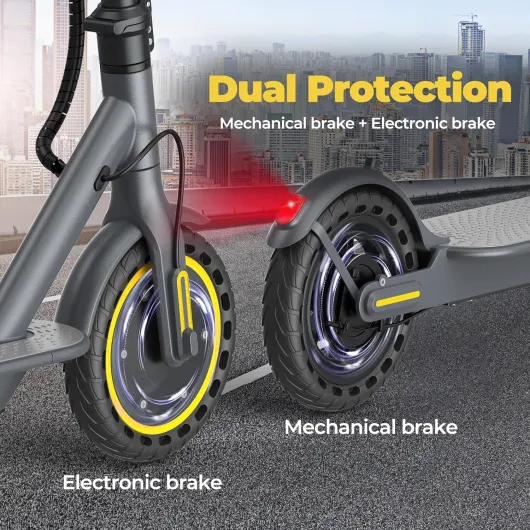
The solid tyres are a plus for durability: no punctures, no pressure to check, and you can ride over small glass or debris without constant fear. For long-term use, that’s a big advantage versus air-filled tyres. The downside is, of course, comfort, but in terms of lifespan, they should last a good while if you don’t ride on sharp edges all day. The braking components (drum brake and electronic brake) are fairly standard. One Amazon reviewer did mention braking not feeling reliable and having safety concerns, which is serious. Personally, my unit’s braking was okay, but I can see how if the brake isn’t adjusted correctly or the electronic brake is too weak, it might feel sketchy.
The locking/folding mechanism is another potential weak point over time. One user complained about the locking not feeling secure, and I kind of get that. When folded, the hook system is fine for carrying, but it doesn’t feel ultra-robust. As a standing locked position, it’s okay, but you have to make sure it’s properly engaged each time. If you throw it around or drop it, I wouldn’t be shocked if the latch or hook needed adjustment or even replacement after a while.
Given the limited warranty and the fact it’s a Chinese brand not as established as the big players, I’d be a bit cautious on long-term durability and after-sales support. The story from the 1-star review about a two-month return/refund process with the third-party seller is a red flag if you’re unlucky and get a faulty unit. So I’d say: build is okay for the price, but don’t expect top-tier robustness or super responsive support if something goes wrong.
Performance: fine on flat, limited on hills, feels safe-ish at 25 km/h
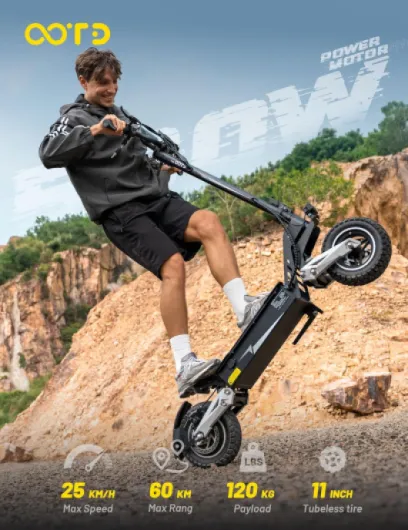
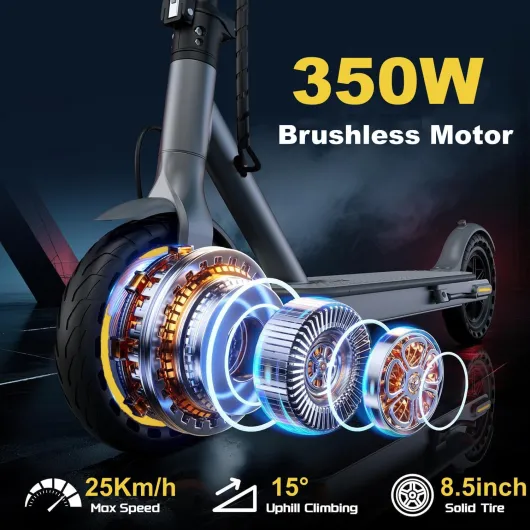
On the performance side, the 350W motor does the job for flat city riding. On level ground, it reaches the advertised 25 km/h without much struggle, and it keeps that speed fairly consistently as long as the battery is above half. The acceleration is not brutal, but it’s enough to keep up with bike lane traffic. If you’re used to more powerful scooters, you’ll find it a bit soft, but as a first scooter or daily commuter, it’s fine. The three speed modes help: eco for slow, normal for everyday use, and the highest mode for when you’re in a hurry.
Where it starts to show its limits is on hills and heavier riders. With my 80 kg, on mild inclines it slows down but still moves. On steeper ramps, it crawls and sometimes drops to 10–12 km/h, which is borderline. If you live in a very hilly area, this isn’t the best choice. It’s more suited to relatively flat cities. Compared to more expensive 500W scooters I’ve tried, you really feel the difference when the road tilts up. So yes, 350W is usable, but don’t expect miracles on slopes.
Stability at speed is acceptable, but you feel the rigid frame and solid tyres on rough surfaces. On smooth pavement, it’s quite pleasant. On cobbles, broken asphalt, or speed bumps, you’ll feel every hit in your legs and arms. The scooter stays controllable, but comfort drops fast. The steering feels reasonably precise, and I never had wobble issues, but this is not something you want to ride one-handed while checking your phone. At 25 km/h, you need to pay attention, especially with those tyres.
Overall, I’d say performance is decent for short urban trips, especially if your route is mostly flat. It’s clearly not built for off-road, long-distance rides, or very hilly terrain. If that’s your use case, you’ll be disappointed. If you just want to get from home to the station or to work a few kilometers away, it does the job as long as you respect its limits.
What you actually get with the Riceel R50
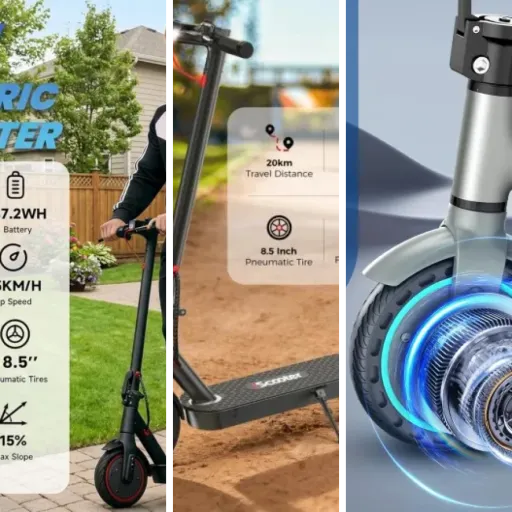
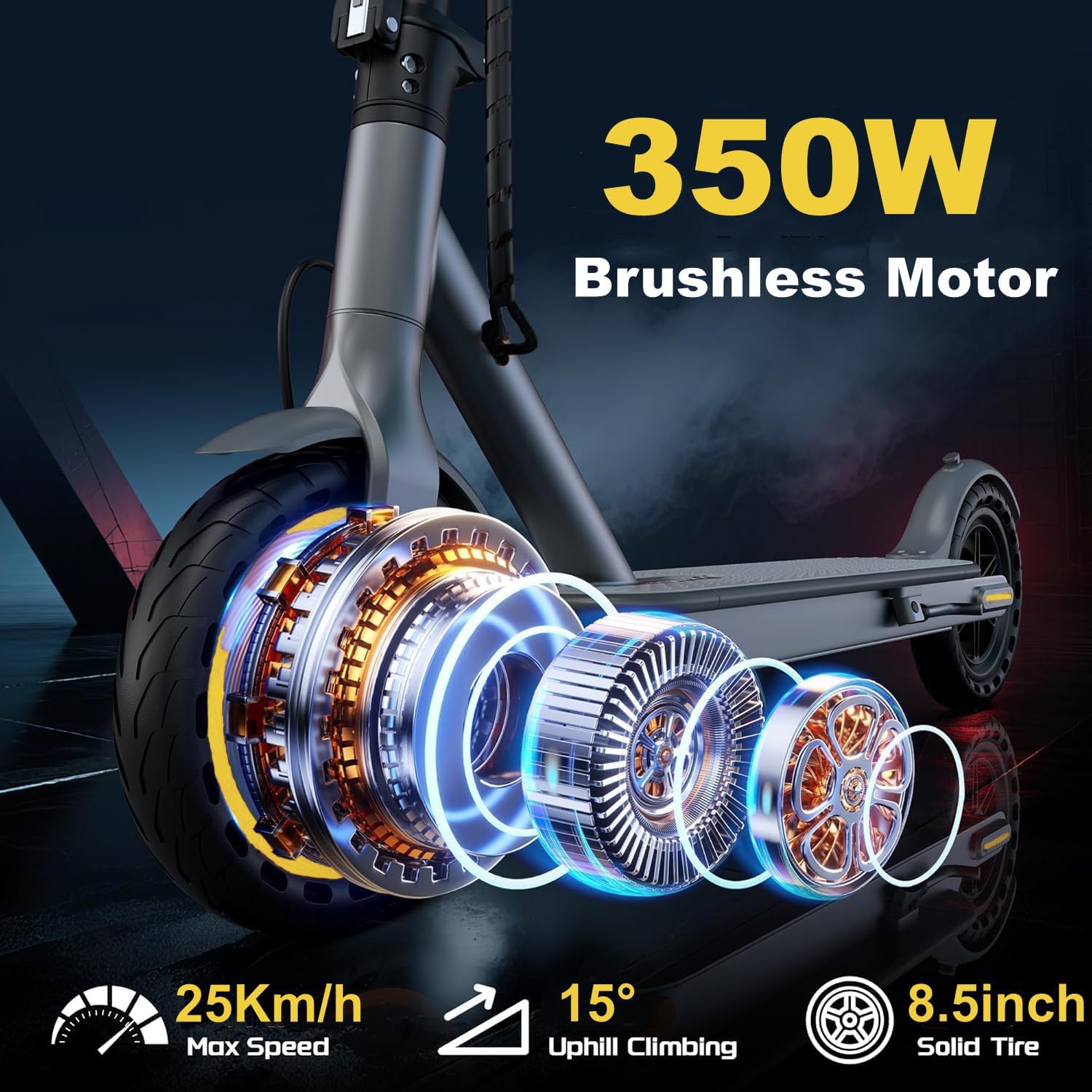
On paper, the Riceel R50 looks pretty solid for the price. You get a 350W brushless motor, a 36V 10.5Ah battery, a claimed 25–35 km range, max speed 25 km/h, and 8.5" solid honeycomb tyres. It has a dual braking system (electronic brake + drum brake), a front headlight and rear brake light, and a one-step folding mechanism. There’s also an app with options like lock/unlock, light control, cruise control, speed modes, and custom top speed. So spec-wise, it hits all the usual commuter scooter boxes.
In the box, you get the scooter mostly assembled, the charger, a small manual, and a couple of basic tools. Assembly is minimal: mainly tightening the handlebar stem and checking bolts. It took me around 10–15 minutes to get it ride-ready, including checking tyre condition and brakes. Nothing complicated, even if you’re not into DIY. The scooter comes in that yellow-gray color scheme which is a bit different from the usual all-black scooters, so it stands out a bit in the street.
In daily use, I’d describe it as a practical, no-frills commuter. It folds quickly, fits easily in a car boot, and is light enough to carry up a couple of flights of stairs, though you still feel the weight if you’re doing that every day. The LED display is basic but clear: you see speed, battery level, and mode. The app pairing works, though it’s not the most polished app I’ve ever used. Once set up, you don’t really need to touch it much, except maybe to lock it when you leave the scooter outside a shop.
The big thing to understand: the marketing focuses on range and power, but in reality, it’s more of a short- to medium-distance city scooter. It’s fine for a daily 3–5 km commute each way, or quick trips to the shops, but if you’re planning 20 km+ rides regularly, you’ll be pushing its limits. So the presentation sounds ambitious, but the actual product sits more in the basic commuter category.
Pros
- Decent 25 km/h performance with 350W motor for flat city commuting
- Solid honeycomb tyres: no punctures and low maintenance
- Quick one-step folding and relatively light, easy to carry and store
- App control with lock, lights, speed modes and cruise control
Cons
- Real-world range closer to 10–15 km, far from the advertised 25–35 km
- No suspension and solid tyres make the ride quite harsh on rough roads
- Mixed feedback on braking confidence and locking mechanism security
- After-sales support via third-party sellers can be slow and frustrating
Conclusion
Editor's rating
Overall, the Riceel R50 is a decent budget electric scooter if you know exactly what you’re getting. For short city commutes, flat routes, and occasional weekend rides, it does the job: 25 km/h top speed, easy one-step folding, solid tyres that don’t puncture, and basic but useful app functions. The dual braking and front/rear lights are reassuring, and for many users, it feels stable and fun enough for daily use. Several buyers are clearly happy and feel they got good value for the price.
But it’s not perfect. The real-world range is closer to 10–15 km than the advertised 25–35 km, especially if you’re an adult riding at full speed. Comfort is limited by the rigid frame and solid tyres, so rough roads are tiring. And there are some serious negative reviews about weak battery performance, braking confidence, and slow after-sales support from third-party sellers. So it’s not a scooter I’d recommend blindly to everyone.
If you’re looking for a short-distance commuter (home–station, quick trips to town) and you’re okay with charging often and accepting a firmer ride, it’s a reasonable option for the money. If you want a reliable long-range scooter for daily 15–20 km use, or you care a lot about strong support and long-term durability, I’d say look at more established brands, even if they cost more. This one is good enough for light use, but it’s not the kind of scooter you buy and forget about for years.