
Summary
Editor's rating
Is it good value for money?
Chunky, practical, but not subtle
Real-world range and charging time
Ride comfort: finally a scooter that doesn’t rattle your teeth
Build quality and how solid it feels
Power, speed and brakes: how it really rides
What you actually get with the Kukirin G2
Pros
- Strong 500W motor with smooth acceleration and decent hill performance for a single motor
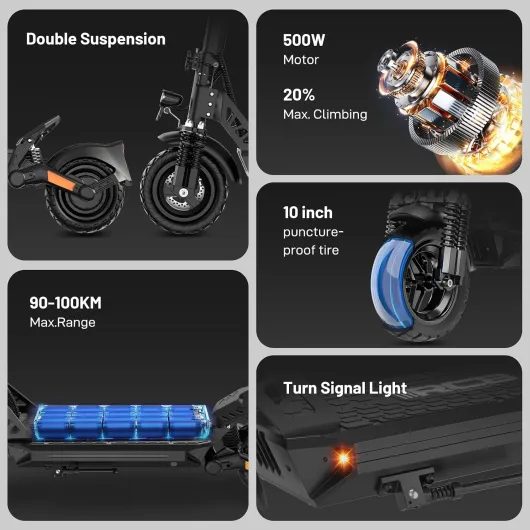
- Dual suspension and 10-inch tubeless tyres give a comfortable and stable ride on rough surfaces
- Good real-world range (around 30–35 km for an average adult) and solid dual disc brakes
Cons
- Heavy at over 25 kg, awkward to carry upstairs despite being foldable
- Touch display less practical with gloves or in rain than physical buttons
- Claimed 55 km range only realistic in very gentle conditions; expect less in normal use

Specifications
View full product page →| Brand | Kukirin |
A beefy scooter that actually feels like a small moped
I’ve been using the Kukirin G2 for a few weeks now as my main way of getting around town and messing about on trails at the weekend. Before this, I had a much lighter 350W commuter scooter, so the jump to this heavier 500W model with dual suspension was a big change. I’ll be honest: this thing is closer to a compact electric moped than a typical slim city scooter. It’s chunky, it’s not exactly light, but it feels a lot more serious once you’re on it.
The first rides were mostly about getting used to the weight (around 26 kg) and the stronger acceleration. I’m about 80 kg and I ride mostly on mixed surfaces: normal roads, some rough cycle paths with roots and cracks, and a bit of gravel path in a park (on private land as the brand keeps repeating). The scooter didn’t struggle at all on those, which is a clear step up from the basic rental-style scooters I’m used to.
What stood out quite fast is the mix of power, comfort and range. It’s not the fastest machine on earth, but for something limited to 25 km/h officially, it feels strong enough and the frame doesn’t feel like it’s going to snap in half when you hit a pothole. Still, it’s not perfect: the weight is a pain for stairs, and the folding system, while handy, doesn’t magically make it “portable”. You can move it, but you won’t enjoy carrying it for long.
If you’re wondering whether this is a realistic daily scooter or just a toy, my answer after a few weeks is: it works fine as a daily ride if you have somewhere safe at ground level to store it, and if you accept the weight. If you live on the 4th floor without a lift, I’d forget it. But if you want something solid, with real suspension and decent brakes, it’s worth looking at closely.
Is it good value for money?
Price-wise, the Kukirin G2 sits in that mid‑range bracket where you expect more than a basic commuter scooter but you’re not paying premium flagship money. For that price, you’re getting 500W motor, dual suspension, dual disc brakes, 10‑inch tubeless tyres, a 48V 15.6Ah battery and a touch display. On paper, that’s a solid package. In practice, after using it, I’d say the feature set lines up well with what you actually feel on the road: more comfort, more stability and more range than the entry‑level stuff.
Compared to the lighter 350W scooters I’ve owned or tested, the G2 brings clear upgrades: better hill performance, stronger braking, and a frame that doesn’t feel like it will fold in half on bad roads. The trade‑off is obvious though: weight and bulk. If you need to carry your scooter into an office every day or up several flights of stairs, I’d probably look at a lighter model even if it means less power. If you have a garage, shed or ground‑floor storage and you mainly roll it rather than carry it, then the extra kilos are less of an issue.
In terms of running costs, you’re mostly looking at tyre wear, brake pads, and electricity, which is cheap for charging. The 8‑hour charge time isn’t fast, but for overnight charging it’s fine. I didn’t have to replace anything yet, but based on the components, parts shouldn’t be impossible to find or outrageously priced, since it uses fairly standard scooter hardware.
Overall, I’d call the value good but not unbeatable. You can find cheaper scooters, but they usually compromise on either battery size, suspension, or brakes. You can also find more expensive models with more power or dual motors, but then you pay a lot more and often end up with an even heavier machine. The G2 hits a decent middle ground for adults who want a robust, comfortable scooter with real range and can live with the weight.
Chunky, practical, but not subtle
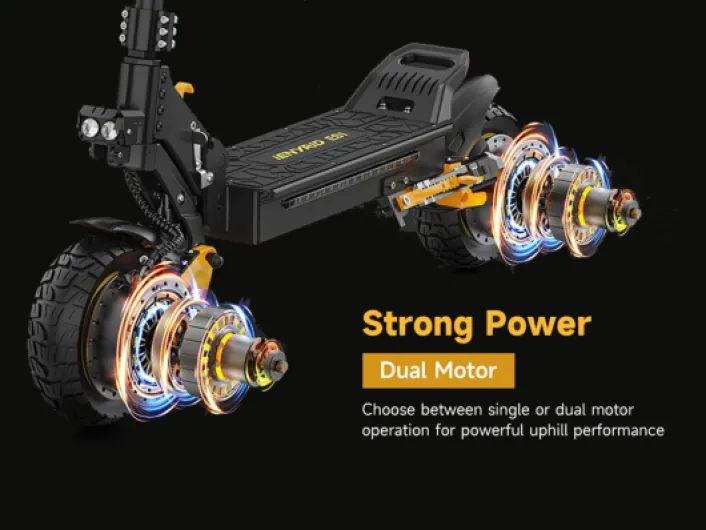
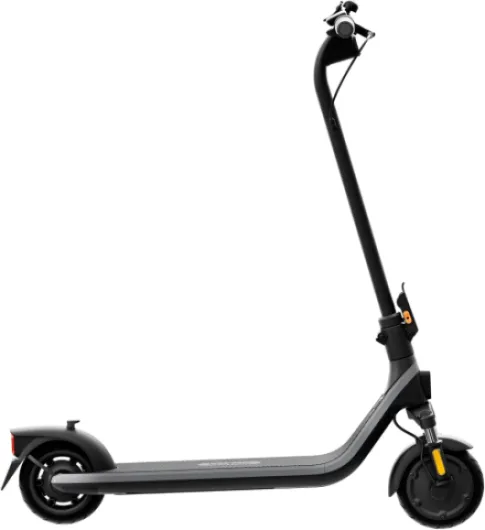
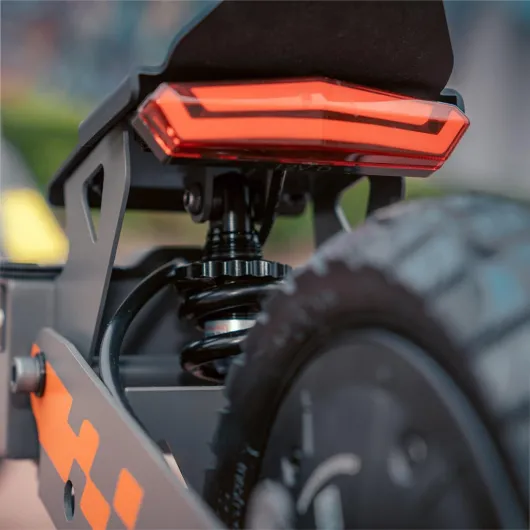
The design of the Kukirin G2 is all about looking and feeling robust rather than sleek. The frame is aluminium, painted black, with a fairly wide deck and a slightly raised rear section you can use as a footrest. Visually it sits in the “off‑road” category: thick tyres, visible suspension, big stem. If you’re after a small, discreet commuter that disappears under a desk, this is not it. On the street it looks closer to the heavier dual‑motor scooters, even though this one is single motor.
The folding mechanism is decent but not magical. The stem folds down and locks to the rear, so you can lift it from the middle. It feels solid once locked upright, which is the important part for safety. Folding takes maybe 10 seconds once you’re used to it. The downside is the weight: at more than 25 kg, carrying it up a flight of stairs is a workout. For me, carrying it from the car to the garage is fine; carrying it up two floors would be a pain. So yes, it’s technically “foldable”, but in real life that’s more about storage than truly portable use.
The touch display on the handlebar is a bit of a mixed bag. It looks modern and shows speed, battery, mileage and mode clearly. You can change speed modes and settings through it. The touch part works, but with gloves or in the rain it’s not as convenient as simple physical buttons. Under strong sunlight the visibility is okay but not perfect; you sometimes have to tilt your head to see the numbers properly. On the plus side, it doesn’t feel cheap or flimsy; it’s just not as practical as a bright non‑touch display with physical controls.
In terms of ergonomics, the handlebar height (around 99 cm) is fine for me at 1.78 m. It’s not adjustable, so shorter or much taller riders will just have to live with it. The grips are ergonomic‑style rubber and feel okay, not premium but not awful. Overall, I’d say the design is functional and solid, clearly biased towards strength and off‑road look rather than compact city chic.
Real-world range and charging time
The battery is a 48V 15.6Ah lithium pack, and the brand claims up to 55 km of range with a 65 kg rider at medium speed. As usual, those numbers are optimistic and based on ideal conditions. In my case, at around 80 kg, riding mostly in the highest speed mode, with some hills and stop‑and‑go city traffic, I’ve been getting roughly 30–35 km per charge before I’m down to the last bar and start getting power sag. If I ride more calmly, mixing modes and keeping closer to 20 km/h, I can push it closer to 40 km, but not much more.
The charging time is around 8 hours from near empty with the supplied charger. That’s basically an overnight charge. For my usage (commuting plus some extra rides), I usually charge it every 2–3 days rather than every single day. The charger itself is nothing special: a typical brick with a fan that makes a bit of noise but nothing extreme. I’d avoid fast‑charging hacks; with this kind of pack, I’d rather keep it stock to protect the battery over time.
One thing I noticed is that the battery gauge on the display behaves like most scooters: it’s fairly accurate in the middle range, but under hard acceleration or uphill it drops and then climbs back when you slow down. That’s normal, but it means you shouldn’t panic if you suddenly see one bar disappear when you’re climbing. Plan your rides based on your own tested range, not the theoretical 55 km. After a few full cycles, you’ll know what you can realistically do on a charge with your weight and routes.
In terms of battery care, the brand insists on using the official charger and avoiding full deep discharges all the time. I’ve tried to keep it between about 15–90% most of the time, and so far there’s no obvious drop in performance. For the price range, I’d say the range is good but not magic: if you expect true 55 km at full speed, you’ll be disappointed; if you want a solid 25–35 km with mixed riding, it’s fine. For most daily commutes under 15 km each way, it’s enough without charging at work.
Ride comfort: finally a scooter that doesn’t rattle your teeth
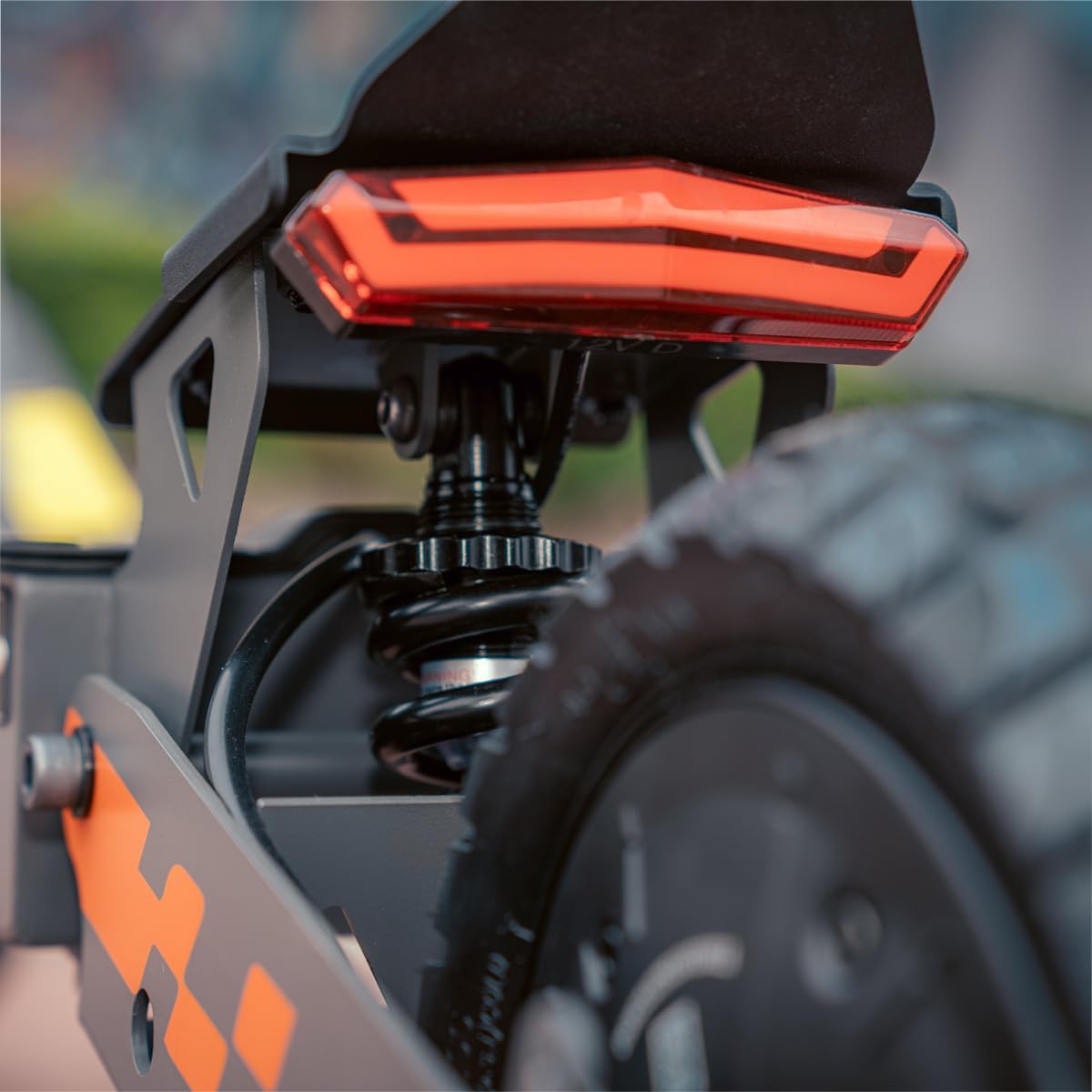
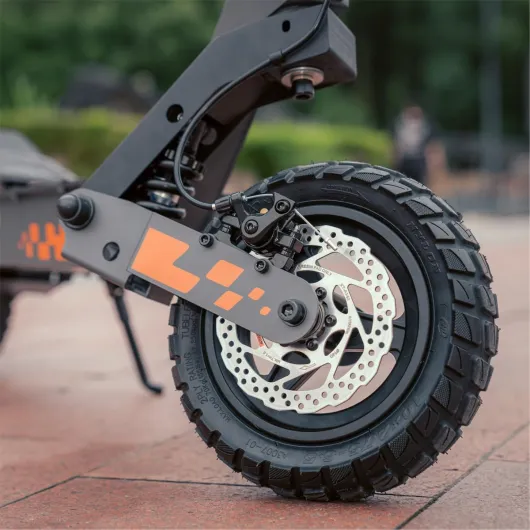
This is where the Kukirin G2 really stands out compared to basic city scooters I’ve used. The combo of 10‑inch tubeless tyres and dual spring suspension makes a clear difference. On my old 8.5‑inch commuter scooter, every pothole and curb edge felt sharp, and after 20–30 minutes my knees and wrists were tired. With the G2, I can ride over rough cycle paths, cracked asphalt and small gravel without feeling like the scooter is going to disintegrate under me.
I’ve taken it over a mix of surfaces: regular tarmac, broken pavement, some compact gravel and a bit of grass (still on private land). The suspension is not luxury‑level, but it does its job: it takes the edge off bumps and helps keep the tyres in contact with the ground. You still feel the bigger hits, but it’s much more controlled. The deck is wide enough to stand with feet side by side or one foot forward, one back. I tend to ride with one foot angled on the rear part and that feels stable even when braking harder.
Noise and vibrations are reasonable. There’s the usual motor whine and some minor rattles on very rough surfaces, but nothing alarming. I didn’t have any weird creaks from the folding joint, which was one of my worries with a heavier scooter. The brake levers are standard scooter style, with a firm feel. You don’t need to crush them to stop, which I prefer because it reduces hand fatigue on longer rides. The grips are okay for rides up to an hour; for daily long commutes, I might add bar ends or slightly softer grips, but that’s personal preference.
One thing to keep in mind: the scooter’s weight and power mean you need to ride it with a bit more respect. It feels very stable at 20–25 km/h, but if you’re on loose gravel and you accelerate hard or brake too sharply, you can still lose traction. So comfort is good, but it doesn’t erase the need for basic riding sense. Overall, for day‑to‑day city use with some rough patches and occasional light off‑road, I’d say the comfort is pretty solid and clearly better than most rental‑style scooters.
Build quality and how solid it feels
Durability is always hard to judge after only a few weeks, but there are some clues. The aluminium frame feels stiff, and there’s no flex in the deck or stem when I ride, even when I hit bumps at speed. The folding joint locks with a reassuring click and I haven’t noticed any play developing so far. That’s important on a heavier scooter, because once those joints start to loosen, the whole ride becomes sketchy. I’ve checked the screws around the folding area and suspension after the first rides; a couple needed a small tighten, which is normal on a new scooter.
The 10‑inch tubeless tyres are a plus for durability. Tubeless means fewer pinch flats compared to inner tubes, and you can run slightly lower pressure for grip without worrying too much. I rode over broken glass once (not on purpose) and nothing happened, so that’s a good sign, but obviously it’s not bulletproof. The discs and calipers look standard scooter/moped style; I expect the pads to be wear parts you’ll replace every so often depending on how aggressively you brake.
About water resistance, it’s rated IPX4, which basically means splash resistant. I’ve ridden it in light rain and through small puddles with no issues. I wouldn’t take it out in a storm or through deep water; that’s asking for trouble on any scooter. The deck grip is decent even when slightly wet, but I still ride more carefully. The cables are mostly tucked in, and I didn’t see any obvious exposed connectors, which is reassuring.
The 12‑month warranty is standard. It’s limited, and they clearly state that wear and tear or misuse isn’t covered. So if you abuse it with jumps or constant off‑road stunts, don’t expect charity. For normal daily use with occasional rough paths, the scooter feels built to handle it. Overall, I’d rate the durability as pretty solid for the price: not indestructible, but it doesn’t give off that flimsy, disposable vibe you get from some cheaper models.
Power, speed and brakes: how it really rides
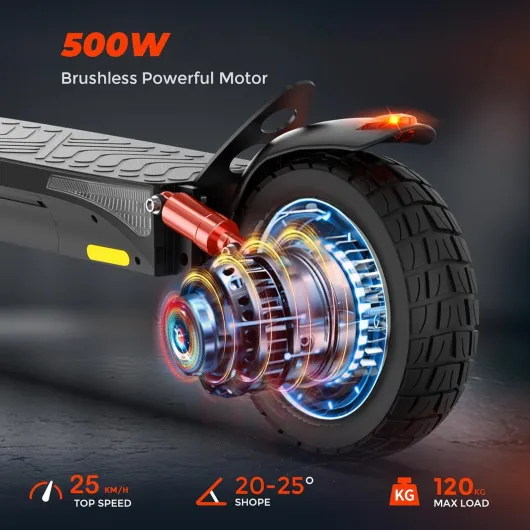
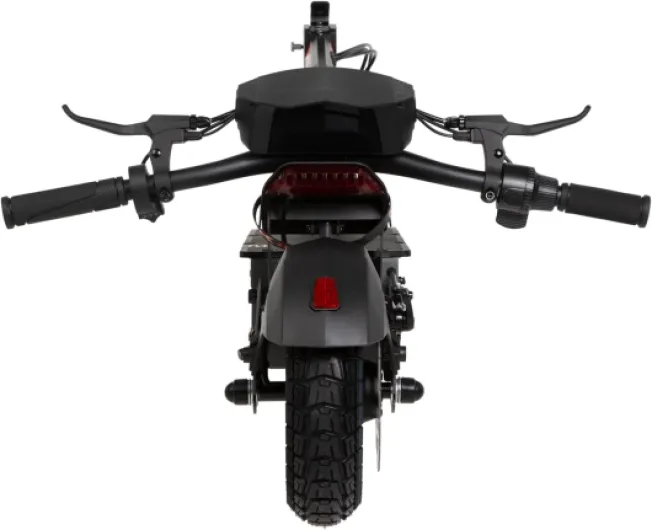
The Kukirin G2 comes with a 500W motor and three speed modes. Officially, it’s limited to 25 km/h (15.5 mph), which is what the spec says. In practice, it gets to that speed quickly enough for city use. I’m around 80 kg and on flat ground the scooter reaches 25 km/h without struggling. On mild inclines, it still holds 20–23 km/h, which is decent. On steeper hills, it slows down but doesn’t die completely like smaller 250–350W scooters I’ve tried. You feel that extra torque when pulling away from a stop, especially in the higher mode.
Acceleration is controlled thanks to the sine‑wave controller. That sounds technical, but basically it means the power delivery is smoother than on some jerky budget scooters. You don’t get that sudden on/off feeling when you touch the throttle, which is reassuring if you’re not used to powerful scooters. There’s also cruise control: hold a stable speed for a few seconds and it keeps it until you tap the brake or throttle. Personally, I use it sometimes on long straight sections, but I turn it off in busy areas because I like full manual control.
The dual disc brakes with motor cut‑off are one of the strong points. Braking power is clearly above average for this price range. From top speed, you can stop in a short distance without the feeling you’re about to fly over the handlebar. You do need to adjust the braking strength to your taste and check the discs regularly, but that’s normal. Compared to cheaper scooters with only a rear drum or electronic brake, the difference is big. In the rain (light rain, I didn’t push it in heavy storms), braking is still effective, though I naturally slowed down more out of caution.
For visibility and safety, you get a front light, rear brake light, turn indicators, reflectors and a bell. The front light is okay for being seen and for slow riding at night, but if I were doing a lot of dark paths, I’d probably add an extra handlebar light. The indicators work, but drivers don’t always notice them, so I still use hand signals when possible. Overall, performance wise, I’d say it’s strong for a 500W single motor: enough power, solid braking, and stable handling up to its limited top speed. It’s not a race scooter, but for daily use and a bit of fun, it does the job well.
What you actually get with the Kukirin G2
Out of the box, the Kukirin G2 comes mostly assembled. In my case, I had to mount the handlebar, check the screws, and that was it. No extra seat or fancy accessories, just the scooter, the charger, and the basic tools. The brand advertises EN17128 compliance, IPX4 water resistance, and a 12‑month warranty. That all sounds nice on paper, but in practice it mostly means: light rain is fine, don’t ride into deep puddles, and don’t expect them to cover you if you jump off stairs or crash it.
The scooter is clearly designed as a more serious adult model: 10‑inch tubeless tyres, dual suspension, dual disc brakes, and a 48V 15.6Ah battery. The official range is up to 55 km with a 65 kg rider at medium speed. I’m heavier and I ride mostly in the highest mode, so I’ll talk about my real numbers in the battery section, but obviously you shouldn’t expect 55 km if you push it hard all the time.
Physically, it’s a big unit: around 126 cm long and 129 cm high with the handlebar. Folded, it’s shorter but still bulky. It fits in a car boot if you don’t have a tiny car, but it’s not the kind of scooter you casually carry onto a crowded metro. The max load is about 120 kg, so heavier riders are still within spec, which is good because a scooter this solid would be pointless if it only handled very light people.
Overall, the presentation is pretty straightforward: this is not a toy, not a super‑premium product either, more like a mid‑range, beefy scooter aimed at adults who want something sturdy with real range and some off‑road capacity. There’s no useless gimmick in the box, but also no extra comfort accessories like a phone holder or a bag. It’s basically: here’s the scooter, here’s the charger, now go ride.
Pros
- Strong 500W motor with smooth acceleration and decent hill performance for a single motor
- Dual suspension and 10-inch tubeless tyres give a comfortable and stable ride on rough surfaces
- Good real-world range (around 30–35 km for an average adult) and solid dual disc brakes
Cons
- Heavy at over 25 kg, awkward to carry upstairs despite being foldable
- Touch display less practical with gloves or in rain than physical buttons
- Claimed 55 km range only realistic in very gentle conditions; expect less in normal use
Conclusion
Editor's rating
After using the Kukirin G2 regularly, my overall feeling is that it’s a solid mid‑range electric scooter aimed at adults who care more about stability, comfort and range than ultra‑light portability. The 500W motor, proper dual suspension, and dual disc brakes make it feel a lot more serious than the slim commuter scooters. It handles rougher surfaces, small curbs and mild off‑road use without drama, and the frame doesn’t feel flimsy. Real‑world range around 30–35 km with mixed riding is enough for most daily commutes if you charge every couple of days.
It’s not perfect though. At more than 25 kg, it’s heavy, and the “foldable” label is mainly about storage, not easy carrying. The touch display looks modern but isn’t as practical as simple buttons when you’re wearing gloves or riding in the rain. The front light is okay but not outstanding, and the IPX4 rating means you still need to be sensible about water. Also, don’t buy it expecting the full 55 km range unless you’re very light and ride slowly.
I’d recommend the Kukirin G2 to people who have ground‑floor or garage storage, want a tougher scooter that can handle bad roads and some off‑road paths, and prefer comfort and stability over minimal weight. If you live in a flat with no lift, need to carry your scooter up stairs daily, or you only ride on smooth city streets for short distances, a lighter and simpler model will probably suit you better and save you some money.