
Summary
Editor's rating
Value for money: decent package if you keep expectations in check
Design: looks decent, more practical than flashy
Battery and range: honest if you stay realistic
Comfort: okay on city streets, harsh on rough ground
Durability and build: feels solid, but long-term is still a question
Performance: good for flat commutes, limited on hills
What you actually get with the Ramba V10
Pros
- Solid basic commuter scooter with reliable dual braking and 10-inch solid wheels
- Decent real-world range (around 16–20 km) and reasonable 4-hour charge time
- App control, LCD display, and LED lights add useful features without complicating things
Cons
- 250W motor struggles on steeper hills and with heavier riders
- Ride comfort is only average on rough or broken surfaces due to solid tyres and basic suspension

Specifications
View full product page →| Brand | Ramba |
A week with the Ramba V10: decent commuter, a few quirks
I’ve been using the Ramba V10 electric scooter for daily trips for about a week, roughly 6–8 km per day. So far, I’d say it’s a pretty solid basic commuter scooter, but not some miracle machine. It does what it says on the box: it goes up to 20 km/h, it folds, the app connects, and the brakes stop you. If that’s what you’re after, you’ll probably be fine with it.
My use case is simple: going to work, quick errands, and visiting friends in town. Mostly flat roads, a few mild slopes, and a mix of bike lanes and regular streets. I weigh around 80 kg, so I’m well under the 120 kg limit. I didn’t baby it: some potholes, a bit of rough asphalt, a couple of wet mornings. Nothing extreme, but not just smooth pavement either.
The first thing that stood out is the weight and size. At 12 kg and with 10-inch solid wheels, it feels more like a mid-range city scooter than a toy for kids. Folded, it fits in the trunk easily and I can carry it up one flight of stairs without dying, but I wouldn’t want to drag it around a mall for an hour. It’s portable, but you still know you’re carrying a scooter.
Overall, my first impression is: it’s not fancy, but functional. The LCD screen, LED lights, and app are nice touches, but the core of the product is just a simple scooter that gets you from A to B at a reasonable speed. If you expect crazy acceleration or long-range touring, you’ll be disappointed. If you just want something to replace a short bus ride, it gets the job done.
Value for money: decent package if you keep expectations in check
In terms of value, the Ramba V10 sits in that middle zone: not the cheapest scooter on the market, not a high-end machine either. For what you get — 250W motor, 20 km/h, 10-inch solid wheels, app control, LCD, dual brakes, LED lights, and a foldable aluminium frame — I’d say it’s good value if your goal is simple commuting. You’re paying for a bit of tech (app, display, LEDs) on top of the basics, but nothing feels purely gimmicky.
Compared to cheaper entry-level scooters I’ve tried before, the Ramba feels a bit more grown-up: better brakes, bigger wheels, and a sturdier frame. On the other hand, compared to more powerful 350–500W scooters, you obviously lose in acceleration and hill handling. So it really depends on what you need. If your rides are mostly flat and short, it makes sense to save some money and go for this. If you live in a very hilly city or want long-range rides on weekends, you might outgrow it fast.
Running costs should be low: solid tyres mean no tubes to replace, and the 4-hour charge on a relatively small battery won’t blow up your electricity bill. The 2-year spare parts availability is another point in favor of value, because it means you can actually fix it instead of throwing it away if something goes wrong. For a scooter meant for adults and teens, that’s pretty important, since teens especially can be rough on gear.
So, from a budget perspective, I’d say the Ramba V10 is decent but nothing special. It’s not the bargain of the century, but it’s also not overpriced for what it offers. If you catch it on a discount, it becomes a very reasonable option for someone who just wants a reliable tool for daily trips and doesn’t care about top speed records or fancy branding.
Design: looks decent, more practical than flashy
The design is pretty simple: black frame with red accents, 10-inch solid wheels, and a straight handlebar with an LCD in the middle. It looks like a normal city scooter. Nothing that makes people stop in the street, but also nothing that screams “cheap toy”. I’d call it neutral and practical. The red/black combo is fine if you don’t want something too colorful. The listing text mentions black and blue, but the model name says Red/Black, so clearly there’s a bit of confusion there. Mine is definitely more black/red than black/blue.
The frame is aluminium and feels sturdy enough for everyday use. The deck is wide enough for my size 43 shoes placed one behind the other, or one sideways and one straight. I never felt like I was about to fall off because of a narrow deck, which is good. The anti-slip surface on the deck does its job, even with slightly damp soles. It doesn’t feel premium, but it grips.
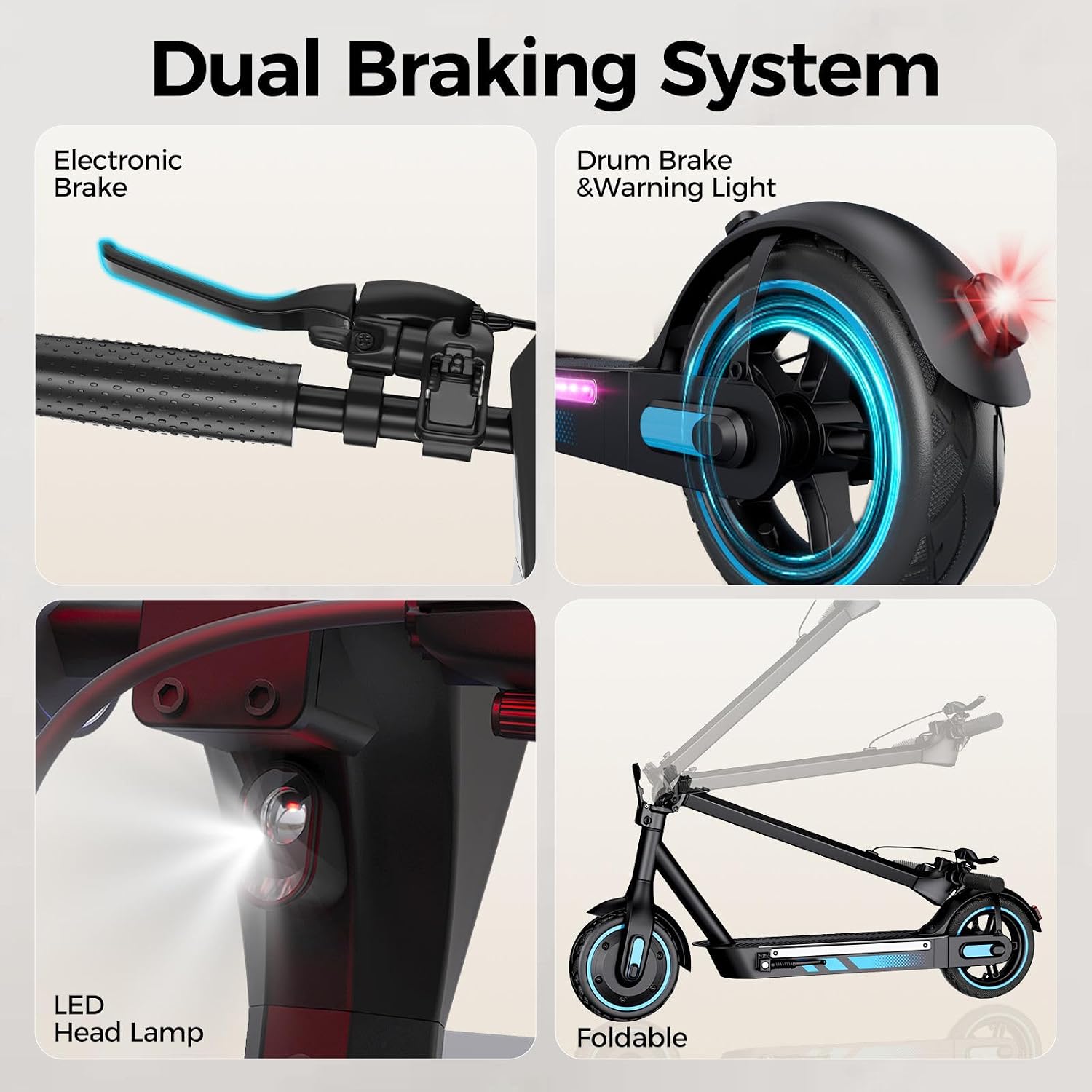
The folding mechanism is fairly standard: pull the latch, fold the stem down, and hook it near the rear wheel. It takes a few seconds. It’s not the smoothest folding system I’ve used, but it’s reliable. No play or wobbling once locked, which is what really matters when you’re riding. The handlebar height (around 120 cm) is okay for my height (1.78 m). Taller people around 1.90 m might find it a bit low, but for average height adults and teens it’s fine.
The LED lights are more for visibility and a bit of style. There’s lighting along the deck and wheels, which makes you more visible in the dark, and honestly it’s pretty handy in traffic so cars and bikes notice you. It’s not about looking cool for me, it’s just nice to feel less invisible at night. Overall, the design is practical and decent, nothing fancy, but it feels like it was thought out for daily commuting, not just for fun rides around the block.
Battery and range: honest if you stay realistic
The brand advertises up to 28 km of range and a 4-hour charge time. In real life, those numbers are always optimistic, and it’s the same here. With my 80 kg weight, mixed riding (not always eco mode, often close to full speed), and mild slopes, I was getting around 16–20 km per charge before the scooter started feeling weaker and I preferred to recharge. That’s still fine for my daily 6–8 km usage, but if you’re expecting 28 km at full blast, that’s not happening.
Charging from almost empty to full took me pretty close to the 4 hours they claim. I usually just plugged it in when I got home from work and it was done by the evening. The charger is not huge, and the cable length is decent. Nothing special to say here: it behaves like most mid-range scooters. The battery indicator on the LCD and in the app is useful, but like most scooters, the last bar drops faster than the first ones, so don’t push your luck if you’re far from home.
One thing I noticed is that performance drops a bit when the battery gets low. The scooter still moves, but it doesn’t hold 20 km/h as easily and feels a bit lazier on starts. This is pretty standard for this kind of product, but it’s worth mentioning. If you plan longer rides, it’s better to think in terms of a safe 15–18 km range rather than believing the maximum number on the box.
In short, the battery is good enough for daily commuting and short trips, as long as you’re honest about your expectations. Charge it regularly, don’t expect miracles, and it will do the job. For heavy users doing 20+ km every day, you might find yourself charging more often than you’d like, but for most people using it for work and errands, it’s manageable.
Comfort: okay on city streets, harsh on rough ground
On the comfort side, the Ramba V10 is fine on decent roads and bike lanes, but you feel it as soon as the surface gets rough. The 10-inch solid wheels plus a basic spring suspension absorb some bumps, but not all. Compared to scooters with air-filled tyres, this one feels a bit harder. The trade-off is that you don’t get flats, which is honestly nice if you’re lazy about maintenance like I am.
On smooth asphalt and bike lanes, the ride is actually quite pleasant. The deck is stable, the grip is good, and the scooter doesn’t rattle too much. I did a couple of 20–25 minute rides in one go and didn’t feel destroyed afterward. My knees and wrists only started complaining when the pavement turned into patched, cracked mess. Over speed bumps you feel a clear thump, but it’s not brutal. Just don’t expect a magic carpet ride.
The handlebar grips are made of anti-slip rubber. They’re not soft and cushy, but they don’t feel cheap either. After a week of use, I didn’t get blisters or anything, just the usual mild hand fatigue you get from long rides on any scooter without serious suspension. The riding position is natural, no weird leaning or hunching. As I said, I’m 1.78 m, and the height felt right; my partner who is shorter also felt comfortable.
Noise-wise, it’s reasonably quiet. You hear the motor a bit and some vibrations on bad roads, but nothing alarming. Overall, I’d say comfort is decent but nothing more. For short commutes and city rides, it’s fine. If your daily path is full of cobblestones or broken pavement, you might want something with better suspension or air tyres. It works, but it’s not super forgiving on bad surfaces.
Durability and build: feels solid, but long-term is still a question
After about a week of use, the Ramba V10 feels solid enough. The aluminium frame doesn’t flex, the folding mechanism locks correctly, and I haven’t noticed any weird creaks or loose parts yet. Obviously, a week is not enough to judge long-term durability, but at least out of the box it doesn’t feel like it’s going to fall apart after a month. The 10-inch solid rubber wheels also give some peace of mind: no punctures, no checking pressure, just ride and forget.
The downside of solid wheels is more vibration, but from a durability point of view, it’s actually reassuring. There are fewer things to maintain. You just need to keep an eye on screws and bolts from time to time, like on any scooter. I went over some rough patches and small potholes and the scooter handled them without any pieces rattling loose. The spring suspension is basic, but at least it takes part of the hit instead of sending everything straight into the frame.
The product comes with a limited manufacturer warranty and mentions 2 years of spare part availability in the EU. That’s decent: it means if something breaks, you’re not stuck with a scooter you can’t repair after six months. Of course, it still depends on how responsive the brand is when you actually need support, and I haven’t had to test that yet, so I can’t comment on the service quality. But on paper, it’s better than random no-name scooters with zero info about spares.
Overall, my feeling is that the Ramba V10 is built to handle regular city use, not hardcore abuse. If you ride normally, avoid jumping off curbs, and don’t leave it outside in the rain all the time, it should last a while. If you’re the type to throw it into a garage full of metal junk and forget about it, you’ll probably manage to break something sooner or later, like with any scooter. It’s solid, but not indestructible.
Performance: good for flat commutes, limited on hills
The 250W motor is the main thing that defines how this scooter performs. On flat ground, it’s totally fine: you reach the 20 km/h top speed and it holds it pretty consistently as long as the battery isn’t almost empty. Acceleration is smooth rather than punchy. You’re not going to be the fastest person in the bike lane, but you keep a steady pace. For city use with traffic lights and pedestrians, that’s honestly enough.
Where you feel the limit is on hills. On mild inclines, it slows down but still moves. On steeper ones, you’ll feel it struggle and your speed can drop a lot. If you live in a very hilly area, this might annoy you. In my case, with just a couple of gentle slopes, it handled them without drama, but this is clearly not a scooter built for big climbs or heavy riders plus hills. With my 80 kg, it was okay; if you’re closer to the 120 kg limit, expect slower starts and more drop on slopes.
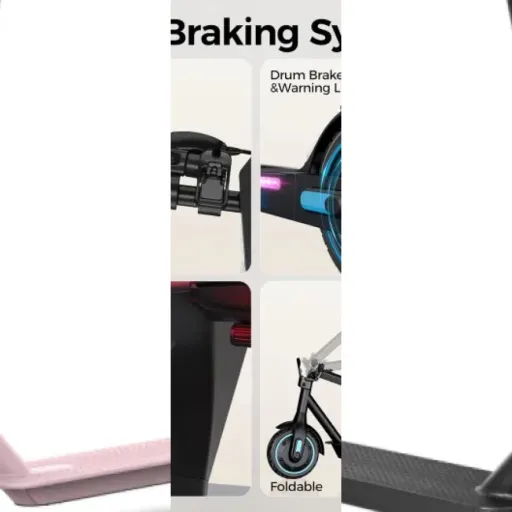
The dual braking system is a good point. You get responsive braking, and you don’t feel like you’re gambling every time you need to stop quickly. I tested it a few times at full speed on dry ground, and it stopped in a reasonable distance without skidding like crazy. In the wet, I just naturally braked a bit earlier, but it still felt controlled. For me, this is one of the strong parts of the scooter: performance is modest in power, but at least the stopping side is handled properly.
The app and LCD don’t really change performance, but they help you manage it. You can check your mode, see how fast you’re really going, and keep an eye on battery so you don’t push it too far. Some people like to tweak settings like cruise control; I tried it once, it worked, but I personally prefer to control the throttle myself. Overall, performance is enough for everyday city rides, but if you’re chasing strong acceleration or need to climb steep hills daily, there are better options with more powerful motors.
What you actually get with the Ramba V10
Out of the box, the Ramba V10 is pretty straightforward. You get the scooter already mostly assembled, a charger, and the basic paperwork. No fancy extras, no bag, no extra bell, nothing like that. It’s literally just the scooter and the charger, which is fine, but don’t expect a lot of accessories. The manual is basic but clear enough to get you going in a few minutes.
The scooter is rated for up to 28 km range, a top speed of 20 km/h, and has a 250W motor. Those numbers are more on the modest side compared to some beefier scooters, but they’re also in line with what’s usually allowed in many European cities. In practice, you feel that 250W on hills: it’s enough for light inclines, but don’t expect it to pull like a 500W model. On flat ground, it’s fine and keeps a steady pace.
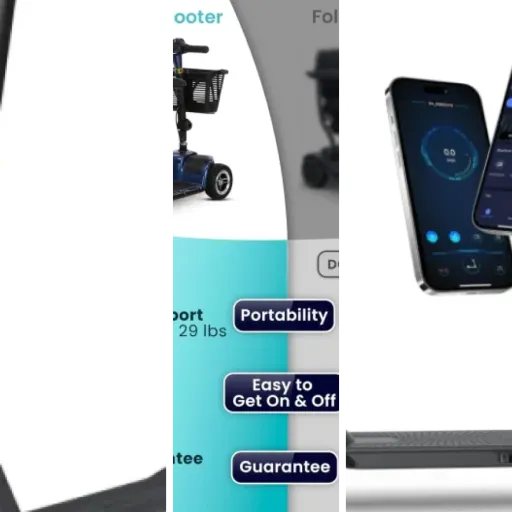
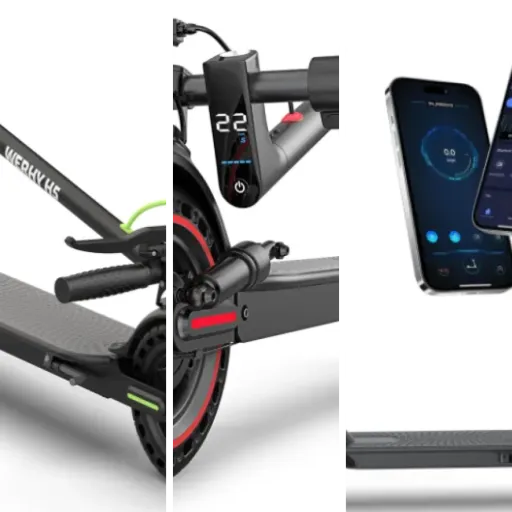
There’s app control, which is something you don’t always get in this price range. The app lets you see speed, battery, mileage, and tweak small things like cruise control and lights. It’s not some deep technical dashboard, but it’s handy if you like checking stats or locking the scooter digitally. The LCD display on the handlebar shows the same basics: speed, battery, mode. It’s readable in daylight and does the job, nothing fancy.
Overall, the presentation is: no-nonsense city scooter with a couple of modern features (app, LEDs, LCD). It’s more about practicality than style. If you want a scooter that looks like a spaceship, this isn’t it. If you just want something that works and doesn’t confuse you with 15 riding modes, it’s quite straightforward.
Pros
- Solid basic commuter scooter with reliable dual braking and 10-inch solid wheels
- Decent real-world range (around 16–20 km) and reasonable 4-hour charge time
- App control, LCD display, and LED lights add useful features without complicating things
Cons
- 250W motor struggles on steeper hills and with heavier riders
- Ride comfort is only average on rough or broken surfaces due to solid tyres and basic suspension
Conclusion
Editor's rating
After using the Ramba V10 for everyday commuting, my overall opinion is that it’s a simple, reliable city scooter with a few nice extras, but nothing mind-blowing. It rides fine on normal roads, the 20 km/h speed is enough for daily trips, and the 250W motor does the job as long as you’re not dealing with big hills. The dual braking system, 10-inch solid wheels, and aluminium frame give it a solid feel, and the app plus LCD display are handy without being overcomplicated. Range is realistic at around 16–20 km for an average adult using it at normal speeds, which covers most short commutes.
On the downside, comfort is only average on rough surfaces, and the motor power will feel limited if you’re heavier or live in a very hilly area. It’s not the scooter for people who want strong acceleration or long-distance rides on weekends. But if you’re mainly looking for a practical, no-nonsense scooter to replace short car or bus trips, and you like the idea of having app control and LED visibility, it’s a solid option. I’d recommend it to students, city workers, or teens and adults who need a daily ride under 10 km and don’t care about top-tier performance. If you need serious power or suspension, you should probably look at a more powerful model and be ready to pay more.