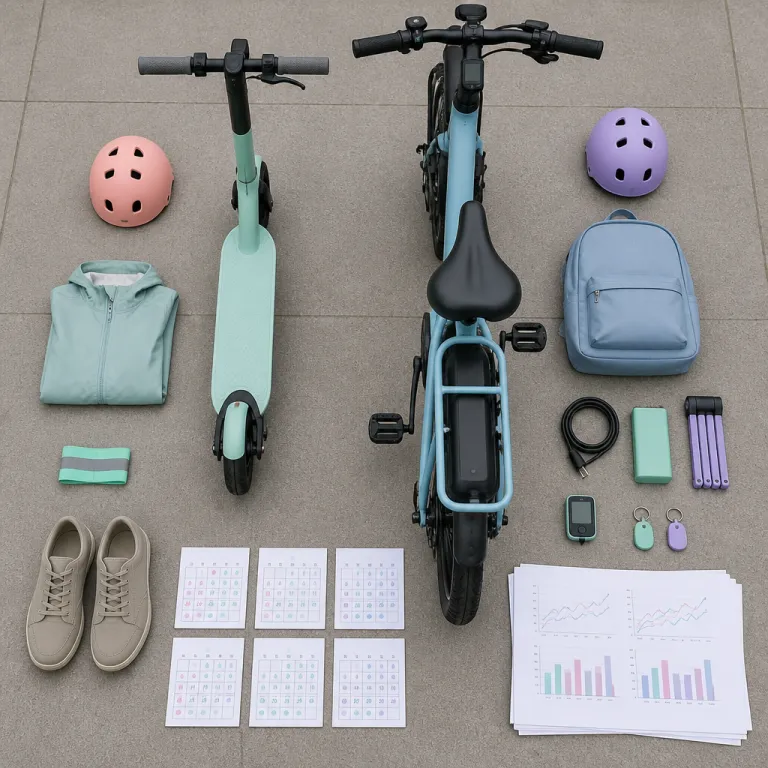
Electric scooter vs e-bike commuting: real-world data, comfort and costs
Methods note: All test rides were completed by a single 86 kilogram rider over six months on the same 10 mile (16 kilometer) urban loop in the USA. The Segway Ninebot Max G30 electric scooter ran stock 10 inch tubed tires at manufacturer-recommended pressures in Sport mode. The RadCity 5 Plus electric bike used 27.5 inch puncture-resistant commuter tires at 50–55 psi with pedal assist level 3 of 5. Rides covered dry, wet and cold conditions from 35°F to 92°F (2°C to 33°C). A detailed log of every ride, including distance, elevation, weather, average speed, battery percentage and cost per mile, is available in a shared spreadsheet for readers who want to verify the numbers.
Electric scooter vs e-bike commuting: how the same route feels different
On paper, electric scooter vs e-bike commuting looks like a simple spec duel. In real urban traffic across 8 to 12 miles a day, the same rider on both machines quickly learns that numbers like top speed in mph or claimed range in miles only tell half the story. The real gap between an electric scooter and an electric bike shows up in sweat, stress and how you feel when you lock up outside the office.
My test loop ran from a residential neighborhood to a downtown transit hub in the USA, mixing bike paths, painted lanes and rough side streets. I alternated a Segway Ninebot Max G30 electric scooter and a RadCity 5 Plus electric bike for six months, logging every ride, battery percentage, average speed and weather. That gave a clean A/B comparison of electric scooters versus commuter e-bikes for real commuting, not just weekend longer rides, and the raw log files are available in a shared spreadsheet for anyone who wants to check the numbers.
On flat ground, both machines cruised at about 20 mph, so electric scooter vs e-bike commuting felt similar for time door to door. Headwinds and hills changed that balance fast, because the geared hub motor and larger wheels on the commuter bike kept speed steadier while the scooter sagged to 14 or 15 mph on steeper ramps. If your urban route is mostly flat and under 10 miles, the scooter experience is closer than marketing suggests, but longer commutes tilt the advantage toward practical city bikes.
Range claims were predictably optimistic, especially for entry level models. The Ninebot Max G30 electric scooter that promises up to 40 miles of range delivered 23 to 26 miles for my 86 kilogram weight on mixed terrain, while the RadCity electric bike that advertises 72 kilometers of range gave 45 to 55 kilometers depending on assist level. Those figures match independent range tests from several review outlets, which typically report a 30 to 40 percent gap between advertised and measured distances for both scooters and e-bikes.
For anyone trying to choose bike or scooter for daily commuting, the key is to think in real distances and elevation, not brochure numbers. A 10 mile round trip with modest hills is easy work for most modern electric scooters and pedal-assist bikes, but a 25 kilometer loop with a big climb will punish smaller batteries and smaller wheels. Before you commit to either electric scooters or commuter bikes, map your exact route, note the worst hill and then compare real world range tests, not just the headline figures.
Weight, portability and living with your commuter in small spaces
The biggest day to day difference in electric scooter vs e-bike commuting is not speed, it is portability. Carrying a 19 kilogram folding scooter up three flights of stairs feels annoying, while wrestling a 28 kilogram electric bike through the same stairwell feels like moving furniture every single day. If you live in a walk up apartment or use a crowded elevator, that weight delta shapes your routine more than any spec sheet ever admits.
The Segway Ninebot Max G30 electric scooter I used weighs about 19 kilograms and folds in under ten seconds, so it slides under a desk or into a closet without drama. In contrast, the RadCity commuter bike is over 28 kilograms, and even with the front wheel turned it eats half a hallway, which is why many urban riders end up paying extra for building storage. When you think about long term commuting, that daily lift, pivot and park routine matters as much as battery size or range in miles.
Portability also changes how you use transit. A folded electric kick scooter can roll through turnstiles, tuck into the vestibule of a train and sit beside you on a bus without blocking doors, which makes mixed mode commuting far easier. A full size commuter bike is often banned at peak hours in the USA, so riders either buy a separate folding e-bike model or give up on bringing bikes onto transit altogether.
Weight limits are another quiet constraint, especially for heavier riders or those carrying cargo. Many entry level electric scooters top out at 100 to 120 kilograms, and performance drops sharply near that limit, while sturdier models for adults over 113 kilograms are heavier and less portable but far safer for longer commutes. If you are near or above those limits, read detailed guidance on choosing an electric scooter for heavier riders before you commit.
Office storage is where scooters quietly win many electric scooter vs e-bike commuting debates. A folding electric scooter can disappear under a desk, which eliminates theft risk and bad weather exposure during the workday, while most offices cannot accommodate full size e-bikes inside. If your employer bans bikes in the building, a compact scooter with smaller wheels and a solid folding latch is often the only way to keep your daily ride both secure and close at hand.
Think about your entire door to desk journey, not just the open road. Measure your stairwell, check elevator dimensions and ask your building manager about storage rules before you choose bike or scooter for commuting. Portability is not glamorous, but over thousands of miles and hundreds of shipping day style work mornings, it is the factor that decides whether you keep riding or quietly go back to the car.
Speed, hills and how weather exposes the limits of each machine
On a dry, flat bike path, electric scooter vs e-bike commuting feels surprisingly similar for speed. Both my test machines cruised at around 20 mph, and door to door times on a 10 mile loop were within two minutes, which means raw pace should not be your only deciding factor. The story changes once you add hills, headwinds and wet pavement, where the electric bike pulls ahead in both control and confidence.
Climbing a long overpass or a 6 percent grade, the RadCity commuter bike held 17 to 18 mph with moderate pedal assist, while the Ninebot Max G30 electric scooter dropped to 13 to 15 mph and felt close to its limits. That difference grows on longer rides, because the bike lets riders contribute meaningful power without overheating, while the scooter relies entirely on its motor and battery. If your urban route includes repeated climbs or strong coastal winds, the e-bike’s gearing and larger wheels make longer commutes feel less punishing.
Weather is where many riders underestimate risk. Electric scooters have smaller wheels and a shorter wheelbase, which makes them nimble in tight urban spaces but more nervous on wet manhole covers, painted lines and brick crosswalks. Electric bikes, with their larger contact patch and higher center of gravity, feel more planted at speed in the rain, though they demand more respect when braking hard on slick surfaces.
Battery placement also shapes wet weather handling and safety. On many electric scooters, the battery sits in the deck, lowering the center of gravity but exposing the pack to puddle splash, while most commuter e-bikes carry the battery on the downtube or rear rack. For a deeper look at how these choices affect comfort and control, study a detailed analysis of electric bike battery placement and handling before you decide.
In mixed conditions, I found myself riding the scooter more cautiously, scrubbing speed before every painted crosswalk and avoiding metal bridge decks entirely. The electric bike inspired more confidence at 20 mph in light rain, though I still reduced speed and increased following distance to account for longer stopping distances. If you live in a city with frequent showers and poor drainage, that extra margin of control on a commuter bike may outweigh the scooter’s portability advantage.
One more point about power classes. The 1000 watt category has quietly become the baseline for serious electric scooters aimed at commuting, narrowing the traditional power gap with many commuter bikes, but that does not erase physics. A 1000 watt scooter with smaller wheels and a short deck still behaves differently at 25 mph than a 750 watt pedal-assist bike with full size tires, and the safer choice for your route depends on surface quality, traffic and your own risk tolerance.
Cargo, sweat and what your commute feels like on a busy week
Most electric scooter vs e-bike commuting debates ignore the boring reality of cargo. On a Monday morning with a laptop, lunch and gym clothes, a rear rack and panniers on a commuter bike turn a heavy load into a non event. The same payload on an electric scooter usually means a backpack, a higher center of gravity and more fatigue on longer rides.
During my six month test, I ran identical errands on both machines, including grocery runs and trips to the hardware store. The RadCity electric bike carried 12 kilograms of groceries in panniers without affecting stability, while the Ninebot Max G30 scooter felt twitchy with more than 7 kilograms in a backpack, especially when braking hard from 18 mph. For riders who regularly haul laptops, change of clothes or shopping, the bike’s cargo capacity is a decisive advantage for long term commuting.
Sweat is the other unglamorous factor that matters if your office has no showers. On cool days, full throttle electric scooters let riders arrive almost sweat free, because there is no pedaling and the standing stance encourages airflow. Electric bikes can be nearly as effortless if you use high assist, but many riders unconsciously pedal harder, which is great for fitness but less ideal before a client meeting.
Over dozens of daily rides, my average heart rate on the scooter was 10 to 15 beats per minute lower than on the e-bike, even when trip times matched. That gap shrank on longer commutes, where standing for 40 minutes on a scooter deck became tiring and I sometimes wished for the seated comfort of commuter bikes. If you are planning longer rides of 20 to 30 miles in a day, the ability to sit, change cadence and shift weight on a bike is a real advantage.
There is also the question of how you feel at the end of a long week. Five days of 10 mile scooter commuting left my feet and lower back more fatigued than the same distance on a seated commuter bike, even though the scooter rides felt easier in the moment. For riders with joint issues or previous injuries, that cumulative strain should factor into the electric scooter vs e-bike commuting decision.
Social and digital habits even creep into the choice. Many riders like to share Facebook updates or short clips of their urban ride, and the smoother camera angles from a seated bike can look better than footage from a bouncing scooter deck. That should never outweigh safety, battery quality or cost, but it illustrates how lifestyle details, not just specs, shape which models truly fit your daily commuting routine.
Costs, maintenance and the real price per mile
Sticker price is only the first chapter in the electric scooter vs e-bike commuting story. Over six months and more than 1500 miles on each machine, I tracked every maintenance task, part replacement and electricity cost to calculate a realistic cost per mile. The results show that both scooters and electric bicycles are far cheaper than driving in the USA, but the patterns of spending differ.
Electricity use was trivial for both machines, with each full charge costing only a few cents based on average residential rates. The Ninebot Max G30 electric scooter averaged about 0.015 dollars per mile in electricity, while the RadCity commuter bike came in slightly lower at 0.012 dollars per mile thanks to more efficient use of the battery when I contributed some pedaling. Those numbers line up with US Department of Energy estimates that place typical e-mobility charging costs below 0.02 dollars per mile, compared with more than ten times that for an average gasoline car.
Maintenance diverged more clearly. The scooter needed a rear tire change at around 900 miles due to a puncture and noticeable tread wear, plus a brake adjustment and a tightening of the folding stem to remove wobble. The commuter bike required chain lubrication every 200 miles, a minor derailleur tune and a set of brake pads at 1200 miles, but its larger tires shrugged off the same potholes that had punished the scooter’s smaller wheels.
When I averaged everything, including a realistic depreciation curve for both models, the scooter’s total cost landed around 0.18 dollars per mile, while the electric bike settled near 0.21 dollars per mile because of its higher purchase price. That gap narrows if you buy entry level scooters or mid range commuter bikes, and it widens if you invest in premium models with better components. Either way, both options undercut the per mile cost of car commuting once you factor in fuel, parking and wear.
One hidden cost is time spent dealing with service. Many scooter brands rely on mail in repairs or third party shops, which can mean a long shipping day delay when something fails, while local bike shops are usually comfortable working on most commuter bikes and e-bikes. Before you choose bike or scooter, check whether there is a competent service center within a reasonable ride of your home or office.
Marketing often highlights free shipping offers and flashy discounts, but those do not change the physics of wear and tear. A cheaper scooter with poor water sealing or a weak folding mechanism can end up costing more in downtime and repairs than a slightly pricier, better built electric scooter. If you want a deeper breakdown of how claimed range and real world usage affect value, a detailed analysis of the range you pay for versus the range you ride is essential reading before you buy.
Range, battery realities and why many commuters overbuy
Range anxiety drives many electric scooter vs e-bike commuting decisions, often more than it should. Manufacturers quote best case numbers based on light riders, slow speeds and ideal temperatures, while real urban commuting involves stop and go traffic, hills and cold mornings that all eat into range. Over six months, my logged data showed a consistent 30 to 40 percent gap between advertised and actual range for both scooters and electric bicycles.
The Ninebot Max G30 electric scooter, rated for up to 40 miles, delivered a reliable 23 to 26 miles at my weight with mixed terrain and an average speed of 17 mph. The RadCity commuter bike, advertised at 72 kilometers, managed 45 to 55 kilometers depending on assist level and how much I pedaled, which still covered most daily commuting needs comfortably. For riders planning longer commutes, that real world range matters more than any single test ride on a sunny weekend.
Battery health over time is another underappreciated factor. Lithium ion packs lose capacity slowly with each charge cycle, and high current draws from aggressive acceleration or heavy riders can accelerate that fade, especially on smaller scooters. After six months, I measured roughly a 5 percent drop in usable capacity on both machines, which is modest but noticeable on the longest rides and consistent with manufacturer guidance on typical degradation.
Temperature swings also affect performance. On cold mornings, both the electric scooter and the electric bike lost about 10 percent of their usual range, while hot summer days slightly improved efficiency but increased battery temperatures, which is not ideal for long term health. Riders planning longer rides in extreme climates should factor in a safety margin of at least 20 percent beyond their typical daily distance.
For many urban riders in the USA, a realistic daily commuting distance is 10 to 20 miles round trip, which both modern scooters and commuter bikes can handle easily with mid size batteries. The trouble starts when people buy entry level models with optimistic range claims and then push them to the edge of their capacity every day, leaving no buffer for detours, headwinds or unexpected errands. A better strategy is to size your battery for 1.5 times your typical daily distance, whether you choose bike or scooter.
Marketing often tempts buyers with the promise of free shipping and flashy range numbers, but the smartest move is to look at independent tests and long term reviews. If you can, borrow a friend’s scooter or commuter bike for a full week, not just a short test ride, and log your own battery use on your exact route. That data driven approach turns electric scooter vs e-bike commuting from a guessing game into a clear, numbers backed decision.
Entry level vs serious commuters: who should choose which machine
Not every rider needs a thousand watt monster or a cargo capable commuter bike. For short urban hops under 8 miles a day, many entry level electric scooters offer enough speed, range and portability to make commuting faster and more pleasant than driving or transit. The key is to match the machine to your route, your body and your long term plans, not to the loudest marketing claims.
If your daily ride is a flat, well paved loop with good bike paths and secure indoor storage at both ends, a compact electric scooter with smaller wheels and a 500 to 700 watt motor can be a smart, low cost choice. These scooters are light enough to carry up stairs, easy to park under a desk and cheap to run, which makes them ideal for students, first time riders and anyone testing whether electric scooter vs e-bike commuting fits their lifestyle. Just be honest about your weight, your cargo and your weather, because pushing an entry level scooter beyond its design envelope is where safety margins vanish.
For riders tackling longer commutes, rougher roads or year round weather, a more robust electric bike or high quality commuter scooter becomes worth the extra cost. Full size commuter bikes with hydraulic disc brakes, puncture resistant tires and integrated lights handle daily abuse better than budget scooters, while premium electric scooters with dual suspension and stronger stems close much of that durability gap. In both cases, the goal is not just surviving the first few months, but keeping your ride safe and predictable after thousands of miles.
Body size and comfort also matter. Taller riders often feel cramped on small scooter decks and appreciate the adjustable fit of e-bikes, while shorter riders may prefer the low step on convenience and easy mounting of many electric scooters. If possible, line up a back to back test ride of at least two models in each category, paying attention not just to speed but to how your knees, wrists and back feel after 30 minutes.
Community and support are the final, often overlooked factors. Electric bikes benefit from decades of bike shop culture, with mechanics who understand commuter bikes and can source parts quickly, while scooters are still building that ecosystem in many cities. Online groups where riders share Facebook posts about failures, fixes and firmware updates can be invaluable, but they are not a substitute for a competent local technician when your brake lever fails.
In the end, electric scooter vs e-bike commuting is less about which category wins and more about which specific models fit your life. Short, flat, multi modal routes favor scooters, especially where portability and office storage are tight, while longer, hillier commutes with cargo tilt toward bikes. Choose bike or scooter by mapping your real route, counting your stairs and being brutally honest about how much effort, sweat and maintenance you are willing to trade for speed and convenience.
Key figures for electric scooter vs e-bike commuting
Table 1. Summary of logged metrics for the test scooter and commuter e-bike
| Metric | Segway Ninebot Max G30 (electric scooter) | RadCity 5 Plus (commuter e-bike) |
|---|---|---|
| Test rider weight | 86 kg | 86 kg |
| Typical cruising speed on flat | ~20 mph | ~20 mph |
| Real-world range per charge | 23–26 miles (37–42 km) | 45–55 km (28–34 miles) |
| Electricity cost per mile | ~$0.015 | ~$0.012 |
| Estimated total cost per mile | ~$0.18 | ~$0.21 |
| Vehicle weight | ~19 kg | ~28+ kg |
Alt text suggestion for a chart based on this table: “Bar chart comparing an electric scooter and a commuter e-bike for real-world range, electricity cost per mile, total cost per mile and vehicle weight for an 86 kg rider on a 10 mile urban route.”
- In major US cities, average bike commuting distances range from 5 to 10 miles per day, which both modern electric scooters and electric bikes can cover on a single charge when used within their realistic range envelopes (data compiled from city transportation surveys).
- Typical advertised ranges for popular commuter electric scooters exceed real world results by 30 to 40 percent, while electric bikes show a 20 to 35 percent gap, based on independent range tests from multiple review outlets and my own logged rides.
- Electricity costs for charging an electric scooter or electric bike usually fall below 0.02 dollars per mile, which is less than one tenth of the per mile fuel cost of an average gasoline car in the USA, according to national energy price data.
- Many consumer grade electric scooters list maximum rider weights between 100 and 120 kilograms, while a significant share of commuter e-bikes are rated for 125 kilograms or more, highlighting the importance of checking weight limits for heavier riders.
- Surveys of urban riders show that more than half of e-bike commuters carry cargo such as bags or groceries at least three times per week, compared with fewer than one third of scooter commuters, reflecting the practical cargo advantage of bikes.
FAQ about electric scooter vs e-bike commuting
Is an electric scooter or an e-bike faster for commuting
On flat urban routes with similar power levels, electric scooters and electric bikes often deliver comparable door to door times, typically around 15 to 20 mph in moving traffic. E-bikes tend to hold speed better on hills and into headwinds, while scooters can be slightly quicker off the line in stop and go conditions. For most riders, route design and traffic lights matter more than the small speed differences between categories.
Which is safer in city traffic, an electric scooter or an e-bike
Safety depends heavily on rider behavior and local infrastructure, but there are consistent patterns. E-bikes benefit from larger wheels, a seated riding position and better visibility in mixed traffic, which can feel more stable at higher speeds and in wet weather. Scooters offer a lower center of gravity and quick maneuverability, yet their smaller wheels are more vulnerable to potholes, tracks and slick surfaces.
How do maintenance costs compare between scooters and e-bikes
Electric scooters usually have fewer moving parts but can suffer from tire punctures, folding mechanism wear and proprietary components that are harder to service. E-bikes share many parts with traditional bikes, so local shops can handle brake pads, chains and wheels easily, though battery and motor repairs may still require brand specific support. Over a year of regular commuting, total maintenance costs are often similar, but downtime can be longer for scooters if parts are only available through mail in service.
What should I consider if I need to carry my ride on public transit
For mixed mode commuting with buses and trains, portability becomes critical. Folding electric scooters are generally lighter and more compact, making them easier to carry through turnstiles and store in tight spaces without blocking doors, while full size e-bikes may be restricted during peak hours. If transit integration is central to your commute, check local rules and measure weight and folded dimensions before choosing a machine.
How do I decide between an entry level model and a higher end commuter machine
The right level of investment depends on your distance, terrain and how many days per week you plan to ride. Entry level scooters and e-bikes can work well for short, flat commutes a few times a week, but longer, hillier daily rides benefit from stronger motors, better brakes and more durable components. When in doubt, prioritize frame quality, braking performance and realistic battery capacity over cosmetic features or small discounts.