
Summary
Editor's rating
Value for money: strong specs for the price, with some trade-offs
Design: big, aggressive, and not very discreet
Battery & range: honest numbers if you ride reasonably
Comfort: finally a scooter that doesn’t beat you up
Build quality & durability: feels solid, but time will tell
Performance: climbs like a beast, but speed is capped
What you actually get with this JOYOR / PLAYBIK T10
Pros
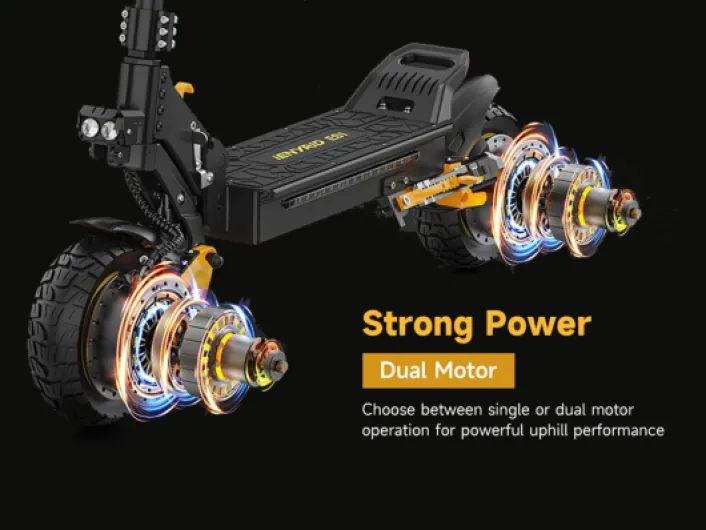
- Strong dual-motor performance with real climbing ability on steep hills
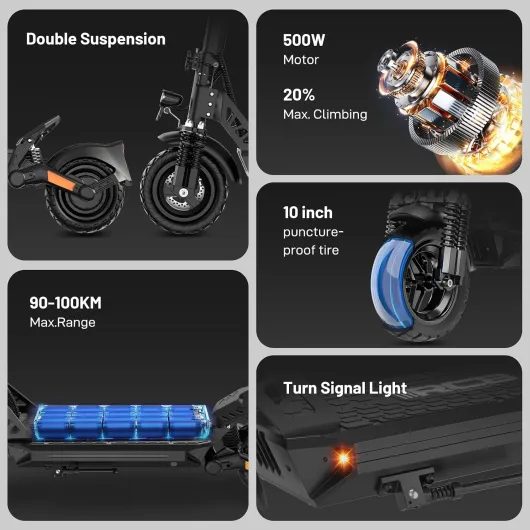
- Comfortable ride thanks to dual suspension and 10" pneumatic off-road tyres
- Good real-world range (around 40–60 km depending on riding style)
- Complete lighting setup with front, rear, side lights and turn signals
Cons
- Heavy and bulky to carry; not ideal if you need to haul it upstairs or on public transport
- Lesser-known brand with potentially less straightforward long-term parts and service
- Charging is fairly slow with the included charger and there’s no fancy fast-charge option

Specifications
View full product page →| Brand | PLAYBIK |
A serious adult scooter, not a toy
I’ve been riding electric scooters for commuting and weekend trips for a few years now – mostly Xiaomi and Ninebot stuff – so I kind of know what you usually get in the mid-range. I picked up this JOYOR / PLAYBIK T10 because I wanted something that could actually handle steep hills and rough cycle paths without crawling at 10 km/h or shaking my teeth out. On paper it looked a bit overkill, but the price was lower than a lot of big-name dual-motor models, so I gave it a shot.
First impression: this is not a small city toy. It’s a big, heavy scooter aimed at adults who don’t mind some weight in exchange for power and range. Out of the box it was about 90% assembled like they say – I basically had to mount the handlebar, check the screws, and pump the tyres to my preferred pressure. Took me around 30–40 minutes taking my time and double-checking everything.
In the first week I used it for daily commuting (about 10–12 km per day) plus a couple of longer rides over 20 km each, mixing city streets, bad tarmac, and some gravel paths. That gave me a decent idea of how it behaves in real life, not just in the product description. My main focus was: does it really climb, is the range honest, and is the ride comfortable enough for 30+ minutes at a time.
Overall, it feels like a scooter built for people who actually ride a lot, not just for short trips to the corner shop. It’s not perfect – the weight and size are a pain if you live upstairs or use public transport – but if you mostly ride on roads and paths and you want power and range without going into crazy premium prices, it’s pretty solid. I’ll break down the details below, because the specs only tell half the story.
Value for money: strong specs for the price, with some trade-offs
In terms of value, this scooter sits in an interesting spot. For what you pay, you get dual motors, a 60V 18Ah battery, dual suspension, hydraulic/disc brakes, and proper lighting. If you compare that to big-name brands offering similar power and range, you’re usually looking at a noticeably higher price tag. That’s the main reason I went for it instead of something more mainstream: on paper, you get a lot of scooter for the money.
Of course, there are trade-offs. You’re dealing with a lesser-known brand (JOYOR / PLAYBIK) and Chinese manufacturing, which means after-sales might not be as smooth as with a premium European brand. The product page mentions lifetime technical support and a 6–12 month warranty, plus parts availability. That sounds good, but you’re still depending on email support and shipping times if something big breaks. If you’re the type who hates any potential hassle, that’s something to consider.
From a pure user point of view, if you actually need the power and range – steep hills, longer trips, rougher paths – then the price makes sense. You’re paying less than for many competing dual-motor models while getting similar or slightly better hardware on paper. If you only ride short flat city trips, then honestly this is overkill and not great value, because you’re dragging around a big heavy scooter when a simpler, lighter model would do the job and be easier to carry and store.
So I’d say the value is good to very good for the right user: someone who rides a lot, has hills or bad roads, and doesn’t mind a bit of DIY mentality if something needs adjusting or fixing. If that’s you, the price-to-performance ratio is hard to beat. If you just want a plug-and-play, light commuter with strong brand support, this is probably not your best option, even if the specs look tempting.
Design: big, aggressive, and not very discreet
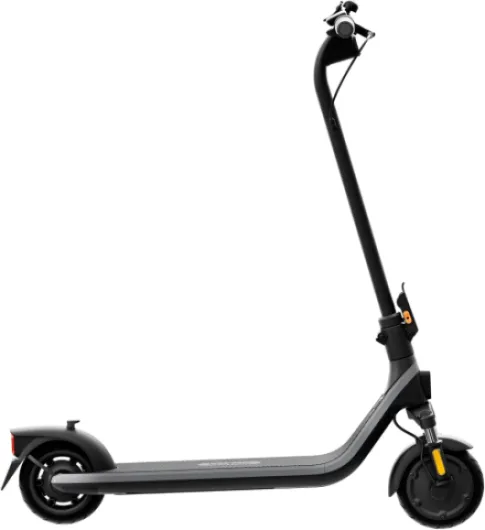
Design-wise, this thing looks like it means business. It’s mostly black, with a wide deck and chunky 10-inch off-road tyres. If you’re used to slim city scooters, this will look and feel much more bulky. Personally, I liked that it feels solid under your feet, but don’t expect a sleek, minimalist look. It’s more “small off-road machine” than “urban gadget”. The folding mechanism is beefier than on entry-level scooters, and that’s good for stability but it also adds weight and bulk to the front.
The deck is wide enough to stand comfortably with one foot forward and one sideways, which is how I usually ride for longer distances. There’s a grippy surface on the deck that actually does its job, even when your shoes are a bit wet. The handlebars are also wider than what you get on cheap scooters, which gives you better control at higher speed and on rough ground. The downside is that it makes it less convenient in narrow hallways or crowded lifts.
The lighting setup is one of the better points. You get bright front headlights with several modes, rear brake light, turn signals, and side marker lights. In the dark you’re definitely visible, which I appreciate because a lot of scooters cheap out on side visibility. The turn signals are usable but, like on most scooters, cars don’t always notice them, so I still use hand signals when I can. Still, for the price range, the lighting package is pretty solid and more complete than what many bigger brands offer.
Folded, it’s technically “portable”, but don’t imagine tossing it over your shoulder. You can carry it up a few stairs if you have to, but it’s awkward and heavy. For me, it’s more of a “roll it into a garage or hallway and park it” scooter, not something I’d fold ten times a day. If you have a lift and some storage space, you’re fine. If you live on the fourth floor without a lift, I’d think twice. So design is good for riding, less good for carrying.
Battery & range: honest numbers if you ride reasonably
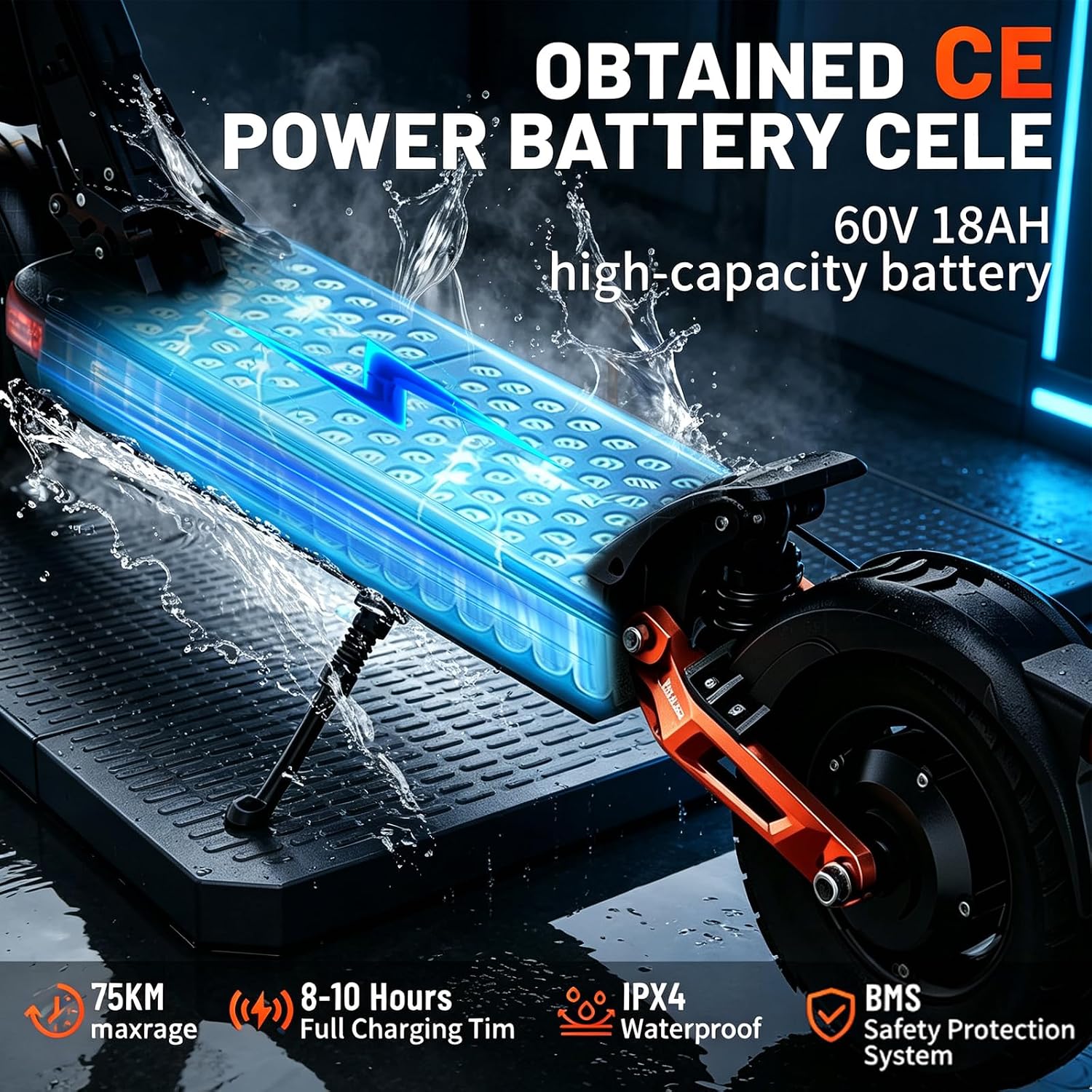
The scooter comes with a 60V 18Ah battery, which is decent capacity for this category. The brand claims up to 75 km of range, which, as usual, is in ideal conditions: light rider, flat ground, eco mode, low speed. In real life, my results were lower but still quite good. I’m about 80 kg with a backpack, mixed terrain, and I don’t baby the throttle.
On one test ride where I mostly stayed in gear 2, kept speeds around 20–25 km/h, and had a mix of flat and mild hills, I got a bit over 50 km before the battery started dropping into the last bars and performance softened. On another week where I used it for commuting plus some short errands, I was charging roughly every 3–4 days for about 40–45 km total. That lines up with the Amazon review where someone said they did nearly 60 km and still had battery left riding fairly calmly.
If you constantly ride in the highest gear, full dual-motor, and hammer the throttle on steep hills, of course the range drops. In that kind of “fun mode”, I’d expect more like 30–40 km before you start seeing a clear power drop. Still, for a scooter with this level of power, that’s decent. The main thing is that you can actually do longer trips – like 15 km out, 15 km back – without worrying too much about getting stuck with a dead battery.
Charging time with the included charger is not super fast. You’re looking at several hours for a full charge from low, so this is more of an overnight or office-hours charge device. No fancy fast-charging here. The battery indicator on the display is okay but, like most scooters, it fluctuates a bit depending on how hard you’re accelerating or climbing. I got used to reading it more by how it behaves over time rather than obsessing over each bar. Overall, the battery side is solid – not mind-blowing, but it fits the power and weight of the scooter and lets you actually use that power without constantly hunting for a plug.
Comfort: finally a scooter that doesn’t beat you up
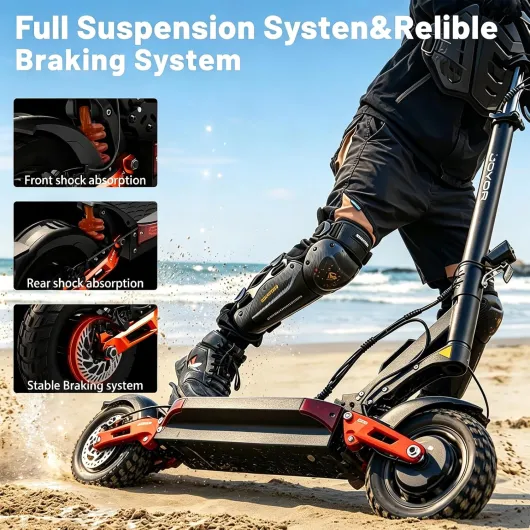
Comfort is where this scooter clearly beats the usual commuter models. The combination of dual suspension and 10-inch pneumatic off-road tyres makes a big difference once you leave perfect tarmac. On my usual route I have broken pavement, speed bumps, and a short gravel section. With my old Xiaomi, I had to slow to a crawl or my wrists and knees would complain. With this T10, I can keep a steady 20–25 km/h and it just soaks most of it up.
The suspension isn’t luxury-car smooth, but for a scooter in this price range it’s honestly pretty comfortable. Small bumps and cracks are handled well, and even rougher patches are manageable as long as you bend your knees a bit. The off-road tyres have enough volume to help with cushioning, but keep in mind you still need to set tyre pressure correctly. Too hard and you lose comfort and grip, too soft and you risk pinch flats and sluggish handling. I ended up slightly below the max recommended pressure and that felt like a good compromise.
The riding position is decent. The deck is wide and long enough, and the adjustable handlebar height is useful if you’re taller or shorter than average. I’m about 1.80 m and ended up slightly above the middle setting. After 30–40 minutes of continuous riding, I didn’t feel cramped or twisted. The only minor complaint is that, like many scooters, the stem can transmit some vibrations to your hands over time, but it’s far from the worst I’ve tried.
Noise and general feel are also okay. The motors make a typical electric whine when you accelerate hard, but nothing crazy. No weird rattles so far after a few weeks, as long as you check and tighten bolts once after the first rides. For daily use, I’d rate comfort as one of the strong points of this model. It’s not a magic carpet, but for bad roads and mixed terrain, it’s a clear step up from basic city scooters.
Build quality & durability: feels solid, but time will tell
From a build perspective, the T10 feels more robust than the typical budget commuter scooter, which it should, given the power and weight. The frame is thick, welds look decent, and there’s no obvious flex in the deck or stem when you ride. I deliberately took it over a series of speed bumps at moderate speed to see if anything would creak or feel loose. So far, no weird noises beyond the normal suspension movement.
The folding mechanism locks in firmly, and I didn’t notice any play in the stem after a few weeks. That said, with any powerful scooter, you really should check bolts and the folding latch regularly, especially in the first month. The user manual mentions this, and it’s not just legal talk. A quick 5-minute check every week can save you bigger problems later. I did a full bolt check after the first three rides and found one that needed a small tightening, nothing major.
The tyres are off-road style and labelled as anti-puncture, but at the end of the day they’re still pneumatic. That means you should expect occasional punctures if you ride through glass or sharp debris. I didn’t get any in my testing period, but I also try to avoid obvious hazards. The good part is that the 10-inch size is pretty standard, so replacements are easy to find. Suspension components also look fairly standard, not some weird proprietary design, which is good if you need parts later.
As for long-term durability, I obviously can’t speak for years of usage yet. But the overall impression is that it’s built to handle adult weight and rougher riding, not just smooth city paths. The brand claims 6–12 months warranty and lifetime technical guidance, which is nice on paper. Being a Chinese-made scooter from a smaller brand, parts and after-sales will never be as straightforward as, say, a big European or US brand, but that’s the trade-off for the lower price. If you’re willing to do basic maintenance yourself and occasionally source parts online, it’s a reasonable bet. If you want full local dealer support and zero hassle, you might want to look at more established (and more expensive) brands.
Performance: climbs like a beast, but speed is capped
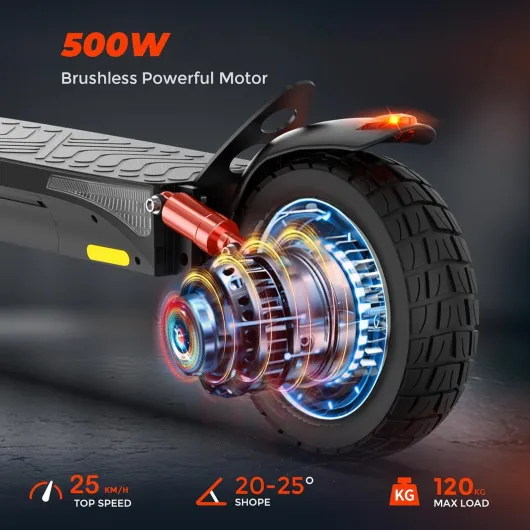
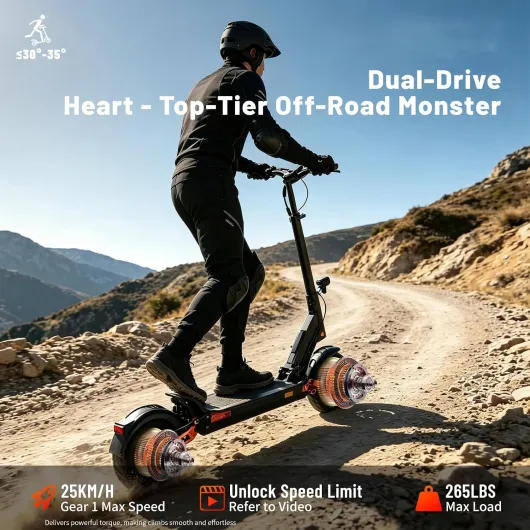
The big selling point here is the dual 2000W motor setup (combined) and the 60V system. In practical terms, acceleration is strong for a scooter in this price bracket. From a standstill up to 25 km/h, it pulls hard, especially in the higher gear and with both motors enabled. You definitely need to lean forward a bit if you floor it, otherwise you feel the front getting light. It’s not motorcycle-level crazy, but compared to single-motor 350–500W scooters, it’s in a different league.
On hills, it actually lives up to the claims better than I expected. I tested it on a few local steep streets where my old scooter would almost die or slow to walking speed. With the T10, it held around 20–25 km/h on climbs that I’d estimate around 15–20%. With a heavier rider or a really long climb, you’ll probably see some drop, but it doesn’t feel like it’s suffering. That matches what some reviewers said about using it in hilly areas. For people living in places with real inclines, this is a big plus.
Now, about speed: it’s advertised as 25 km/h, which lines up with local regulations in many countries. Out of the box, mine was capped at around that speed. Depending on your region, there might be ways in the settings to unlock more, but I’m not going to give a tutorial on that. Just know that, stock, it’s fast enough for city use and off-road fun, but it’s not a 60+ km/h monster unless you start tinkering, and that comes with safety and legal issues.
Braking is handled by front and rear hydraulic/disc brakes plus electronic regenerative braking. The stopping power is more than enough for the 25 km/h range. You can do controlled emergency stops without locking the wheels too easily, once you get used to the feel. I’d recommend practicing a few hard stops in a safe area because the first time you really squeeze the levers, you realize this is not like the weak brakes on cheap scooters. Overall, performance is clearly the main reason to buy this model: strong acceleration, real climbing ability, and stable behavior at speed.
What you actually get with this JOYOR / PLAYBIK T10
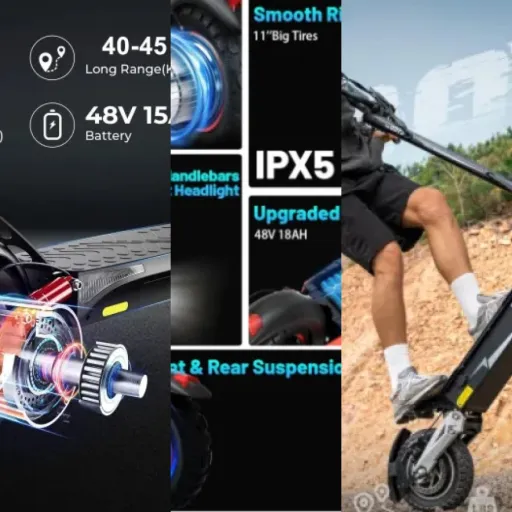
On paper, the T10 is a dual-motor, 60V 18Ah scooter with up to 75 km advertised range, 10-inch off-road pneumatic tyres, dual suspension and dual disc brakes, plus a bunch of lights. In practice, the main thing to understand is: this is a 2000W-class scooter with a decent-sized battery. It’s built for adults up to 120 kg, and it clearly leans more toward performance and off-road than to compact city usage.
In the box you get the scooter, a basic charger, a small tool kit, and a user manual. Nothing fancy, but it’s enough to get you going. The charger is the usual brick – not especially fast, not horrible either. The manual is actually readable, which is rare, and covers the main settings and basic maintenance. I still ended up checking a couple of things online, but you can manage with what they give you.
The control layout is pretty standard if you’ve used higher-powered scooters: you’ve got a central LCD/LED display for speed, battery, mode, etc., thumb or trigger throttle (depends on the batch, mine was thumb), brake levers for the front and rear, and buttons to switch modes and lights. There are multiple riding modes/gears – I mostly used gear 2 for daily riding, and gear 3 only when I wanted to climb fast or mess around a bit.
Compared with the usual Xiaomi/Ninebot stuff, this feels like moving from a city bicycle to a small motorbike. More weight, more power, more to think about. If you just want something light to fold and carry onto a train, this is the wrong style of scooter. But if you want something that can handle hills, crappy roads, and longer distances, the way this thing is configured makes sense. It’s basically a budget-friendly entry into the “proper” powerful scooter category.
Pros
- Strong dual-motor performance with real climbing ability on steep hills
- Comfortable ride thanks to dual suspension and 10" pneumatic off-road tyres
- Good real-world range (around 40–60 km depending on riding style)
- Complete lighting setup with front, rear, side lights and turn signals
Cons
- Heavy and bulky to carry; not ideal if you need to haul it upstairs or on public transport
- Lesser-known brand with potentially less straightforward long-term parts and service
- Charging is fairly slow with the included charger and there’s no fancy fast-charge option
Conclusion
Editor's rating
Overall, the JOYOR / PLAYBIK T10 feels like a proper adult scooter for people who care more about power and range than about brand prestige or minimal weight. The dual motors, 60V battery, and off-road tyres actually deliver in real life: it climbs steep hills without drama, handles broken pavement and gravel far better than basic city scooters, and gives you enough range to do real trips without babysitting the battery. Comfort is decent thanks to the dual suspension and wide deck, and the lighting setup is genuinely useful for riding in the dark.
It’s not perfect. It’s heavy and bulky, so if you need to carry it up stairs or in and out of public transport every day, it will get annoying fast. Being from a smaller Chinese brand, long-term parts and service are a bit of a question mark, and you should be ready to do basic maintenance and occasional bolt checks yourself. The top speed is capped to match regulations, so if you’re dreaming of crazy high-speed runs out of the box, this is not that kind of machine unless you start tweaking, which comes with its own issues.
I’d recommend this scooter to riders who: live in hilly areas, regularly do 15–30 km trips, have rough or mixed surfaces on their routes, and have a place to store a bigger, heavier scooter. For that profile, it’s good value and gets the job done with some margin. If you’re a casual city rider, mostly flat terrain, and you need something light and super easy to handle and service, I’d look at simpler, lighter models instead, even if the specs look less exciting on paper.