
Summary
Editor's rating
Is it worth the price compared to cheaper training wheels?
Design focused more on stability than looks
Heavy metal parts and real tires, not toy plastic
Built to survive real kid abuse
How it actually rides with a kid on it
What you actually get in the box
Pros
- Very sturdy construction with steel bar, solid axle, and 8-inch pneumatic 4-ply tires
- Adjustable bar angle lets you tune how much the training wheels touch the ground
- Mounts to solid points under the scooter, reducing risk of frame damage and improving stability
Cons
- Heavier than cheaper training wheel kits, making the scooter bulkier to move
- Smaller clamp bolts feel like the weak link and can be over-tightened if you’re not careful

Specifications
View full product page →| Brand | Hardline Products |
Serious training wheels for kids who really send it
I put these Hardline USA Wheels for Tots on a kid’s Razor-style scooter because my 5‑year‑old went from balance bike to "I want a real scooter" in about 10 seconds. I wasn’t looking for cute plastic training wheels; I wanted something that could handle real falls, curbs, and a kid who doesn’t know when to slow down. These looked more like mini motorcycle parts than toy accessories, so I gave them a shot.
Out of the box, the first thing I noticed is the weight. The whole kit is around 12 pounds, and you feel it. This isn’t flimsy stamped metal. There’s a proper steel axle, thick brackets, and 8‑inch pneumatic tires that look closer to small pit bike wheels than the usual toy stuff. My first thought was: "Okay, at least if my kid tips over, these aren’t going to fold in half."
I installed them under the floorboard, using the center stand mount area like the instructions suggest. The setup is clearly built with Razor Pocket Mod scooters in mind, but I also tried mocking it up on a small e‑dirt bike just to see, and with a bit of fiddling it would work too. So it’s not just locked to one model, but you do need to be comfortable with tools. If you hate wrenches, this isn’t plug‑and‑play.
After a couple weekends of use, I’d say these training wheels are more like a mini stabilizer kit than toy wheels. They’re not perfect, and there are a few small hardware choices I’d change, but in terms of function and safety for learning, they get the job done well. If your kid rides timidly on flat pavement, it might be overkill. If they ride like a maniac, it starts to make sense.
Is it worth the price compared to cheaper training wheels?
Price-wise, this kit sits above the usual toy‑grade training wheels but below some of the fancier, brand‑specific systems. You’re paying for heavy materials, real tires, and hardware that doesn’t feel like it came from a bargain bin. If you just want something for a kid to putter slowly on smooth pavement for a month, you can probably get away with a cheaper setup. But if you’re pairing it with a Razor Pocket Mod or a small e‑dirt bike that has some speed and weight, this price starts to make more sense.
Compared to the OEM‑style training wheels I looked at that bolt into the frame, I actually prefer this peg/center‑mount style. If something does bend or take a hit, I’d rather it be a replaceable bracket or peg area than a frame bolt that’s a pain to fix. That design choice adds value in my eyes because it reduces the chance of expensive damage to the scooter itself. Also, the adjustability of the bar angle gives you more life out of the kit: you can start very stable, then gradually raise the training wheels as the kid gets better.
The downside is the weight and the fact you really should be at least somewhat handy to install it properly. If you’d have to pay a shop to mount it, the overall cost climbs, and at that point it might feel a bit steep. But if you’re comfortable with basic tools and you plan to use it for more than a few weeks, it’s a decent trade-off between cost and durability.
Overall, I’d call the value pretty solid for parents with active kids and heavier scooters, and just "okay" if your use case is light, short-term, and 100% on smooth sidewalks. You’re paying for overbuilt parts and the peace of mind that it won’t fold the first time your kid hits a bump sideways. For me, that’s worth it, but it’s not the cheapest route if you only need training wheels for a very short learning phase.
Design focused more on stability than looks
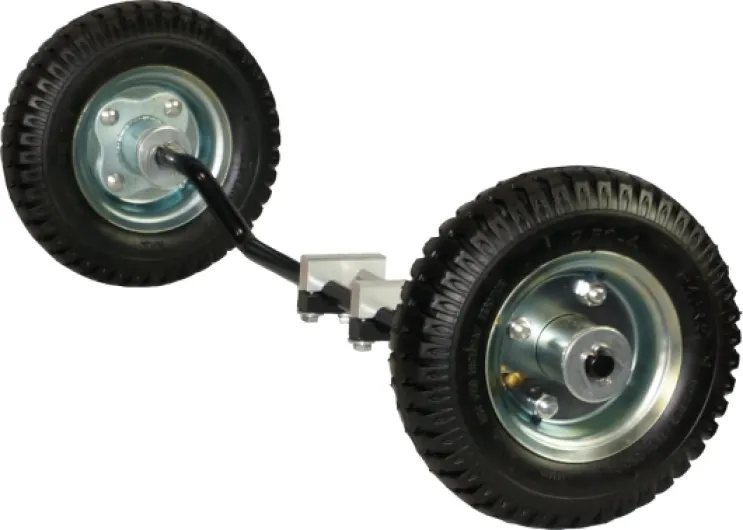
The design is pretty simple: a thick crossbar runs across the scooter under the floorboard, and the two training wheels sit wide on each side, connected by a solid steel axle. The idea is to keep the scooter’s rear tire on the ground while the side wheels catch the lean. It’s not some complicated suspension system; it’s just a rigid setup that prioritizes stability. The shape of the bar is smart though: you can rotate it a bit to control how much the training wheels touch the ground.
In practice, that adjustability is useful. At first, I set the wheels almost flat so they were touching the ground all the time. That made the scooter feel like a trike: super stable, but a bit weird in turns because the rear tire didn’t always get full contact on bumpy ground. After watching my kid ride, I rotated the bar slightly so the main tire carried more weight and the side wheels only caught when leaning. That made it feel closer to a real scooter while still giving him a safety net.
Visually, it’s basic: black parts, chunky brackets, and plain wheels. No one is buying this for style. On the plus side, it doesn’t look like a toy add‑on; it looks like part of the scooter. On the downside, if you’re trying to keep the scooter cute (especially the Sweet Pea / Euro style ones), this does make it look more industrial. My kid didn’t care, but some parents might.
The only design choice I’m not fully sold on is the smaller fasteners used to clamp the bar and stop it rotating. They work, but they feel like the weak link in an otherwise overbuilt kit. I didn’t snap mine, but I was careful after reading about people shearing one when really cranking it down. If they had matched those to the same heavy duty level as the axle hardware, it would feel completely dialed.
Heavy metal parts and real tires, not toy plastic
Material-wise, this is where the kit justifies its price. The bar and brackets are solid steel, not thin stamped junk. The axle is thick and straight, and once it’s torqued down there’s no noticeable flex when the kid leans hard on one side. You can literally pick up the rear of the scooter by the training wheels and it doesn’t feel like anything is bending or creaking. That gives some confidence when you’re watching a kid slam around on it.
The wheels themselves are 8‑inch pneumatic tires with 4‑ply construction. That’s overkill compared to the usual hard plastic training wheels you see on bikes, but it makes sense here. The scooter has some weight, the kid has some weight, and they’re often riding on patchy pavement or gravel. The tires soak up small bumps and don’t chip or flat spot like plastic ones. I ran them over cracks, driveway lips, and a bit of dirt, and they held up fine with no weird wear in the first weeks.
The included hardware is mostly Grade 8 bolts and decent washers, so you’re not dealing with soft bolts that round off instantly. The only complaint I have is the same as before: the smaller clamp bolts feel a bit softer than the rest. You can feel it when you tighten them; they don’t inspire the same confidence. They still did their job, but I’d personally keep an eye on them or swap them out later if you plan to keep the kit long term.
Overall, the materials are more in line with small motorcycle parts than scooter toys. That’s both good and bad. Good because it should last through multiple kids or a couple seasons of rough use. Slight downside because the whole setup is heavy, which means moving the scooter around or loading it into a car is more of a workout. For me, the trade‑off is worth it: I’d rather deal with extra weight than watch thin brackets twist the first time the scooter tips over.
Built to survive real kid abuse
Durability was the main reason I went for this kit instead of the lighter, cheaper options. After a few weekends of use, including some intentional rough riding to see what it can take, there are no signs of structural problems. The steel bar isn’t bending, the brackets haven’t warped, and the axle is still straight. My kid has dumped the scooter sideways a couple of times at low speed, and it just scrapes the wheel and keeps going.
The pneumatic tires hold air well. I filled them once at the start and haven’t had to top them off yet. The rubber doesn’t look chewed up despite rolling over gravel and random backyard obstacles. Compared to the hard plastic training wheels we had on a previous bike, these are way less noisy and don’t show that ugly flat spot you get after a few skids. They feel like they’ll last at least through one or two full seasons and probably another kid after that.
The only area I’m slightly cautious about long term is the smaller clamp bolts that lock the bar angle. They’re fine so far, but based on other users snapping one when over‑tightening, I’d say don’t go gorilla‑tight on them. If you’re the type who really cranks bolts down, you might want to swap those for higher grade ones later. It’s not a dealbreaker, just the only part of the kit that doesn’t feel overbuilt.
Overall, from a durability standpoint, this feels like something you buy once and then move from scooter to scooter or bike to bike if you stay within similar frame styles. The finish is basic black, which hides scratches well. Even if it gets beat up, it’ll be cosmetic, not structural. For parents who know their kid is going to crash a lot while learning, this kit feels like a safer bet than the thin bolt-on training wheels that twist the first time they catch a curb.
How it actually rides with a kid on it
Once installed, the performance is pretty straightforward: it keeps the scooter upright at low speeds and catches the kid when they lean too far. On flat pavement, my 5‑year‑old was able to hop on and ride right away without that wobbly beginner phase you usually get. The wide stance of the wheels gives a stable base, and there’s no feeling that it’s going to tip if they shift their weight suddenly. For building confidence, it works well.
Where it gets more interesting is on uneven ground. On our slightly bumpy driveway, the rigid setup means one side wheel can lift for a moment while the other one grabs, but the main rear tire still stays mostly planted if you’ve adjusted the bar angle right. When I had the bar too low, the rear tire was a bit too light and would lose some traction on rough spots, which made starts a bit jerky. After rotating the bar to take some load off the side wheels, the scooter felt more natural, and the kid didn’t notice the bumps as much.
In turns, the behavior depends a lot on how aggressively you set the angle. If the training wheels are almost level with the main tire, the scooter corners kind of like a three-wheeler: both side wheels tend to grab, and it feels stiff. With a bit more tilt, the kid can lean slightly, and the outside wheel only kicks in when they overdo it. That’s the sweet spot in my opinion, because it teaches them to lean a bit instead of just steering flat like a trike.
I didn’t notice any wobbling or bending even after a few low-speed tip‑overs and curb hits. The wheels kept their shape, and the brackets stayed tight. I did recheck the bolts after the first ride and again after a week, and a couple needed a small snug-up, which is normal for a new install. Once re‑torqued, everything stayed put. So in terms of performance, it’s solid: it stabilizes the scooter, handles rougher terrain better than plastic wheels, and gives you enough adjustment to tune how “safe” or “sporty” you want it to feel.
What you actually get in the box
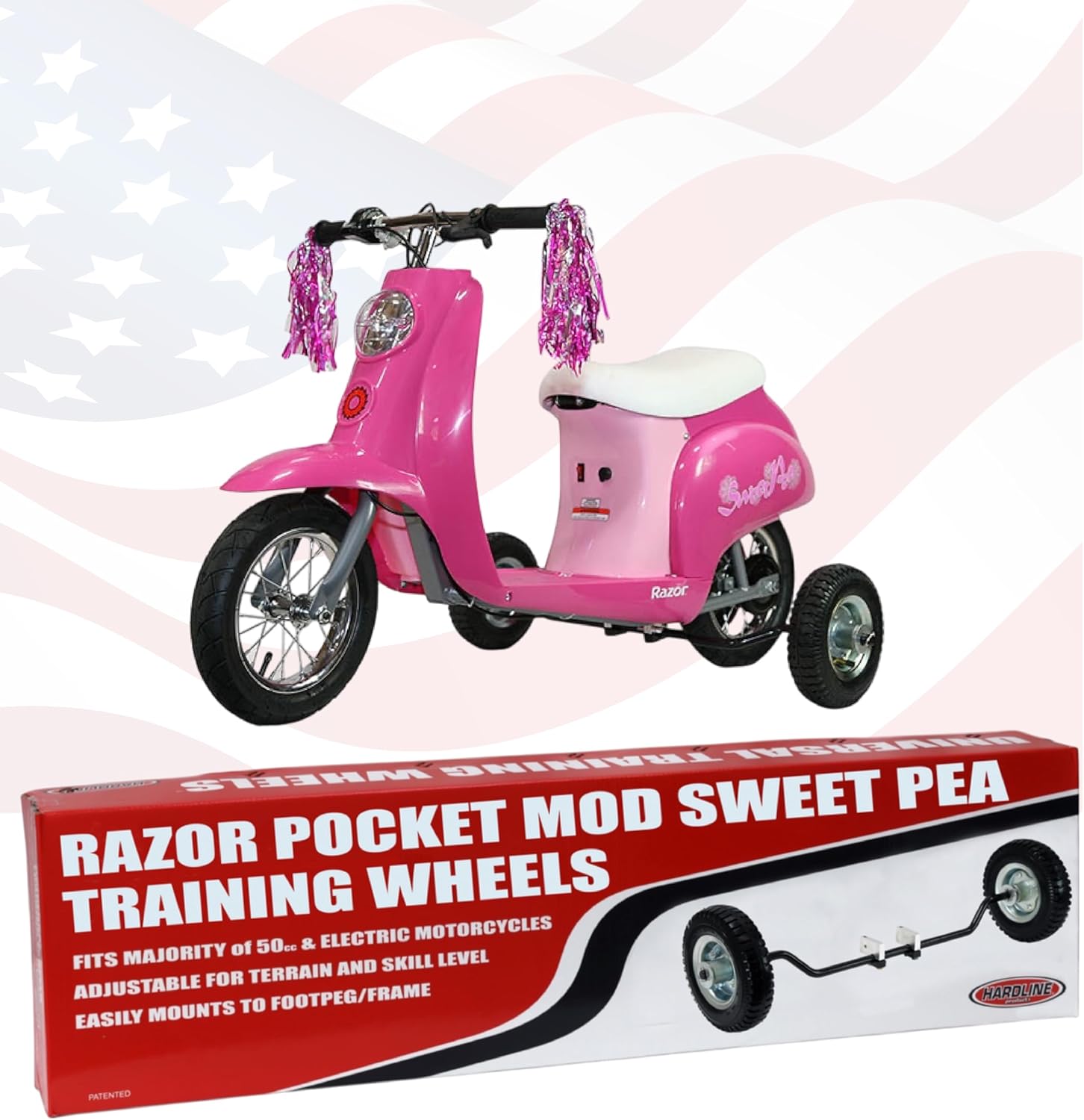
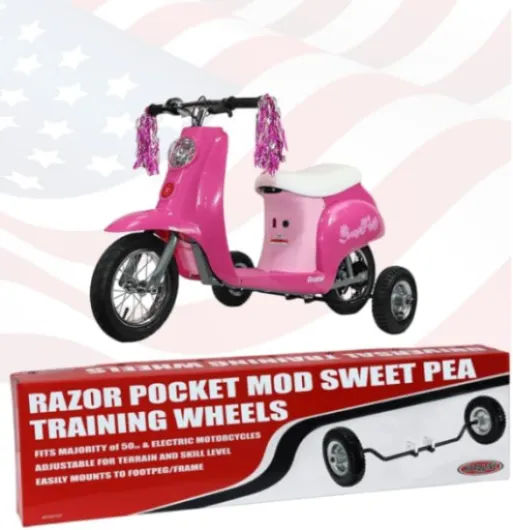
In the box you get a complete kit: two 8‑inch pneumatic wheels already mounted on rims, a solid steel axle, the long crossbar, the brackets that tie into the scooter’s center stand mount area, clamps, and a pile of bolts and washers. It’s not one of those half-baked kits where you have to run to the hardware store for missing nuts. Everything you need is there, at least for the Razor Pocket Mod style frames.
The instructions are basic but usable. They’re not super polished, but if you’ve ever installed pegs or a rack on a bike, you’ll figure it out. The layout is logical: bar mounts under the floorboard, axle goes through the bar ends, wheels slide on, then you lock everything down with the included Grade 8 hardware. The only thing that feels a bit light compared to the rest are the smaller clamp bolts that hold the bar’s rotation angle in place. They’re not junk, but they don’t match the beefiness of the rest of the kit.
One detail I liked is that the kit is clearly designed around the Razor Pocket Mod family: Euro, Sweet Pea, Betty, etc. That means the mounting points line up with real spots on the frame instead of some sketchy universal strap approach. You’re not clamping to plastic bodywork or bending sheet metal; you’re going into a solid area that can actually handle side loads when your kid leans hard on one wheel.
Overall, the presentation is straightforward: this feels like a small motorcycle accessory more than a toy. No fancy branding, no overdone packaging, just a heavy kit in a box. If you’re the kind of person who judges quality by how many metal parts you’re pulling out of the packaging, you’ll probably be happy. If you’re expecting a cute, lightweight toy add‑on, this will feel a bit overbuilt and intimidating at first glance.
Pros
- Very sturdy construction with steel bar, solid axle, and 8-inch pneumatic 4-ply tires
- Adjustable bar angle lets you tune how much the training wheels touch the ground
- Mounts to solid points under the scooter, reducing risk of frame damage and improving stability
Cons
- Heavier than cheaper training wheel kits, making the scooter bulkier to move
- Smaller clamp bolts feel like the weak link and can be over-tightened if you’re not careful
Conclusion
Editor's rating
After using the Hardline USA Wheels for Tots kit on a Razor‑style scooter for a few weeks, my takeaway is pretty simple: it’s a heavy, no‑nonsense set of training wheels that actually feels built for real-world crashes, not just slow parking lot rides. The steel bar, solid axle, and 8‑inch pneumatic tires give the scooter a stable base and handle rougher ground better than the typical plastic training wheels. The adjustability of the bar angle is genuinely useful, letting you choose between very stable "trike" behavior or a more natural feel where the training wheels only catch when the kid leans too far.
It’s not perfect. The smaller clamp bolts are the weak spot in an otherwise tough kit, and the whole setup adds noticeable weight to the scooter. Installation is also not for someone who’s scared of tools; you need basic mechanical sense to mount it properly and adjust it. But once it’s dialed in, it does exactly what you want: keeps the kid upright, survives tip‑overs, and doesn’t twist or bend at the first sign of abuse.
If you’ve got a Razor Pocket Mod, Stacyc 12E, small PW50‑type bike, or similar, and your kid rides with enthusiasm (or zero fear), this kit makes sense. You’ll get durability and real stability, and you can reuse it on the next machine. If your kid is timid, only rides on smooth sidewalks, or you just need something cheap for a short learning phase, you can probably save money with a lighter, simpler option. This one is for parents who expect the scooter to actually get used and dropped, not just posed for photos.