
Summary
Editor's rating
Value for money: good commuter if you accept the compromises
Design: simple, compact, and a bit basic in places
Battery and range: honest if you’re realistic, not if you chase the max numbers
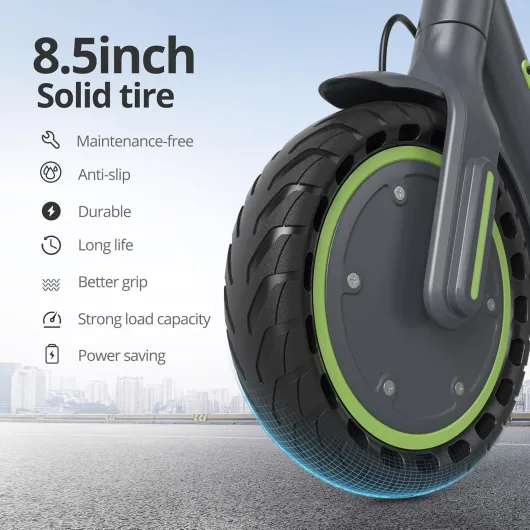
Comfort: solid tires = no flats, more vibrations
Durability and build: feels solid, with a few budget quirks
Performance: good for city cruising, not a hill killer
Specs on paper vs how it feels in real life
Pros
- Good speed and usable range for short city commutes (around 9–11 real miles at full speed)
- Solid tires mean no flats or pressure checks, low maintenance
- Light enough to carry short distances and folds quickly for storage or transport
Cons
- Ride is quite firm on rough pavement due to solid tires and basic suspension
- Struggles on steeper hills, especially with heavier riders
- Fixed handlebar height and slightly rough app/cable finish compared to bigger brands

Specifications
View full product page →| Brand | Roinside |
A budget commuter scooter that actually gets used
I’ve been using this Roinside UP6 (350W, 8.5'' solid tires, green version) as a daily run-around for a couple of weeks: grocery runs, short work commutes, and quick trips around the neighborhood. I’m not a scooter nerd, I just wanted something faster than walking and less hassle than a bike. In that context, this thing does its job pretty well. It’s not perfect, but I’m actually grabbing it a lot, which says more than any spec sheet.
Out of the box, setup was pretty basic: unfold, drop the handlebar in, deal with the cable, tighten screws, charge, done. No crazy tools, no complicated tuning. The app is a bit clunky but usable; I mostly used it to unlock the higher speed and play with the start mode. After that, I barely opened it again. So if you hate messing with apps, you’ll survive.
In real life, the scooter is more about practicality than thrills. It’s light enough to haul up a flight of stairs, folds in a few seconds, and fits easily behind a door or in a car trunk. The 350W motor isn’t going to rip your arms off, but for flat city riding it’s fine. Hills are where it starts to feel underpowered, especially if you’re heavier or carrying a bag.
Overall, my first impression is: good value for someone who wants a simple commuter, not a toy for speed junkies. The solid tires are both the best and worst part – no punctures, but you definitely feel the road. If you’re expecting Segway-level polish, you’ll see the difference, but for the price, it’s a pretty solid compromise.
Value for money: good commuter if you accept the compromises
Considering the price range this Roinside sits in, I’d say the value is pretty solid. You’re getting a 350W motor, solid tires (no flats), a functional app, dual braking, and a folding frame that’s light enough to carry up stairs. Compared to big brands like Segway or Razor with similar specs, this usually comes in cheaper, and you’re not losing much in terms of raw performance. Where you do feel the price difference is in refinement: the app polish, cable routing, finish, and sometimes after-sales support.
For someone who just wants a simple way to get around campus, commute a few miles, or follow kids on bikes/scooters, it makes sense. You don’t have to think about tire pressure, you don’t need to be super gentle with it, and the learning curve is low. The 12-month parts service is nice on paper, though how good it is will depend a lot on how responsive the seller is in your region.
On the flip side, if you have steep hills, long daily distances, or you care a lot about ride comfort, you might be better off paying more for a scooter with a stronger motor and air-filled tires. Those models cost more, but they ride smoother and handle inclines better. It really depends what your priority is: low maintenance and decent price, or comfort and power.
Overall, I’d call this good value for money for flat-to-mild city use. It’s not the best scooter out there, but for the cost, it delivers a lot: decent speed, usable range, no puncture headaches, and a folding design that fits normal life. If you go in with realistic expectations and don’t chase the advertised max numbers, you’ll probably be satisfied with what you get.

Design: simple, compact, and a bit basic in places
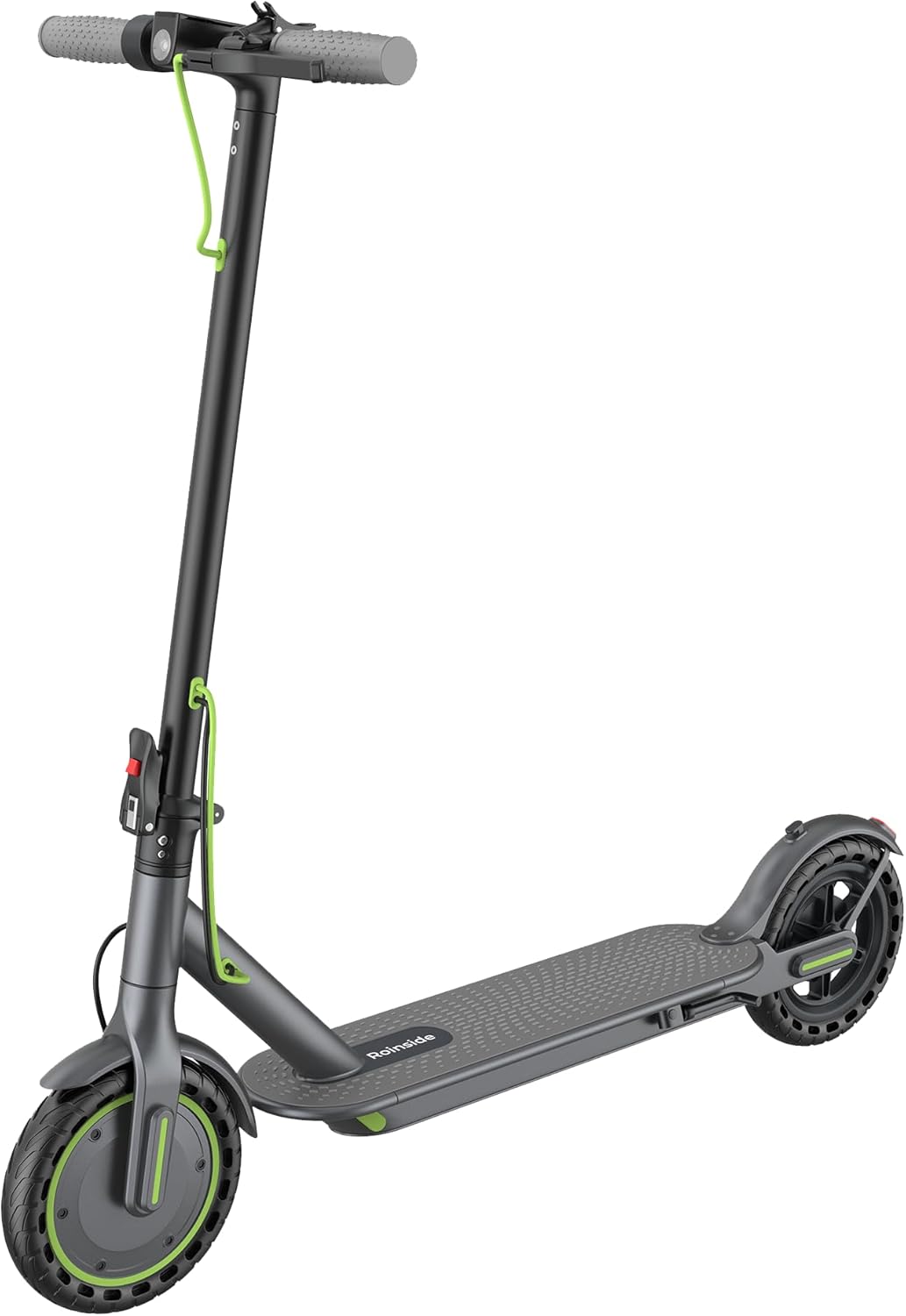
Design-wise, this scooter is pretty straightforward. Matte black base, some green accents, and a fairly standard folding stem. Nothing flashy, but it doesn’t look cheap either. The deck is medium-width, enough space to stand with one foot forward and one slightly angled. If you’ve ridden rental scooters before, this feels familiar, just a touch more compact. The green color on this version is actually nice in person – not neon, more like a clean accent that makes it easy to spot in a bike rack.
The folding mechanism is easy: unlatch, fold the stem down, hook it, done. It takes maybe five seconds once you’ve done it a couple of times. The latch feels decent – not loose, not ultra-robust either, but good enough for daily use as long as you don’t slam it around. Folded, it’s flat enough to slide behind a door, under a desk, or in a car trunk. I’ve carried it single-handed by the stem; at 27 lb, it’s not light like a laptop, but for short distances it’s manageable.
The handlebar layout is basic but clear: throttle on one side, brake lever on the other, central display with power/light button. One downside: handlebar height is fixed. If you’re very tall or very short, you just have to live with it. For an average-height adult it’s fine, but I can see some people finding it slightly low or high. Also, the bar shape doesn’t leave a ton of space for mounting a phone holder; you can do it, but it’s not as clean as on some other scooters.
My only real design gripe is the cabling near the handlebar and stem. The cables are thick and seem durable, but tucking them into the shaft during assembly is a bit fiddly, and it feels like something you could pinch if you’re careless. Once assembled, they’re mostly out of the way, but they still look a bit exposed compared to more premium brands. Overall, the design is practical and no-nonsense, but you can see where they saved money compared to higher-end scooters.
Battery and range: honest if you’re realistic, not if you chase the max numbers
The scooter comes with a 323Wh battery and the brand claims up to 15 miles on this 350W / 8.5'' version. As usual, that number is optimistic and based on light riders, flat ground, and lower speeds. In my use, riding close to full speed most of the time, stopping and starting a lot, and weighing around an average adult, I was getting roughly 9–11 miles before the battery got low enough that the scooter started to feel noticeably slower.
One thing to note: as the battery level drops, the scooter gradually caps your max speed. So the first half of the battery feels snappy and close to the claimed 19 mph. The last quarter feels more sluggish, especially on any incline. It doesn’t just die suddenly, but you notice the performance tapering off. This is annoying, but also pretty standard for scooters in this price range, and it probably helps protect the battery a bit.
Charging takes around 4–4.5 hours from low to full with the included charger. The charger brick gets warm, nothing crazy, but I wouldn’t bury it under a blanket or stick it in a tight drawer while charging. I tend to plug it in when I get home, let it charge while I’m around, and unplug once it’s full. That’s more about basic lithium battery care than anything specific to this scooter.
Realistically, if your daily commute is under 4–5 miles each way, you’re fine with one charge, even if you ride fast. If you’re planning longer trips, you either ride slower in eco mode or accept that you’ll be closer to the limit. For the price and battery size, I’d say the range is decent but not impressive. It’s enough for normal city use or campus life, but not something you’d pick for all-day exploring without access to a plug.
Comfort: solid tires = no flats, more vibrations
Comfort is where the scooter is clearly built around low maintenance rather than plush riding. The 8.5'' solid tires are nice because you don’t have to think about punctures or air pressure, but they also mean you feel pretty much every crack and bump in the road. There is a front suspension, and it helps a bit, but don’t expect it to magically smooth out rough sidewalks. On decent pavement it rides fine; on broken sidewalks or cobblestones it gets jittery.
The deck grip is good. The rubberized surface keeps your feet in place when you brake or accelerate, and you don’t slide around, even if your shoes are a bit wet. Space-wise, it’s okay for one adult. I usually ride with one foot forward and the other at an angle, and that feels stable enough. Riding two people is technically possible but really not advised; the deck just isn’t long enough to be safe or comfortable, and the scooter isn’t designed for that.
Handlebar vibrations are noticeable on rough ground. You don’t get the soft, cushy feeling of air-filled tires. After a longer ride on bad pavement, you do feel it in your hands. The grips themselves are decent – not fancy, but they don’t slip and haven’t degraded so far. If you’re planning to ride mostly on smooth bike lanes or decent roads, it’s fine. If your city has terrible pavement, be ready for a bit of shaking.
Noise-wise, it’s pretty quiet. You mainly hear the electric motor whine and some rolling noise from the solid tires. Nothing annoying, just a normal e-scooter sound. Overall, comfort is acceptable but nothing more. The trade-off is clear: you get the peace of mind of not dealing with flats, at the cost of a harsher ride. If you’re okay with that and you mostly do short trips, it’s a fair deal. If you want a softer, more bike-like ride, you’ll want a model with pneumatic tires instead.
Durability and build: feels solid, with a few budget quirks
Build quality is better than the super-cheap no-name scooters, but you can still tell it’s not a premium model. The frame is aluminum and feels solid underfoot – no scary flex when you hit small bumps or brake hard. The deck casing under the scooter is a solid piece that protects the battery and electronics from random hits and scrapes. I’ve clipped a few curbs and it just left cosmetic marks, nothing structural.
The solid tires are a big plus from a durability standpoint. You don’t worry about glass, thorns, or slow leaks. They also don’t seem to wear insanely fast, as long as you’re not constantly locking the rear wheel or using the rear fender as a brake. The rims feel sturdy, and I haven’t had any issues with rocks or debris getting stuck between the wheel and frame. Long term, the main question is replacement: it’s not as obvious what to buy when they’re worn, compared to standard pneumatic tires. That’s something to keep in mind if you plan to keep it for years.
The folding joint and latch haven’t loosened on me so far, but I’d check the screws and bolts regularly. Same for the stem and handlebar area – there are a few screws that can back out over time on any scooter, especially with solid tires that transmit more vibration. A quick check every couple of weeks is just part of the deal with this kind of product.
As for weather, I wouldn’t treat it as waterproof. Light splashes or a quick ride on slightly wet pavement seem fine, but I’d avoid heavy rain or deep puddles. The brand doesn’t brag about a strong water rating, so I’d assume “splash resistant at best.” Overall, it feels like a scooter that can take daily use and some abuse, as long as you’re not throwing it around or riding it like a stunt toy. The weak points are more about comfort and finish than about things breaking immediately.
Performance: good for city cruising, not a hill killer
In terms of performance, this Roinside feels decent for everyday commuting. The 350W motor gets you up to around 18–19 mph on flat ground with a typical adult rider. Acceleration is not brutal but it’s quick enough that you don’t feel sluggish. It’s stronger than a lot of cheap off-brand scooters I’ve tried, but clearly weaker than some of the beefier 500W+ models or the faster rental scooters in big cities.
Where it starts to show its limits is on hills. On mild inclines, it keeps moving, just slower. On steeper slopes, it can really bog down, especially if you’re close to the 200+ lb range or carrying a backpack. You’ll still get up, but don’t expect to fly. If your daily route has a lot of hills, I’d think twice or accept that you’ll be going slower there. On flat or slightly rolling terrain, it’s totally fine and feels stable at speed once you get used to it.
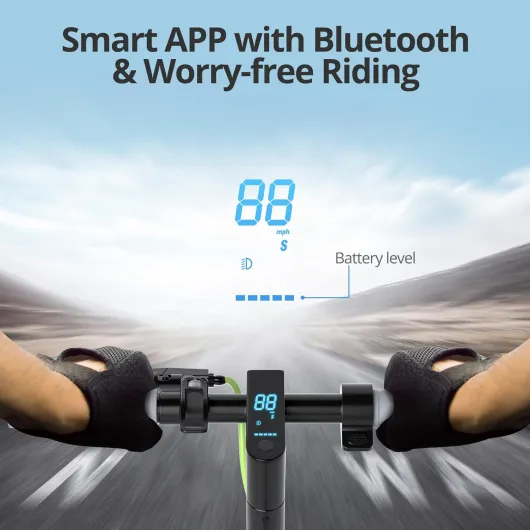
The three speed modes make sense: a slow mode for crowded areas, a medium one for casual riding, and the fastest one for open stretches. Switching modes is straightforward via the display or app. I ended up just using the top mode most of the time and managing my speed with the throttle. The throttle response is fairly smooth; it doesn’t jerk forward when you tap it, which is good if you’re new to scooters.
Braking performance is one of the stronger points. The disc brake plus electronic brake combo gives you good stopping power without having to squeeze like crazy. You still need to be careful not to grab it too hard at full speed, especially on rough ground, or you can get a bit of wobble, but that’s normal. You can also use the rear fender as a traditional scooter brake, but that will just eat the rear tire faster, so I’d stick to the handle brake. Overall, for flat-city commuting and campus riding, the performance is solid, just don’t buy it expecting aggressive hill climbing or racing-level speed.
Specs on paper vs how it feels in real life
On paper, this Roinside scooter looks fairly standard for an entry/mid-range commuter: 350W brushless motor, 8.5'' solid tires, claimed up to 15 miles range on this specific version, and a top speed around 19 mph. Weight is about 27 lb, and it’s rated to carry up to 265 lb. You also get a digital display, an app with lock and speed control, and a dual braking setup (disc + electronic). It checks most of the boxes you see in scooters that cost a bit more from bigger brands.
In practice, you can ignore the ideal marketing numbers. With a normal adult rider, you’re realistically looking at something like 9–12 miles of range if you ride at full speed most of the time, a bit more if you baby it and stay in lower modes. The 19 mph cap is accurate, but you only really hit that on flat ground with enough battery left. As the battery drains, the scooter slowly starts limiting your speed, which is annoying but pretty standard for this type of product.
The app is… fine. You can:
- Switch between speed modes
- Choose glide start vs full electric start
- Lock the scooter (motor lock, not a physical lock)
- See battery percentage and some stats
Overall, the spec sheet matches reality “well enough” for the price. It’s a commuter tool, not a performance machine. If you buy it expecting 15 miles at full speed for a 200 lb rider on hills, you’ll be disappointed. If you assume a more realistic range and treat the top speed as a “best case on flat ground,” it lines up with what you actually get.
Pros
- Good speed and usable range for short city commutes (around 9–11 real miles at full speed)
- Solid tires mean no flats or pressure checks, low maintenance
- Light enough to carry short distances and folds quickly for storage or transport
Cons
- Ride is quite firm on rough pavement due to solid tires and basic suspension
- Struggles on steeper hills, especially with heavier riders
- Fixed handlebar height and slightly rough app/cable finish compared to bigger brands
Conclusion
Editor's rating
After using the Roinside UP6 for everyday trips, my overall take is that it’s a practical, budget-friendly commuter scooter that does most things right and cuts corners in predictable places. The 350W motor is enough for flat-city riding, the top speed around 19 mph feels decent, and the solid tires remove the constant worry about flats. It folds quickly, isn’t insanely heavy, and the range is fine as long as your daily routes are under roughly 10 miles total at full speed.
Where it falls short is comfort and hill performance. The solid 8.5'' tires and basic suspension mean you feel rough pavement, and on steeper hills the motor clearly struggles, especially with heavier riders. The app and cable management feel a bit budget, and the fixed handlebar height won’t suit everyone. But none of this makes it unusable; it just means you need to know what you’re buying.
If you’re a student, city commuter on mostly flat ground, or a parent wanting to keep up with kids on scooters or bikes, this is a good fit and offers strong value for the price. If you want a cushy ride, frequent long-distance trips, or live in a very hilly area, I’d look at something more powerful with pneumatic tires. Overall, I’d give it a solid 4/5: not perfect, but a sensible, no-drama option for everyday use.