
Summary
Editor's rating
Is it worth the price compared to cheaper scooters?
Big, black, and definitely not a toy
Real-world range vs the 43-mile claim
Ride comfort: finally not getting beaten up by bad pavement
Build quality and how it holds up day to day
Speed, acceleration and braking in real life
What you actually get in the box
Pros
- Strong 1000W motor with good hill-climbing and up to ~22 mph top speed
- Dual suspension and 10-inch tubeless self-healing tires give a comfortable, stable ride
- Solid build quality with UL-certified battery, good brakes, and integrated lights/turn signals
Cons
- Very heavy and not convenient to carry frequently
- Real-world range is closer to 20–25 miles, well below the 43-mile marketing number

Specifications
View full product page →| Brand | Segway |
A grown-up scooter that actually feels like a vehicle
I’ve been riding the Segway Ninebot Max G2 for daily commuting and random errands, roughly 8–12 miles a day, a few weeks in a row. Before this I went through a couple of cheap $300 scooters that rattled apart or lost battery after a few months. So I wanted something I could actually rely on, even if it meant spending more. This one clearly sits in the "adult scooter" category, both in weight and in how it rides.
First impression: it’s big and heavy. The box is around 65 lbs and you really do want two people to move it, especially if you live in an apartment with stairs. It feels closer to a small moped than a toy. Once out of the box though, setup is simple: unfold, tighten a few screws, connect a cable in the stem, and you’re basically done. The built-in fast charger is handy, just plug a cable directly into the deck instead of messing with a brick.
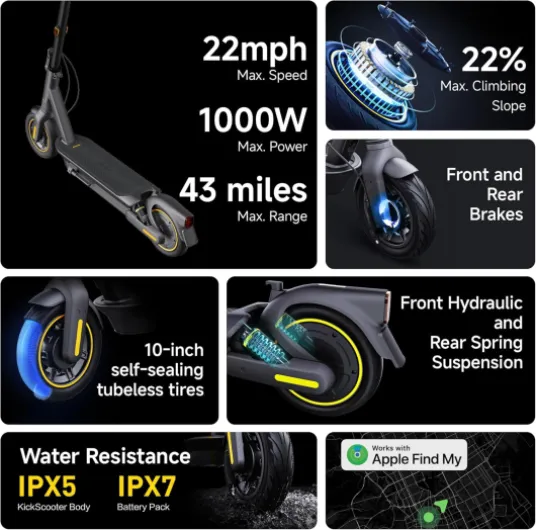
On the road, the combo of the 1000W motor, dual suspension, and 10-inch tubeless self-healing tires makes a big difference compared to budget scooters. It doesn’t jump around on cracks and rough bike paths, and it has enough torque to handle hills without you having to kick. The listed top speed is about 22 mph, and in practice it gets close to that with an average-sized adult, which is honestly more than enough for city streets and shared paths.
It’s not perfect: it’s heavy to carry, the range they advertise (up to 43 miles) is optimistic if you ride in the fastest mode, and the app stuff (Apple Find My, traction control tuning, etc.) is nice but not life-changing. But if you’re tired of fragile scooters and want something that feels more like actual transportation, this one is pretty solid so far. Just know what you’re getting into: speed and comfort, yes; light and portable, definitely not.
Is it worth the price compared to cheaper scooters?
Price-wise, the Max G2 sits well above the $300–$400 entry-level scooters, and more in the mid-range commuter bracket. So the real question is: does it justify the jump? For me, yes, mainly because the cheap scooters kept breaking – wobbly stems, dying batteries, weak brakes. This feels more like a small investment in daily transport than a gadget you replace every year.
What you’re paying for here is: a stronger 1000W motor, real dual suspension, larger self-healing tires, better brakes, and a frame that doesn’t feel like it’s flexing under you. Add in things like UL certification, built-in charger, decent lighting, and Apple Find My, and it starts to look like a complete package. If you commute regularly and rely on this instead of a car or bus, the cost spreads out pretty logically over time.
On the flip side, if you only ride occasionally on flat bike paths for fun, this might be overkill. It’s heavy, more expensive, and you won’t use half the features. In that case, a lighter, cheaper scooter might make more sense and be easier to carry and store. Also, if you’re obsessed with range and want true 40–50 mile real-world rides at high speed, you’ll probably need to look at bigger, more expensive models or something with an external battery system.
Overall, I’d call the value good but not cheap. You’re not paying for fancy design or gimmicks; you’re paying for solid performance, comfort, and build quality that actually feels like it will last. If you’ve already wasted money on a couple of low-end scooters, this feels like the sensible “buy once, cry once” option. If this is your first scooter and you’re not sure you’ll use it much, the price might sting more than the benefits you actually get.
Big, black, and definitely not a toy
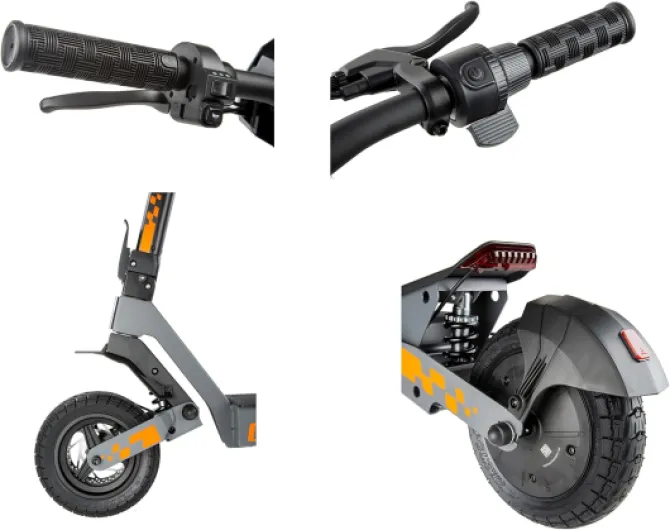
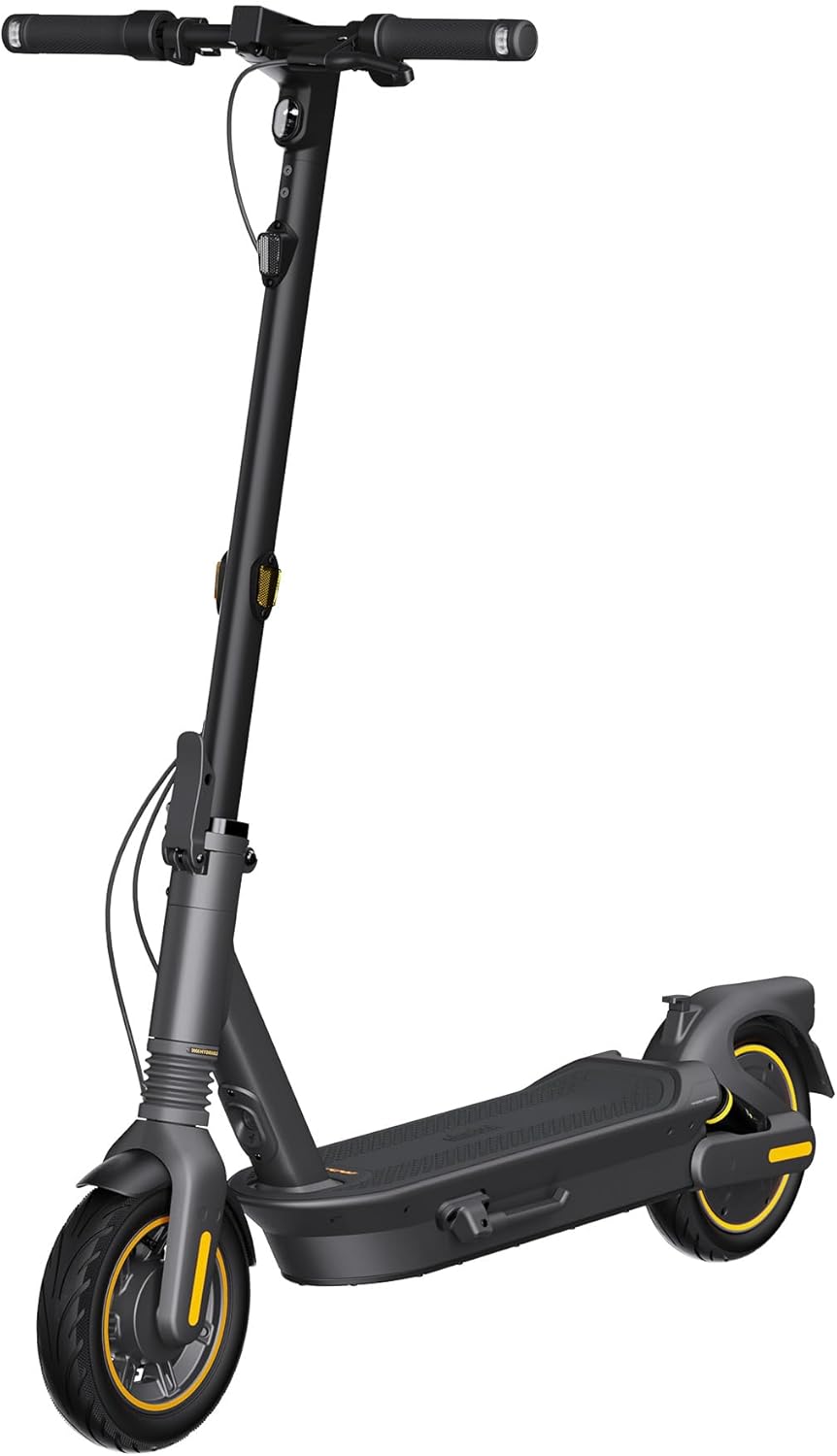
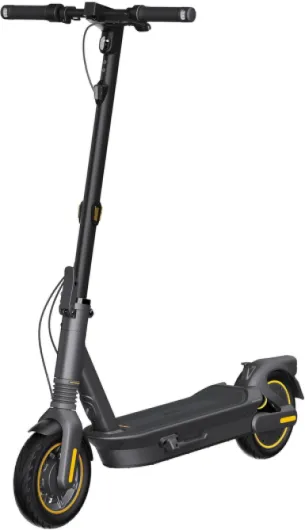
Design-wise, the Max G2 looks like a serious commuter scooter. Matte black frame, thick stem, wide deck, and those 10-inch tubeless tires give it a chunky, solid look. It’s not flashy, but people can tell it’s not a cheap rental-style scooter. The dimensions are roughly 47.6 x 22.4 x 49.8 inches, so it takes up some space in a hallway or trunk. Folded, it’s flatter but still long and heavy, so don’t expect to casually toss it under a café table.
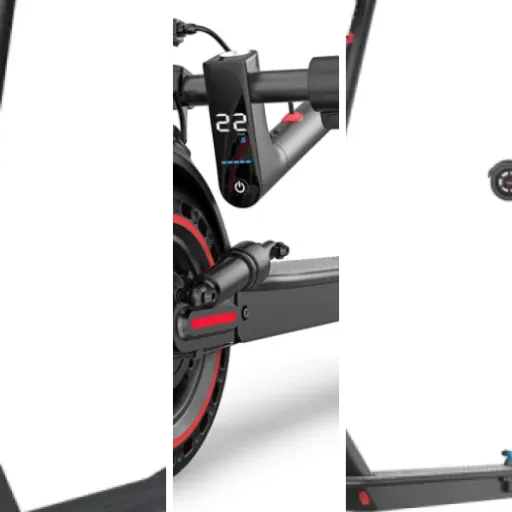
The handlebar area is well laid out: central display, thumb throttle on the right, brake lever, and controls within easy reach. The display is bright enough to read in daylight. The deck is long and wide, so you can stand with one foot forward and one sideways comfortably, even if you’re taller. I’m around 6 ft and never felt cramped. The stated weight limit is 265 lbs, and based on how the frame feels, that rating seems realistic. Heavier riders I’ve seen on similar Segway models still get decent speed and stability.
One thing to highlight: this scooter is not designed for ultra-portability. The folding mechanism is solid and quick (takes a few seconds), but it’s still a 60+ lb machine. Carrying it up stairs or onto a crowded train is a workout. If you’re thinking of something to constantly fold and carry, this will annoy you. If you mostly roll it into an elevator or garage, it’s fine.
Overall, the design is focused on stability and durability: thick stem, big deck, big tires, dual suspension, integrated lights. It looks and feels like a small urban vehicle more than a gadget. If you want a sleek, super-light scooter, look elsewhere. If you want something that feels planted and safe at 20 mph, this design makes sense.
Real-world range vs the 43-mile claim
Battery and range are where marketing and reality always clash, so here’s the blunt version. Segway says up to 43 miles on the Max G2 with its 551 Wh battery and their "RideyLONG" optimization. That number is technically possible, but only in Eco mode, flat ground, light rider, low speed, and ideal conditions. In real life, you won’t see that unless you ride like a grandma and avoid hills.
With mixed riding (mostly Drive mode, some Sport bursts, stop-and-go traffic, a few hills), I’m getting around 20–25 miles per charge at ~190 lbs. If I stay almost entirely in Eco and cruise bike paths at 10–12 mph, I can push past 30 miles, but it’s boring. Heavier riders or people living in very hilly areas will probably land closer to 15–20 miles if they’re using Sport a lot. So the range is good, but not magical. The upside is that the power curve is pretty consistent – it doesn’t suddenly die at the end like some cheap scooters.
Charging time is about 6 hours from nearly empty, which matches the specs. The built-in charger is nice because you only carry a cable, not a brick. The display even shows estimated time remaining to full, which is handy if you’re topping up during the day. The battery is inside the deck, so no external pack to worry about, and it’s UL-2272/2271 certified, which is reassuring if you’re charging indoors.
If you’re doing a short to medium commute (say 5–8 miles each way), you’ll be fine charging every 1–2 days depending on speed mode and weight. If you plan on long weekend rides or food delivery shifts, expect to either ride slower, charge mid-day, or accept that you won’t get anywhere near the brochure number. It’s a solid battery setup, just don’t buy it thinking you’ll always ride 40+ miles at max speed on a single charge – that’s not how it works.
Ride comfort: finally not getting beaten up by bad pavement
The big difference between this and cheaper scooters I’ve owned is comfort on rough roads. The Max G2 has front hydraulic suspension and a rear spring setup, plus 10-inch tubeless self-healing tires. In practice, that combo smooths out cracks, expansion joints, and small potholes much better than rigid or single-suspension scooters. You still feel the road, but it’s not that harsh, rattly feeling where your hands go numb after 15 minutes.
On my commute, I have a mix of bike lane, patched asphalt, and some brick sections. On my old budget scooter, the brick part was miserable at 15 mph; I’d slow down to 8–10 mph just to keep my teeth from chattering. On the G2, I can comfortably stay around 15–18 mph on the same stretch without feeling like the scooter is going to shake apart. The deck grip is solid, and the ergonomic grips help on longer rides. Standing for 30–40 minutes straight is still standing, but it’s way more tolerable on this than on rigid models.
For heavier riders (200+ lbs), the suspension still does its job. You’ll compress it more on big hits, but you’re not bottoming out constantly. The self-healing tires are also a plus for comfort and peace of mind: they’re air-filled, so they absorb more than solid tires, but they have a sealant layer inside to resist punctures. I’ve rolled over glass bits and debris a few times already with no flats so far.
The only downside comfort-wise is the weight when you’re off the scooter. Carrying it up a flight of stairs after a long ride is not fun. Also, at max speed in Sport mode, hitting unexpected bumps can still be sketchy – the scooter handles them better than cheaper ones, but physics is physics. I’d say it’s very comfortable up to 18–20 mph on average city surfaces; beyond that, you’re the limiting factor, not the scooter.
Build quality and how it holds up day to day
The Max G2 feels sturdy right out of the box. The frame is alloy steel, the stem doesn’t flex noticeably, and the folding mechanism locks in with a reassuring clunk. Compared to cheaper scooters I’ve owned that started creaking within a week, this one feels tighter. After a few weeks of daily use, including some rough patches and rain, I haven’t noticed any major play in the stem or weird noises beyond the usual tire and motor sounds.
The scooter is tested for vibration and drop resistance, and you can tell it’s built to take more abuse than the typical budget model. The 10-inch tubeless self-sealing tires are a big plus for durability: they handle glass and small debris better than basic tubes. I haven’t had a flat yet. Other users have mentioned occasional grinding sounds from the front wheel or minor noises that went away after adjusting or using the brake hard a few times, so there might be some small quirks, but nothing catastrophic.
Water-wise, I’ve been caught in light to moderate rain a couple of times. No issues so far: lights worked, brakes fine, no error codes. I wouldn’t deliberately ride it through deep puddles, but for normal wet commuting it seems okay. The lights, turn signals, and brake light have held up without flickering or loose connections. The deck rubber still grips well even when wet.
It’s backed by a 2-year limited warranty, which is decent for this category, but you still want to check screws, keep the stem latch clean, and not treat it like a rental you can throw around. The biggest durability downside is just the weight: if you drop this thing or slam it into curbs, you can damage stuff because there’s a lot of mass. Treated as a daily vehicle and not as a stunt toy, it feels like it should last several seasons without falling apart, which is more than I can say for the cheaper scooters I burned through.

Speed, acceleration and braking in real life
The Max G2 is clearly tuned for real commuting rather than just casual park rides. The 1000W motor (peak) has strong acceleration, especially in Sport mode. You get three riding modes: Eco, Drive, and Sport. Eco tops out around 10 mph and feels slow but efficient; Drive sits around the mid-teens; Sport gets you up near the advertised 22 mph. With my weight (around 190 lbs), I hit about 21–22 mph on flat ground in Sport, which is plenty for city use.
From a standstill, you need a small kick to engage, then it pulls smoothly. It’s not jerky, but it has enough torque that you feel it. On hills, it does way better than the cheap scooters I owned. Short, steep inclines that used to drop me to walking speed are now handled at 10–15 mph depending on grade. If you’re close to the 265 lb limit, expect slower hill speeds, but from what I’ve seen and from other user feedback, it still climbs without dying.
Braking is handled by a front drum brake and a rear electronic brake. Out of the box, the braking is strong enough to make you lean forward a bit if you squeeze too hard. The feel is progressive, not on/off. In emergency stops, it has enough bite to bring you down from 20+ mph quickly without feeling unstable, as long as your weight is balanced. Compared to scooters with only electronic brakes or tiny discs, this setup feels much more trustworthy.
Segway also added TCS (traction control) to help with slippery or loose surfaces. In practice, you notice it most when accelerating on wet pavement or on dusty patches: the front wheel doesn’t spin out as easily. It’s not magic – you can still slide if you ride like an idiot in the rain – but it helps keep the scooter predictable. Overall, performance-wise, it feels like a proper urban commuter: quick enough, solid braking, and stable, not a toy that tops out at 12 mph and struggles with every slope.
What you actually get in the box
Out of the box, you get the scooter pre-assembled for the most part, a charger cable (the brick is built into the scooter), a small accessory box with screws and tools, and the usual paperwork. The outer carton is clearly marked with “This Side Up” and other warnings, and that’s not overkill: at around 65 lbs boxed, it’s not fun to drag around by yourself. I had to tilt it and sort of walk it into my hallway. If you live upstairs, plan ahead.
Assembly is basic: you bolt the handlebar onto the stem with the supplied screws, plug in the handlebar cable, and unfold the latch. Took me maybe 15–20 minutes going slowly and double-checking everything. The user manual is actually readable and covers the basics: how to charge, what the error codes mean, how to store it, and what to check after delivery (like loose screws or tire damage). For a motorized product that can throw you off at 20+ mph, I appreciated the safety focus.
The first power-on forces you through the app pairing, which is slightly annoying if you just want to ride, but once that’s done you don’t really have to live in the app. The display on the stem shows speed, battery bars, riding mode, and turn signals. You can tweak a few things in the app like traction control and some riding preferences, but day-to-day you just hold the power button, kick off, and go.
As for the advertised features: UL-2272/2271 certification is more about peace of mind (battery/fire safety). You also get built-in front light, brake light, and actual turn signals, plus Apple Find My support if you’re in the iPhone camp. It doesn’t feel like a toy scooter with gadgets thrown on; it feels more like a compact, basic electric vehicle. Just don’t expect anything fancy in the box beyond the essentials: no extra tires, no phone mount, nothing like that.
Pros
- Strong 1000W motor with good hill-climbing and up to ~22 mph top speed
- Dual suspension and 10-inch tubeless self-healing tires give a comfortable, stable ride
- Solid build quality with UL-certified battery, good brakes, and integrated lights/turn signals
Cons
- Very heavy and not convenient to carry frequently
- Real-world range is closer to 20–25 miles, well below the 43-mile marketing number
Conclusion
Editor's rating
The Segway Ninebot Max G2 is a serious commuter scooter for people who actually plan to use it regularly, not just on sunny Sundays. It’s fast enough (around 22 mph), climbs hills better than most budget models, and the dual suspension plus 10-inch tubeless tires make daily rides much more comfortable. Add solid brakes, built-in lights, turn signals, and UL-certified battery safety, and you get something that feels closer to a compact vehicle than a toy. Real-world range is decent, typically 20–25 miles with mixed riding for an average adult, which covers most commutes without anxiety.
It’s not for everyone though. The biggest downsides are the weight and the optimistic range claims. At over 60 lbs, carrying it up stairs or on crowded trains is a hassle. The 43-mile number is marketing; in normal use you’ll see about half of that unless you ride slow in Eco. If you only ride occasionally, or you need something super portable, this is probably too much scooter. But if you’re tired of flimsy $300 scooters and want something that feels robust, comfortable, and reliable for daily use, the Max G2 is a pretty solid choice. Think of it as a practical, no-nonsense commuter machine: not flashy, not perfect, but it gets the job done very well for the right kind of rider.