
Summary
Editor's rating
Value for money: where it makes sense and where it doesn’t
Design: compact, stable, but not exactly sleek
Battery and charging: solid range, but respect the hills
Comfort: good seat, but you feel every bump
Durability and build: sturdy frame, a few quirks
Performance: smooth on flat ground, modest on hills
What you actually get out of the box
Pros
- Stable 4‑wheel design with a comfortable, swiveling seat and flip‑up armrests
- Disassembles into four pieces that fit in most car trunks, with a removable battery pack
- Good value for money with decent range and a 5‑year guarantee for everyday flat‑ground use
Cons
- Loud beeping and neutral alarm can be annoying and embarrassing in quiet places
- No real suspension and modest hill performance, especially if the battery isn’t fully charged
- Heavier pieces (rear section and battery) can be hard to lift for users with limited strength

Specifications
View full product page →| Brand | Vive |
A small scooter that actually gets used
I’ve been using the Vive 4 Wheel Mobility Scooter (blue sapphire version) for a mix of errands, doctor visits, and the odd trip to the park. I’m not a technician or a reseller; I’m just someone who needed help walking longer distances and wanted something that fits in a normal car. I’ll be blunt: this scooter is not perfect, but it’s pretty solid for the price and it does what most people actually need day to day.
When I ordered it, I was a bit worried about assembly, weight, and whether it would handle small outdoor trips or just be an indoor toy. After a few weeks of use, I can say it’s clearly built more for flat surfaces and light outdoor use than hardcore off‑roading, but it holds up better on grass, dirt paths, and rough sidewalks than I expected. Just don’t expect suspension comfort or all‑terrain performance.
The main things that stood out for me are: it’s easy enough to take apart and throw into a mid‑size SUV or hatchback, the controls are dead simple, and the battery range is fine as long as you actually charge it fully before going anywhere with hills. On the downside, the beeping is loud and annoying, the seat can feel a bit wobbly at first, and lifting the heavier pieces is no joke if you have back issues.
If you’re looking for a realistic, non‑sugarcoated opinion: this scooter is good value for money for basic mobility, especially for older adults who want independence for shopping, appointments, and outings. If you’re heavy, live on steep hills, or want something cushy and super powerful, you’ll probably want to look at a bigger, more expensive model.
Value for money: where it makes sense and where it doesn’t
For the price point this Vive scooter usually sits at, I’d say it offers good value for money if your expectations are realistic. You’re getting a four‑wheel, relatively compact scooter with a decent battery, removable seat and battery pack, headlight, basket, and a 5‑year guarantee from a known brand. It’s not packed with fancy features, but it covers the basics well enough for most everyday users: trips to the store, medical appointments, outings with family, and moving around larger indoor spaces.
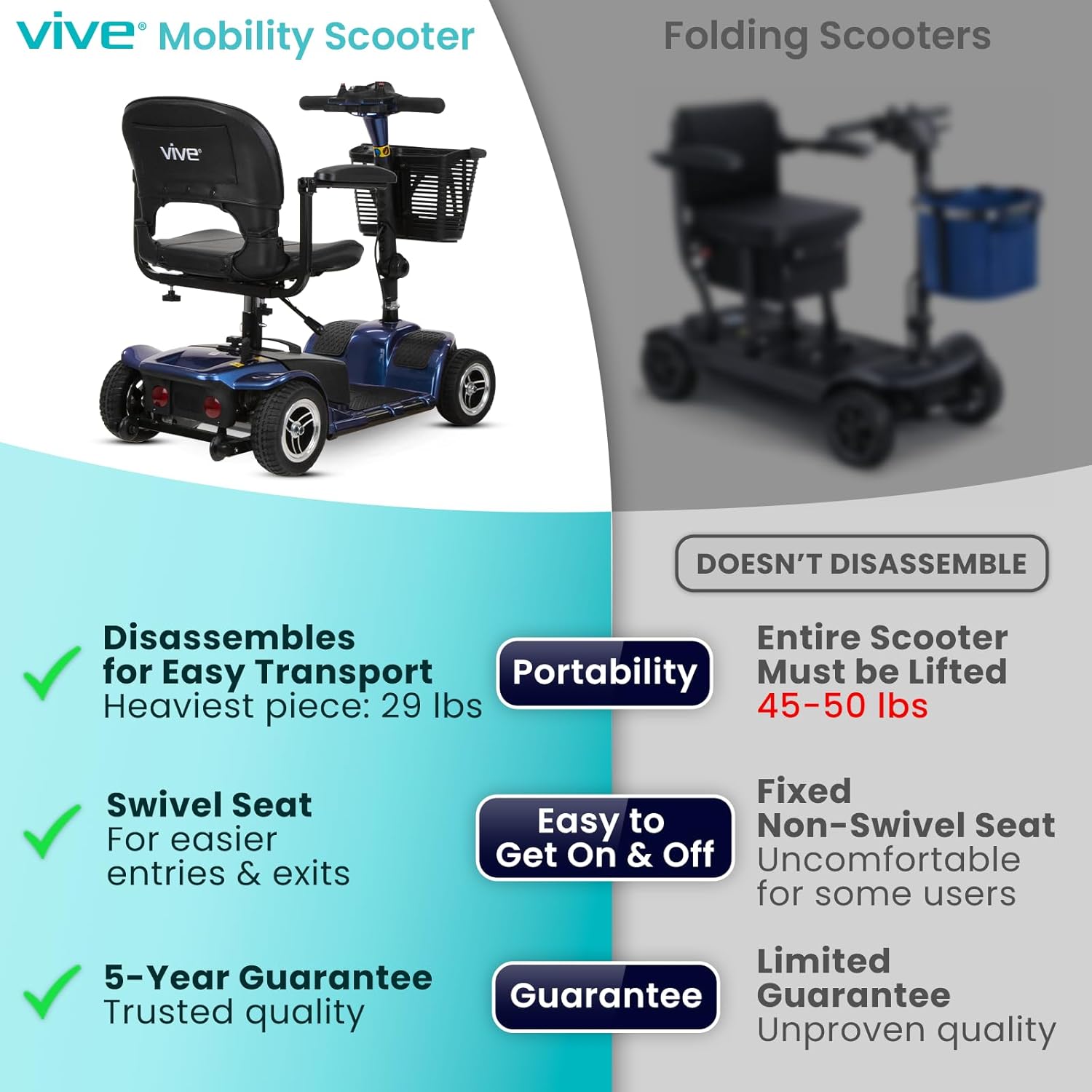
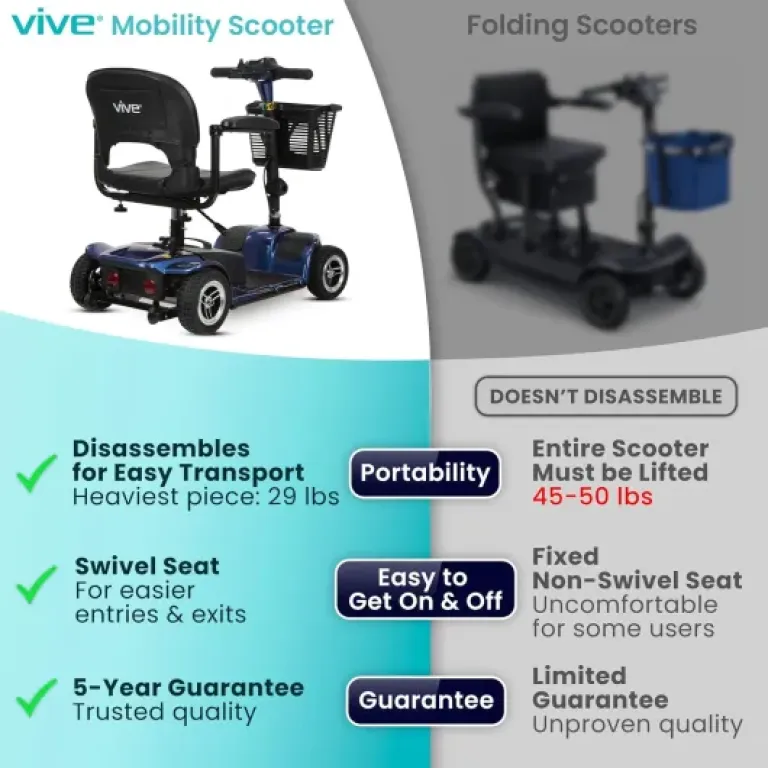
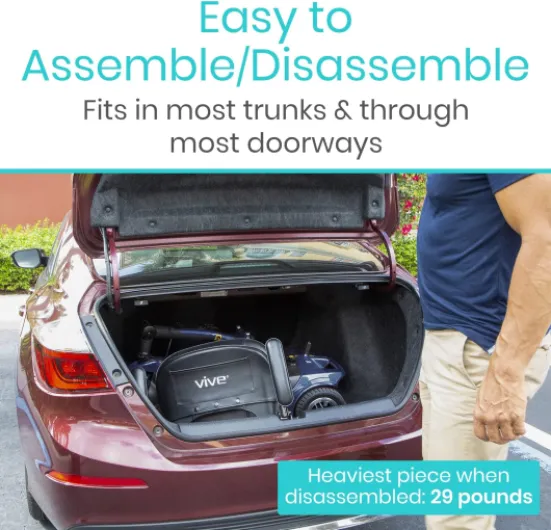
Where the value really shows is for people who need a mix of indoor and light outdoor use and want something that can still be transported in a regular car. The fact that it disassembles into four pieces makes it much more practical than a big, heavy full‑size scooter that needs a lift on the back of the car. If you or a family member can handle lifting the 29 lb rear section and the battery, this saves you from buying extra transport equipment.
On the flip side, there are a few compromises that come with the price. The lack of real suspension, the loud beeping, the average turning radius, and the modest hill performance are all reminders that this is a budget‑friendly scooter, not a high‑end one. If you live in a very hilly area, are close to the 265 lb weight limit, or want something ultra‑comfortable and quiet, you may feel it’s a bit underpowered or basic and might be better off spending more on a higher‑tier model.
Overall, if your main goal is to regain mobility for everyday tasks without spending a fortune, this scooter is a pretty solid deal. It’s not trying to be fancy; it just gets the job done. If you’re okay with that and can live with a few annoyances, the price‑to‑performance ratio is hard to argue with.
Design: compact, stable, but not exactly sleek
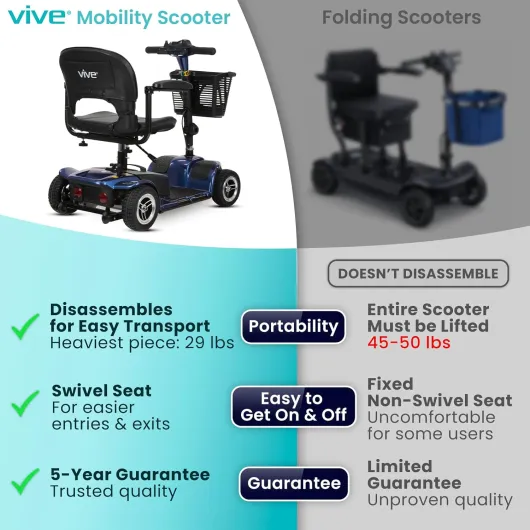
Design‑wise, this is a fairly standard compact 4‑wheel scooter. The blue sapphire color gives it a bit of personality so it doesn’t look like hospital equipment, but it’s still very much a practical medical device, not some stylish gadget. Dimensions are around 38" long, 19.5" wide, and 33" high, so it fits easily through standard doors and down supermarket aisles. I’ve taken it into crowded waiting rooms and small shops without feeling like I was blocking everything.
The four‑wheel setup gives it good stability. I never felt like it would tip over on sloped sidewalks or going off a curb cut at an angle. The trade‑off is the turning radius: it’s not as tight as a 3‑wheel scooter. In tight indoor spaces, you sometimes need a three‑point turn instead of just spinning around. For me, stability is worth the slightly worse maneuverability, but if you live in a tiny apartment with narrow hallways, that’s something to think about.
The tiller folds down and the seat comes off, which is what makes it possible to transport it in a car. The heaviest piece is the rear section at about 29 lbs, but honestly, the battery box feels almost as heavy in the hand. If you have serious lifting restrictions, you’ll probably need a ramp or someone to help. Design in that sense is “portable if you’re reasonably strong or have help,” not “featherweight travel scooter.”
Little touches I liked: the swivel seat that lets you rotate to get off without twisting your back, and the flip‑up armrests that make side transfers easier. What I didn’t love: the loud beeping when you turn it on or when it’s in neutral. In a quiet waiting room, it feels like you’re setting off an alarm. Overall, the design is practical and user‑friendly, but clearly focused on function, not style or silence.
Battery and charging: solid range, but respect the hills
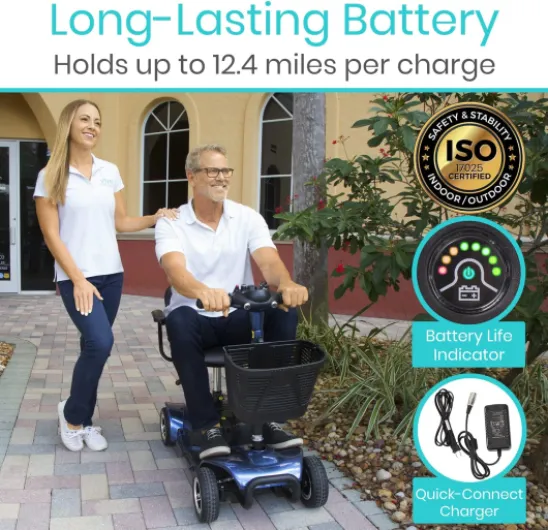
The scooter runs on a pair of 12V batteries housed in one removable battery pack. The brand advertises up to 12.4 miles per charge, and in real life, that’s possible only under ideal conditions: lighter rider, mostly flat terrain, and not constantly at max speed. In my case, with mixed indoor/outdoor use and a couple of mild hills, I’m seeing something more like 6–9 miles before the battery indicator starts dropping into the lower range where you don’t feel like pushing it.
One important detail: hills eat the battery. If you leave home with the battery only half charged and try to climb a long or steep hill, you can absolutely get stuck halfway. That’s not a theory; it has happened. The scooter will simply lose power and stop. If you fully charge it the night before any longer or hill‑heavy outing, it does much better and will make it up hills that would otherwise kill it at half charge. The motor feels more responsive and you don’t get that sluggish, struggling sensation.
Charging is straightforward. You plug the charger into the battery pack and into the wall, and the indicator lets you know when it’s done. Charge time from low to full is a few hours—good enough to top it off overnight or during the day between uses. One nice thing is that you can remove just the battery and bring it inside, leaving the scooter in the car or garage. Some people even use a power inverter in their car to charge on the go, which works but isn’t officially built‑in.
The battery indicator is color‑coded and not super precise, but it’s useful enough to know if you’re in the safe zone or should start heading back. My take: the battery system is decent and reliable if you treat it right—charge fully, don’t constantly run it to empty, and be realistic about hills. If you expect all‑day heavy use on steep terrain, this battery setup will feel limited, but for typical errands and day trips, it holds up fine.
Comfort: good seat, but you feel every bump
On comfort, I’d say this scooter is decent but not luxurious. The seat is actually better than it looks in photos. It’s about 15.75" wide, padded enough for a couple of hours of use without your backside going numb, and the backrest gives reasonable support. I’ve done longer outings like shopping plus a walk through a park, and the seat stayed comfortable. The material feels like standard vinyl, so it’s easy to wipe down, but you’ll sweat a bit if it’s hot outside.
The swivel function on the seat is genuinely useful. Being able to rotate the seat to the side and step off instead of twisting your body is a big plus if you have knee, hip, or back problems. At first, the seat can feel a bit wobbly because it’s mounted with a pin, and you do notice a slight play when you shift your weight. It’s not unsafe, just a bit unsettling until you get used to it. After a few days, I stopped thinking about it.
Where comfort takes a hit is the ride quality. There is basically no real suspension, so you feel potholes, sidewalk cracks, and rough ground. It’s not bone‑shattering, but if you have joint pain, you’ll want to avoid bumpy paths when you can. On smooth indoor floors and good sidewalks, it’s fine. On grass and dirt, it still moves, but every bump is noticeable, and you’ll hear the frame rattling a bit.
The adjustable armrests are handy and padded enough to rest your arms, but they’re not super wide or plush. For most people, they’re fine. If you’re bigger or like a lot of elbow room, you might ride with one armrest up or removed. In short: seat comfort is solid for this price range, but don’t expect a cushy, car‑like ride. It’s comfortable to sit on; the ground underneath is what makes it less pleasant when things get rough.
Durability and build: sturdy frame, a few quirks
In terms of durability, the Vive scooter feels sturdy where it counts. The metal frame and base don’t flex, and the plastics on the body panels and fenders are thick enough that you don’t feel like they’ll crack from a minor bump. I’ve bumped into door frames, shopping cart rails, and the odd curb and, aside from some cosmetic scuffs, the scooter has handled it without any real damage. It’s clearly built for regular, everyday use, not just occasional rides.
The flat‑free tires are a big plus for durability. No punctures to worry about, and after repeated use on pavement, sidewalks, and some grass and dirt, they just show normal wear, nothing unusual. They’re not soft or cushy, but they’re reliable. The seat hardware and armrest hinges feel solid once you get used to how they move. The only thing that might throw you off at first is that slight wobble in the seat mount, which is more about design than actual weakness.
The electronics—ignition, control panel, light, and beeper—work consistently. Some people have mentioned the beeper being too loud, and I agree, but that’s more of an annoyance than a durability issue. The neutral alarm is very loud, and the manual isn’t crystal clear about it, which can lead you to think something is broken when it’s not. Once you understand how the freewheel/neutral lever works, that problem goes away.
Long‑term, the main wear points are probably going to be the battery pack (as with any mobility device) and cosmetic scratches on the colored plastic. If you’re careful loading it into a car and don’t drop the seat onto the fenders, it will stay looking decent. If you’re rough with it, you’ll collect scrapes, but nothing that affects function. Considering the price, the overall build feels pretty solid. Not luxury‑grade, but absolutely capable of daily use for adults and seniors who need reliable mobility.
Performance: smooth on flat ground, modest on hills
In everyday use, the performance is what I’d call “good enough for normal life.” The scooter tops out around 3.7 mph, which feels like a brisk walking pace. You control it with a simple speed dial and a lever for forward/reverse. Acceleration is smooth, not jerky, so you don’t feel like you’re going to shoot forward by accident. Indoors, it’s easy to feather the throttle and move slowly in tight spaces. Outdoors, it has no issue keeping up with someone walking next to you.
On flat surfaces—mall floors, parking lots, grocery stores, sidewalks—it runs smoothly and feels stable. The 8" flat‑free tires are low maintenance and grip well enough on dry pavement, short grass, and compact dirt. I’ve taken it over shallow potholes and uneven sidewalks without it getting stuck. You do feel the impacts, but it doesn’t lose traction or stall. Just don’t try to treat it like an off‑road vehicle; soft sand, deep gravel, or big holes will be a problem.
Hills are where you need to manage your expectations. It can handle moderate inclines if the battery is fully charged, but if you start a climb at half charge, you really notice the power drop. One user mentioned it actually died halfway up a steep hill when not fully charged, and I’ve seen the same thing: the scooter slows down and feels strained. On steeper slopes, you want to start with a full battery and maybe keep the speed dial a bit lower so it doesn’t bog down.
The turning radius is okay but not tight. In wide aisles and open spaces, no issue. In narrow hallways or crowded rooms, you sometimes need to back up and adjust. For me, the trade‑off is acceptable because the four wheels give more confidence on uneven ground. Overall, performance is fine for errands, appointments, and casual outings, but it’s not a powerhouse. If you live in a very hilly area or are close to the weight limit, you might want something stronger.
What you actually get out of the box
Out of the box, the Vive 4 Wheel Mobility Scooter comes in a big, slightly intimidating carton, but once you open it, the parts are pretty straightforward: base with rear wheels and motor, front section with tiller, seat, battery pack, front basket, charger, and a couple of small bits like the key and knobs. No bag of a thousand tiny screws, which I appreciated. The instructions are clear enough that you don’t need to be handy to figure it out. Realistically, it’s a 20–30 minute job the first time, faster after that.
The scooter is rated to support up to 265 lbs, has a top speed of about 3.7 mph, and claims around 12.4 miles per charge. Those numbers are in the right ballpark in real use, but only if you’re on mostly flat ground and start with a full charge. Once you add hills, heavier users, and stop‑and‑go, the range feels more like 6–9 miles before you start seeing the battery gauge drop quicker. It runs off two 12V batteries in a single removable battery box, which is handy because you can carry just the battery inside to charge.
The controls are all on the tiller: speed dial, forward/reverse, horn, headlight switch, and a simple battery indicator. There are two keys, which is nice if you’re forgetful. No fancy display, no app, no nonsense. It’s clearly built for older users who just want to turn a key and go. The front basket is basic but useful for a purse, small bag of groceries, or an oxygen concentrator.
Overall, in terms of what you actually get, it’s a compact, basic mobility scooter that covers the essentials: stability with four wheels, a comfortable enough seat, a light, a basket, and a removable battery with a standard charger. Nothing fancy, but it’s pretty much plug‑and‑play for everyday mobility needs, which is what most people in this price range are looking for.
Pros
- Stable 4‑wheel design with a comfortable, swiveling seat and flip‑up armrests
- Disassembles into four pieces that fit in most car trunks, with a removable battery pack
- Good value for money with decent range and a 5‑year guarantee for everyday flat‑ground use
Cons
- Loud beeping and neutral alarm can be annoying and embarrassing in quiet places
- No real suspension and modest hill performance, especially if the battery isn’t fully charged
- Heavier pieces (rear section and battery) can be hard to lift for users with limited strength
Conclusion
Editor's rating
After living with the Vive 4 Wheel Mobility Scooter for a while, my overall take is that it’s a solid, no‑nonsense option for people who need basic mobility help and don’t want to dive into the higher price range. It’s stable, reasonably comfortable, simple to operate, and can be broken down to fit into most car trunks. The battery life is good enough for typical daily use as long as you’re disciplined about charging it fully before longer or hill‑heavy outings. It’s clearly designed around real‑world needs like shopping, appointments, and casual trips, not extreme terrain or long‑distance travel.
It’s not perfect. The beeping is loud and can be embarrassing in quiet places, the seat feels a bit wobbly at first, and hills expose its limits pretty quickly, especially if the battery isn’t topped up. There’s also no suspension, so rough ground is tiring if you have joint pain. But for the price, and considering the 5‑year guarantee and overall build quality, it’s hard to complain too much. It does what it’s supposed to do without trying to be something it’s not.
I’d recommend this scooter to seniors or adults up to around the mid‑200 lb range who mainly need help on flat or mildly sloped surfaces—shopping centers, medical buildings, parks with decent paths, and neighborhood sidewalks. It’s also a good choice if you want something that can be transported in a regular car without a special lift, as long as someone can handle the heavier pieces. If you’re heavier, live in a very hilly area, or want maximum comfort and power, I’d skip this and look at larger, more powerful models with better suspension and stronger motors.