
Summary
Editor's rating
Value for money: fun toy if it matches your use case
Design: fun shape, not exactly compact
Comfort & handling: easy to learn, but not for everyone
Materials & build: solid frame, some cheaper details
Durability: sturdy frame, cosmetic wear shows fast
Performance: flat ground fun, hills are a pain
What the DeltaWing actually is (and isn’t)
Pros
- Fun drifting and carving style that feels different from a normal scooter
- Solid steel frame and big 16" front wheel handle flat surfaces well
- Easy to learn for most kids and can be used by older kids and some adults
Cons
- Bulky, does not fold, and awkward to store or transport in small cars
- Not great on hills or rough sidewalks; more tiring than a classic scooter
- Foot grip on the rear wings wears/peels relatively quickly

Specifications
View full product page →| Brand | Razor |
A three‑wheeled scooter that actually feels different
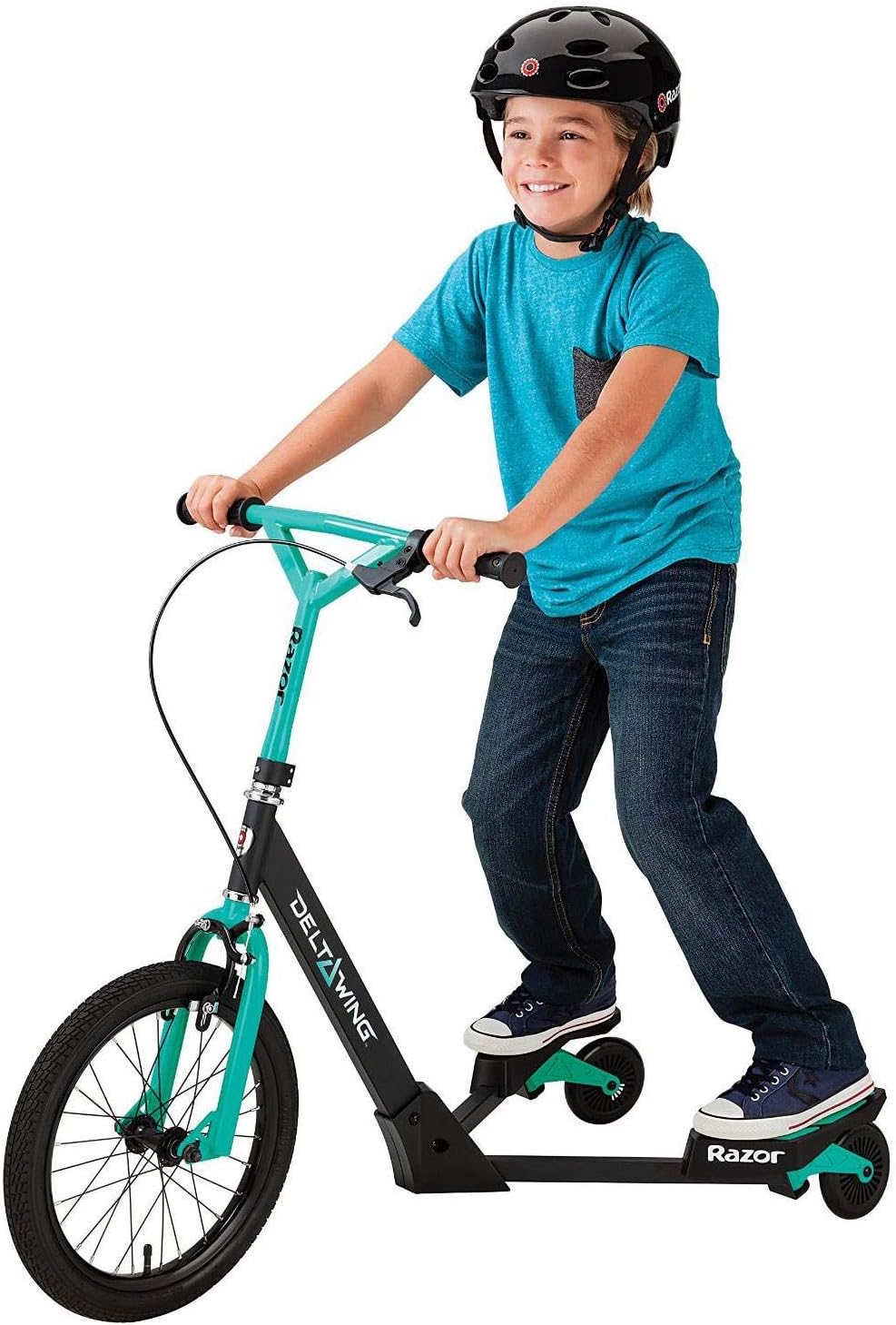
I’ve been testing the Razor DeltaWing Scooter (Black/Mint Green, one size) for a couple of weeks with kids in the 7–11 range and a couple of adults hopping on it too. If you’re picturing a classic two‑wheel scooter, forget that. This thing rides more like a mix between a trike and a drift kart. The whole point is to swing your hips and carve side to side, not just push in a straight line.
In practice, the first thing that stands out is the big 16" front tire and the two small rear casters. On flat, smooth ground, it rolls pretty well and feels stable once you’re moving. On rougher sidewalks, you feel every crack but it’s still manageable. It’s clearly built more for parks, driveways, and parking lots than for bumpy neighborhood sidewalks full of roots and potholes.
I mainly let an 8‑year‑old and a 10‑year‑old use it, plus I tried it myself (adult around 80 kg, under the 143 lb / 65 kg limit I’d say it’s probably more honest than the official number). Both kids got the basics in less than 10 minutes. To really drift cleanly and do tight turns took them a few days of messing around. So there is a bit of a learning curve, but it’s not frustrating. They laughed more than they fell, which is what matters.
Overall, my first impression: it’s fun, a bit bulky, and not very practical for transport, but it does exactly what it’s supposed to do – get kids outside, burning energy, and trying silly turns. If you’re after a daily commuting scooter, wrong product. If you want a toy for flat spaces where kids can spin and slide, then it starts to make sense.
Value for money: fun toy if it matches your use case
In terms of value, I’d put the Razor DeltaWing in the “pretty solid if you use it right” category. It’s not the cheapest scooter out there, but you’re getting a different riding style than the usual two‑wheel models. For families where kids are already bored of regular scooters and bikes, this actually feels like something new that pulls them outside again. In my case, the 10‑year‑old who had stopped using his normal scooter suddenly wanted to go to the park again just to drift around on this.
On the flip side, you’re paying for a product that’s not very versatile. It doesn’t fold, it’s bulky, and it’s not ideal for hills or rough sidewalks. If your kid mostly needs a way to ride to school or around the neighborhood, a standard scooter will probably be cheaper, lighter, and more practical. The DeltaWing makes more sense as an extra toy for weekends in a big driveway, a cul‑de‑sac, or a nearby park with smooth paths.
Considering the build quality, the 143 lb weight limit, and the fact that older kids and even adults can hop on it, the lifespan across multiple kids is a plus. You can easily pass it down to younger siblings. You may need to replace or re‑tape the foot grips at some point, but that’s a cheap fix. As long as the frame and wheels hold up – and they seem to – you’re getting a few years of occasional use out of it.
So, value verdict: if you have space to ride it and kids who like trying tricks and drifting, the price makes sense and feels fair. If you’re tight on storage, live in a very hilly area, or want a practical daily scooter, the money is better spent on a simpler folding model. For our use (flat suburb, garage space, kids who like messing around), I’d give the value a solid 4/5.
Design: fun shape, not exactly compact
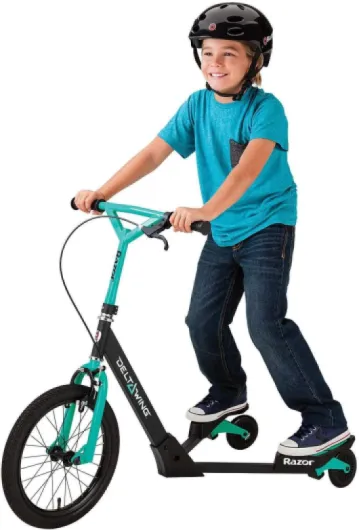
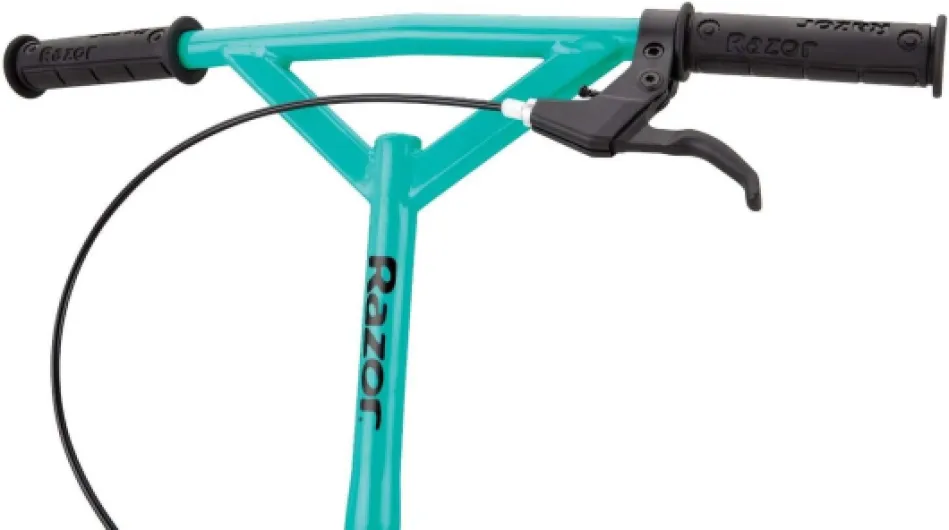
Design‑wise, the Black/Mint Green version actually looks pretty cool in person. The mint accents pop just enough without being too loud. The Y‑shaped handlebar gives it a more aggressive, BMX‑like look compared to a classic T‑bar scooter. Kids immediately gravitate to it because it doesn’t look like the usual thing everyone else has. From a distance, you can tell it’s made for drifting just by the stance and the two wide rear wings.
The big front wheel is the other key part of the design. At 16" with a pneumatic tire, it feels more like a small bike wheel than a scooter wheel. That helps a lot on cracks, small stones, and uneven patches. You’re not getting a magic carpet, but it doesn’t stop dead on tiny obstacles like the tiny hard wheels on regular scooters. The two rear wheels are smaller 125 mm casters on angled arms, which is what lets you slide the back end around when you lean and turn.
On the downside, this design makes it bulky and awkward to store. It doesn’t fold. The rear wings stick out, so it eats a decent chunk of floor space in a garage or hallway. In my case, it basically claimed a permanent parking spot in the corner of the garage. If you live in an apartment and need to bring it upstairs or in an elevator, expect to bump into walls a few times. Weight‑wise, at around 8.8 kg, it’s not crazy heavy, but it’s not fun to carry for long either.
From a usability point of view, I’d say the design focuses on stability and fun over practicality. Wide stance, low center of gravity, and that big front wheel make it pretty confidence‑inspiring for kids once they get the hang of it. But you pay for that with size and lack of folding. It’s a trade‑off: if you have the space, the layout works well for what it’s meant to do. If you need something compact, this isn’t it.
Comfort & handling: easy to learn, but not for everyone
Comfort‑wise, once you get rolling, the DeltaWing is pretty forgiving. The wide stance and three wheels make it feel stable at low speeds. Kids who are a bit timid on regular scooters actually felt more confident on this, because they didn’t worry as much about tipping sideways. The big front wheel smooths out small bumps, and the soft rubber grips on the handlebar are pleasant enough even after a longer session.
The learning curve is there, though. The first 5–10 minutes, most kids kind of wobble and try to ride it like a normal scooter. You really have to explain that they should keep both feet on the rear wings and use their body weight to steer and drift. After that clicks, they start enjoying it. For adults, it’s straightforward, but you do feel a bit cramped because this is clearly sized around teens/kids. The adjustable handlebar height helps, but if you’re tall, you’ll be slightly hunched.
One thing to note: going uphill or on rougher ground is not comfortable. You feel the extra drag, and because you’re pushing with one foot while the other stays on the wing, it’s more tiring than on a normal scooter. After 20–30 minutes of mixed riding, kids wanted short breaks, mostly after messing around with spins and sudden turns. No one complained about foot pain from the platforms, but the constant twisting and carving is a workout for legs and core, which is good exercise but can be tiring for younger kids.
Handling is fun but has limits. It can do very tight turns and even almost zero‑radius spins if you lean and pull the bar right, but sharp turns at speed are sketchy. The back can step out more than expected, and if the rider panics and stiffens up, they can easily lose balance. After one scare, we told the kids: no sharp turns at full speed, and that solved most issues. Once they respected that, everyone stayed upright. So comfort and handling are solid as long as you ride it the way it’s meant to be ridden.
Materials & build: solid frame, some cheaper details
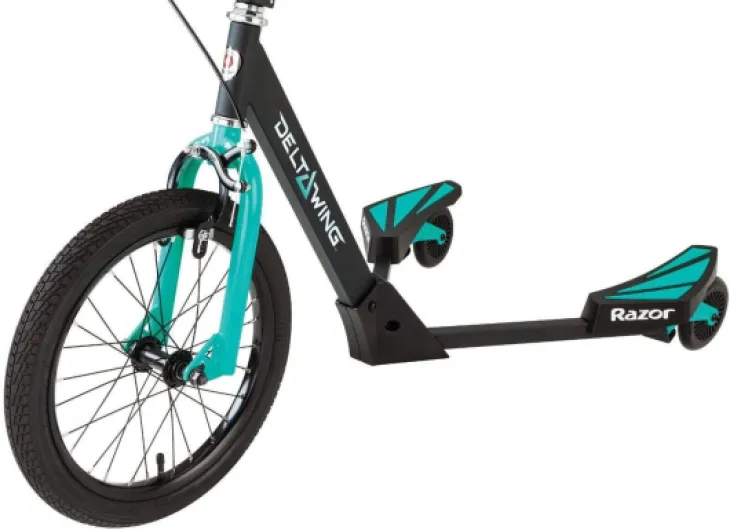
On paper, the DeltaWing uses a steel frame with polymer wings and rubber wheels. In the hand, it feels pretty solid where it matters. The central frame tube and front fork don’t flex much, even with an adult on it. When I stood on it and tried to rock it side to side, there was no scary creaking or bending. So as far as the skeleton goes, it feels trustworthy enough for everyday kid abuse.
The rear wings are made of a hard plastic with grip tape on top. Here’s where you see some cost cutting. The grip tape on our unit started showing signs of peeling at the edges after a few sessions, and that lines up with some Amazon reviews mentioning the same thing. It’s not a disaster – you can always stick new skateboard grip tape on – but still, it’s annoying to see wear that fast on a brand new product that’s not exactly dirt cheap.
The wheels themselves are decent. The front pneumatic tire is standard and easy enough to inflate. It holds air fine; I only had to top it up once in two weeks. The rear casters are hard rubber and roll smoothly. Bearings are nothing fancy, but they spin well enough for this type of toy. The brake lever and cable feel like basic bike components – they work, but don’t expect high‑end smoothness. For kids, it’s fine, though small hands may struggle with reach and force, especially younger than 7–8.
Overall, the materials feel good enough for regular family use, but not bulletproof. The frame seems like it’ll outlive the rest of the parts. The weaker points are the grip tape and cosmetic scuffing on the wings. If you have rough kids, expect scratches and a more “used” look quickly. Personally, I’m okay with that – it’s a toy, not furniture – but if you’re picky about cosmetics, be warned it doesn’t stay pretty for long.
Durability: sturdy frame, cosmetic wear shows fast
After a couple of weeks of regular use – a few sessions per week, around 30–45 minutes each – the frame and main structure still feel tight. No loose bolts, no weird noises, and the steering is still straight. The steel frame gives a feeling that it’ll survive a few years of kid use without bending. We had a couple of small low‑speed falls and one sideways tip‑over, and nothing bent or snapped, just some scratches on the wings.
The weaker part is definitely the foot grip and cosmetic finish. The grip material on the rear wings started to peel slightly on one side by day 2–3, which matches what another reviewer mentioned. It’s not falling off completely, but the edges lift a bit and start to collect dirt. Functionally, it still grips fine, but you can tell this part won’t look fresh for long. The plastic wings also scratch quickly if kids drag it on the ground or bump into walls.
The wheels and bearings have held up fine so far. The rear casters still spin freely, and the front tire hasn’t lost any noticeable air. No wobbling on the front wheel either. The brake cable hasn’t stretched much, though I did give it a quick adjustment after a week just to keep the lever feeling firm. For a kid’s ride‑on, this is all pretty normal; nothing screams "this will die in a month".
Long term, my guess is: the frame and front wheel will outlast the cosmetic parts. If you’re okay with a scratched, slightly beat‑up look, it should keep functioning for quite a while. If you want it to stay pristine, you’ll be disappointed, because the surfaces mark easily. For the price, I’d call the durability decent but not bulletproof. You’re mostly paying for the riding style and brand, not tank‑level ruggedness.
Performance: flat ground fun, hills are a pain
In terms of performance, this thing is all about flat surfaces. On a smooth parking lot or a park path, it’s genuinely fun. You get it rolling with a few pushes, then you start carving by shifting your weight and gently turning the handlebar. When you pull the bar slightly towards you, bend your knees, and lean, the rear casters kick out a bit and you get that drifting feel. Kids figured that out in a couple of minutes and spent the rest of the time trying to do tighter and tighter spins.
On even a slight uphill, it becomes work. Because of the extra friction from the rear casters and the overall weight, it’s noticeably harder to push than a classic two‑wheel scooter. My 10‑year‑old could manage small inclines, but my 8‑year‑old got tired and annoyed pretty fast. So if your neighborhood is full of slopes, expect some complaints. Going downhill is obviously easier, but you need to watch speed because sharp turns at higher speed can throw you off. I had one moment where I tried a sharper right turn and almost got launched. Kids will test the limits, so helmet and pads aren’t optional in my opinion.
The front brake works fine on flat ground and mild slopes. It’s not ultra powerful, but it slows you down reasonably. For younger kids with small hands, reaching and squeezing it firmly is a bit of a stretch. My almost 6‑year‑old tester could ride it, but he barely managed to use the brake effectively, so we limited him to very flat, open spaces with no traffic or obstacles. For older kids (8+), the brake is okay once you adjust the lever angle properly.
So, performance verdict: great for drifting and playing on flat, open areas; mediocre for actual transport or hills. If you set the right expectations – this is a toy, not a vehicle – it delivers. If you expect it to replace walking to school or cruising long distances, you’ll find it sluggish and tiring compared to a normal scooter.
What the DeltaWing actually is (and isn’t)
The Razor DeltaWing is basically a three‑wheel drift scooter. One big 16" pneumatic front wheel, two small 125 mm rear casters set at a low angle, and two wide rear platforms where you put your feet. You steer with a Y‑shaped handlebar and a front hand brake, just like a bike. The brand sells it as suitable for “adult / unisex‑teen”, but the real sweet spot in my tests was kids from about 7 to 13. Adults can ride it for fun, but it’s clearly tuned with kids in mind.
Assembly out of the box is pretty straightforward. It came with everything needed and the instructions are basic but clear. My 10‑year‑old did most of the assembly while I just tightened everything at the end. Expect around 20–30 minutes if you’re not used to this sort of thing. Nothing felt overly cheap during assembly: the frame is steel, the wings are a hard polymer, and the handlebar and brake are similar quality to what you find on mid‑range kids’ bikes.
In day‑to‑day use, the DeltaWing is more of a playground toy than a point‑A‑to‑B scooter. It doesn’t fold, it’s quite long (about 43"), and the two rear wheels make it awkward to carry or fit into a small trunk. I can squeeze it into a hatchback if I fold the rear seats, but it’s not something you just grab and throw in the car like a normal scooter. If space in your car or garage is tight, that’s something to think about.
If I had to sum up the concept: this is a product for drifting, spinning, and goofing around on flat ground, not for commuting, not for long distances, and not for hills. Once you accept that, it does its job quite well and kids really lean into the whole carving style. If you were expecting a practical scooter to replace walking, you’ll be disappointed; if you want something different from the usual Razor A‑style scooter, you’ll get why this exists.
Pros
- Fun drifting and carving style that feels different from a normal scooter
- Solid steel frame and big 16" front wheel handle flat surfaces well
- Easy to learn for most kids and can be used by older kids and some adults
Cons
- Bulky, does not fold, and awkward to store or transport in small cars
- Not great on hills or rough sidewalks; more tiring than a classic scooter
- Foot grip on the rear wings wears/peels relatively quickly
Conclusion
Editor's rating
After a good amount of use with a couple of kids (and some adult test rides), I’d say the Razor DeltaWing Scooter is a fun drift toy with some clear limits. It’s well suited for flat, open spaces and kids who like to mess around, carve, and spin rather than just ride straight from point A to point B. The steel frame feels solid, the big front tire helps on small bumps, and the three‑wheel stance gives decent stability once you get used to the riding style.
On the downside, it’s bulky, doesn’t fold, and isn’t great on hills or rough sidewalks. The foot grip on the wings starts to show wear pretty quickly, and younger kids may struggle to reach and squeeze the brake properly. So it’s not the best pick if you’re short on storage, live in a very hilly neighborhood, or want something mainly for commuting or school runs.
Who is it for? Families with space to ride, mostly flat terrain, and kids roughly in the 7–13 age range who already have the basics of balance and are looking for something different from a normal scooter. Also decent if parents want to hop on occasionally for a laugh. Who should skip it? Anyone needing a compact, foldable, practical scooter, or those expecting smooth performance on hills and rough ground. In that context, I’d rate it 4/5: very fun in the right conditions, but not an all‑rounder.