Summary
Editor's rating
Value for money: solid commuter if you catch it at the right price
Design: simple, compact, and a bit stiff
Battery and range: realistic numbers, not marketing fantasy
Comfort: solid tires = no flats, but you’ll feel the road
Durability and build: feels sturdy enough if you don’t abuse it
Performance: decent speed, okay on hills, better on flats
What you actually get with the WERHY H5
Pros
- Decent real-world speed (around 16–17 mph) and smooth acceleration for city use
- Solid tires and aluminum frame mean low maintenance and no flats
- Quick folding mechanism and relatively light package, easy to store and carry short distances
Cons
- No suspension and solid 8.5" tires make the ride quite stiff on rough roads
- Real-world range closer to 9–11 miles, well below the advertised 15 for many riders

Specifications
View full product page →| Brand | WERHY |
| Color | Green |
| Age Range (Description) | Adult |
| Special Feature | Cruise Control, Dual Braking System, Foldable, Lightweight |
| Weight Limit | 265 Pounds |
| Number of Wheels | 2 |
| Model Name | H5 |
| Wheel Material | Rubber |
A budget commuter scooter that actually feels usable
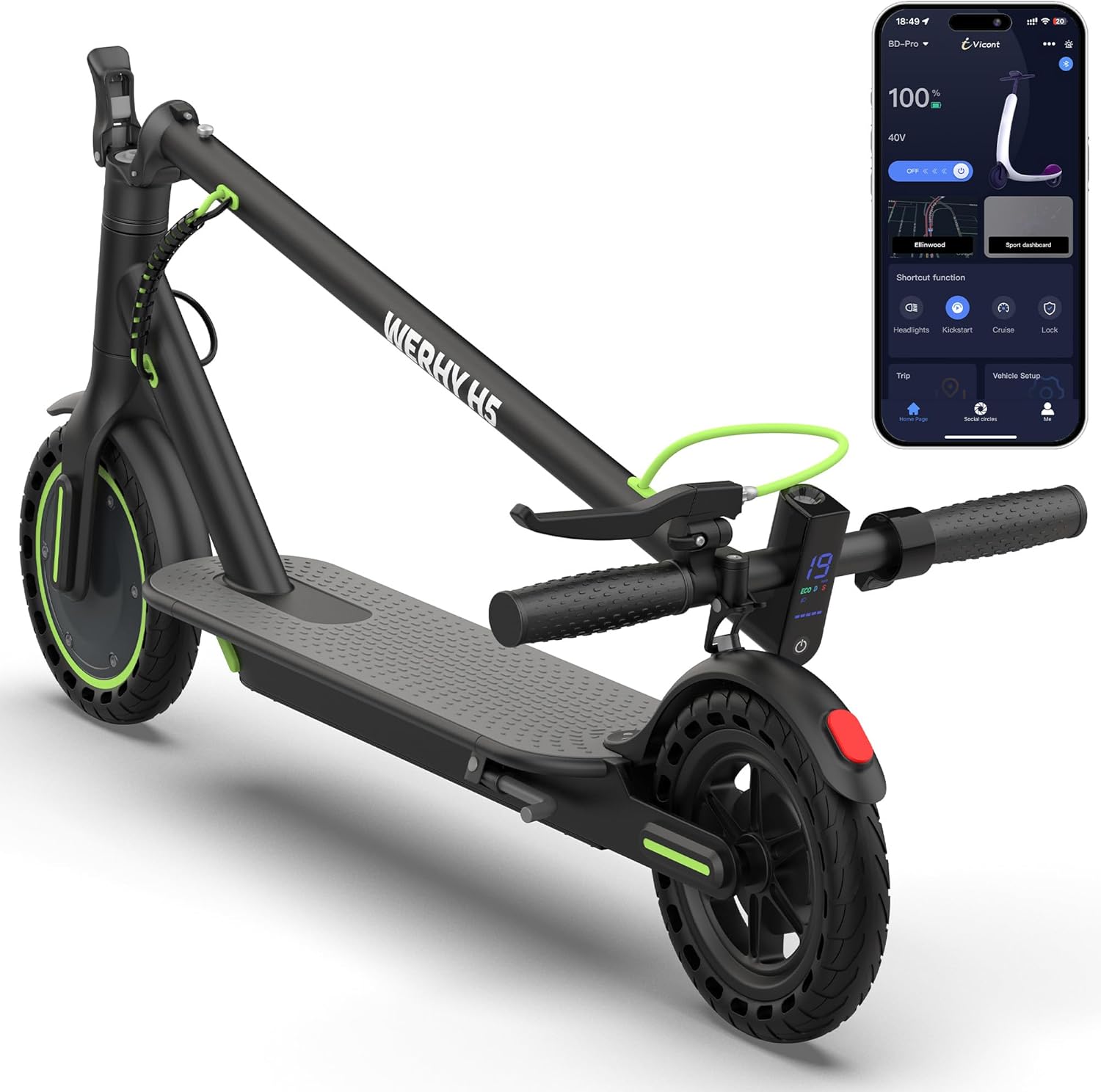
I’ve been using this WERHY H5 8.5" 350W scooter for daily trips for a couple of weeks now – mostly rides to the office, quick runs to the store, and some casual evening rides. I’m not a scooter nerd, just someone who wanted something faster than walking and less hassle than a bike. I picked this one because of the price, the 19 mph top speed on paper, and the solid tires (I’m done with fixing flats). I’m around 185 lbs, so well under the 265 lbs limit.
Out of the box, it was pretty straightforward. Four screws for the handlebar, plug in a cable, and that’s about it. I charged it fully before the first ride – took roughly 3 hours from what looked like a half-charged battery. First impression: it doesn’t feel like a toy, but it also doesn’t feel like a heavy-duty rental scooter. Somewhere in between, which is fine for the price point.
On the road, it’s clearly built for city streets and bike paths, not rough terrain. The 350W motor is enough to get going quickly on flat ground, but you definitely feel it working on hills. The app is a nice extra, but honestly, after playing with it the first evening, I mostly just use the physical buttons. I just want to turn it on, set a speed mode, and go.
Overall, after these first weeks, I’d say it’s a pretty solid commuter scooter if your expectations match the specs: short to medium rides, mostly flat terrain, and you don’t mind feeling bumps because there’s no suspension. It’s not perfect, but it gets the job done for everyday use without costing as much as the big brands.
Value for money: solid commuter if you catch it at the right price
From a value perspective, this WERHY H5 sits in a pretty good spot. You’re not paying for a big brand name, but you still get a usable scooter with decent performance, dual brakes, solid tires, and an app. Compared to some entry-level models from bigger brands, you usually pay less for roughly similar specs (350W motor, 15–18 mph, around 10–15 miles real range). If you’re just getting into electric scooters and don’t want to drop a ton of cash, this one makes sense.
Where they clearly saved money is in comfort and polish. No suspension, smaller battery, basic display, and a fairly stiff ride. If you compare it to more expensive scooters, you’ll notice the difference in ride quality and power. But those often cost a lot more. In that context, this model is good value if your expectations are realistic: it’s a short- to medium-distance commuter tool, not a long-range or high-performance machine.
What I like is that the core functions are there and work properly: it folds quickly, it brakes well, it has lights that are actually visible, and the motor has enough power for most city situations. The app is a bonus, but even if you ignore it, the scooter is fully usable with just the onboard controls. You’re not paying extra for gimmicks that you’ll never use.
If you find it at a reasonable price (often under what you’d pay for a big-name equivalent), I’d say it’s good value for money, especially for students and office workers with short commutes. If the price creeps too close to more powerful or better-equipped competitors, then it becomes harder to justify. So, worth it? Yes, as long as you get it at a fair discount or normal street price and you know it’s mainly for flat urban riding.
Design: simple, compact, and a bit stiff
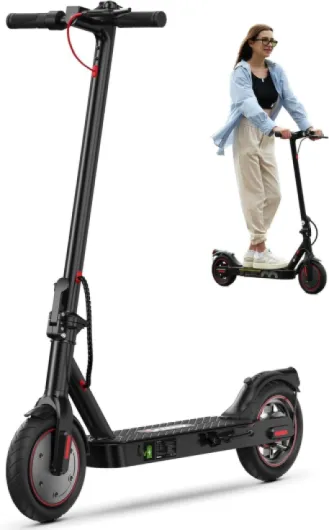
Design-wise, this scooter keeps things basic. The frame is aircraft-grade aluminum, which sounds fancy, but in practice it just feels like a normal metal scooter frame: fairly light and rigid. The green color actually looks nicer in person than in the photos – it’s not neon, more of a medium green that stands out just enough without screaming for attention. The deck is long enough for me to stand with one foot in front of the other comfortably (I’m 5'10"), but if you have big feet, you’ll probably end up riding with one foot slightly sideways.
The folding mechanism is straightforward. You pull a latch near the base of the stem, fold the handlebar column down, and hook it onto a latch at the rear. It takes a few seconds once you get used to it. It feels reasonably secure when locked upright; I didn’t have any wobble in the stem after tightening everything once. That said, like most budget scooters, I wouldn’t slam it off curbs or abuse it. It’s clearly made for smoother riding.
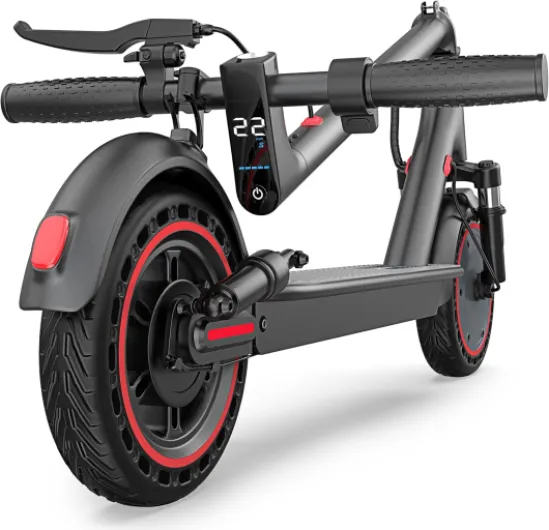
The handlebar is fixed height, which is fine for me, but shorter riders might find it a bit tall and taller riders might find it a bit low. It’s a compromise. The display is small but readable, even in daylight if you tilt it a bit. You see speed, battery bars, and which mode you’re in. No nonsense there. The cables are semi-exposed but routed decently. It doesn’t look premium, but it doesn’t look like a cheap toy either.
One thing to mention: there’s no suspension, and combined with the solid 8.5" tires, the whole scooter feels quite stiff. You feel cracks and bumps through the deck and handlebars. It’s not unbearable, but if you expect a cushy ride, this isn’t it. Design is clearly focused on low maintenance and simplicity rather than comfort. Personally, I prefer that to dealing with punctures all the time, but it’s a trade-off you should be aware of.
Battery and range: realistic numbers, not marketing fantasy
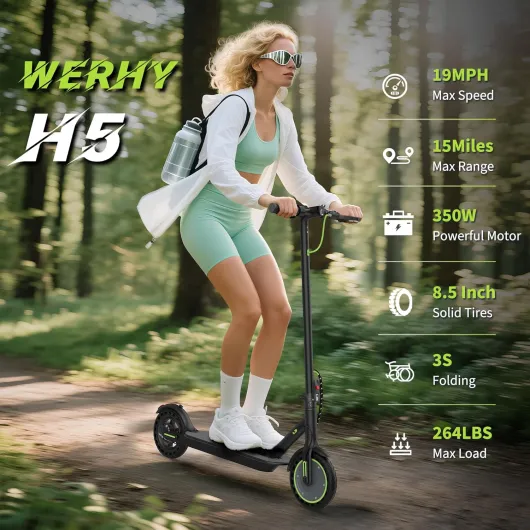
The scooter comes with a 36V/5.2Ah battery, which on paper translates to about 15 miles of range. As usual, that’s the “perfect conditions, light rider, slow speed” figure. In real-world use, I’m getting around 9–11 miles per charge. My typical pattern is: 3–4 mile commute each way, plus maybe a short detour, riding mostly in the middle mode with occasional Sport bursts. By the time I’m home, I’m usually down to 2 out of 5 battery bars, sometimes 1 if there was more wind or more hills.
Charging time with the included charger is around 3–4 hours from low battery to full. I usually just plug it in when I get home and it’s done by the time I’m ready to go out again. The charger is small and light enough to throw in a backpack, so if you’re doing longer trips, you could recharge at work. The only small annoyance is the little rubber cap on the charge port – it protects against dust and splashes, but it’s a bit fiddly to open and close.
One thing I noticed: the last bar of battery drops faster than the first ones. So when you’re down to the last bar, don’t plan a long ride. The scooter also starts to limit power slightly when the battery gets low, which means slower acceleration and lower top speed. That’s normal, but it’s good to know so you’re not surprised when it suddenly feels more sluggish near the end of the charge.
If your daily use is under 8–10 miles total, this battery is fine and you’ll probably charge once a day or every other day. If you’re thinking of 15+ mile round trips at full speed, this specific version is not ideal. You’d need either the bigger battery model or a different scooter. For city errands, commuting, and short rides, the battery is decent, just don’t believe the max range number blindly.
Comfort: solid tires = no flats, but you’ll feel the road
Comfort is honestly where this scooter is just okay, not great. The 8.5" solid tires are low-maintenance, which I like, but they pass pretty much every bump straight into your feet and hands. On smooth asphalt or well-maintained bike paths, the ride is fine. On rough pavement, cracks, or brick paths, you’ll definitely notice the vibrations. If you have wrist or knee issues, this might bother you on longer rides.
The deck grip is good, though. The rubberized surface keeps your shoes planted even when it’s a bit damp. I never felt like I was slipping, even when I had to brake harder. The width is enough for a normal stance; I ride with my front foot angled slightly and back foot sideways, and it’s comfortable for 20–30 minute rides. Beyond that, the lack of suspension starts to get tiring if the road isn’t smooth.
The handlebar grips are ergonomic enough and don’t feel cheap or sticky. After a 30-minute ride, my hands weren’t sore, just a bit buzzed from the vibrations on bumpier streets. The fixed handlebar height is acceptable for my 5'10" frame. If you’re much shorter than 5'5" or taller than 6'2", you might not find the position ideal, but for average height adults and teens, it’s fine.
Bottom line: comfort is okay for short to medium rides, but this is not a plush scooter. You trade comfort for low maintenance. If your roads are mostly decent and you’re not super sensitive to vibration, you’ll get used to it quickly. If your daily route is full of potholes and rough surfaces, I’d either look for a model with air tires or at least some basic suspension, or be ready to slow down and pick smoother lines.
Durability and build: feels sturdy enough if you don’t abuse it
In terms of build, the scooter feels more solid than I expected at this price, but you can still tell it’s a budget-friendly product. The aluminum frame doesn’t flex much, and there was no creaking or strange noises after a couple of weeks of daily use. The folding hinge feels tight once locked, and I didn’t notice any play developing yet. Of course, long-term durability is something you only really see after months, but first impressions are positive.
The solid tires are the main durability plus. No tubes, no punctures, no worrying about glass or small debris. You just ride. The downside is the harsher ride, but from a durability standpoint, it’s great. You’ll probably wear the tread down after a lot of miles, but that’s normal. The brakes – drum at the rear and electronic at the front – worked consistently. No squeaking so far, and the braking power stayed the same after multiple rides.
The paint and finish are okay. After carrying it up and down some stairs and brushing against walls, I’ve got a couple of small scuffs, but nothing major. It’s not the kind of finish that looks pristine forever, but it holds up fine. The cables and connectors don’t look fragile, and the deck housing for the battery feels well sealed. I wouldn’t ride it through deep puddles or in heavy rain, though; it’s not advertised as fully waterproof, and I don’t trust budget scooters in bad weather.
The brand offers 180/365-day warranty on different parts, which is decent. I haven’t had to use support yet, so I can’t judge how responsive they are. Overall, if you treat it like a commuter tool and not a stunt toy, I don’t see any obvious weak point that screams “this will break in a month.” Just don’t throw it around, avoid jumping curbs, and it should hold up for regular use.
Performance: decent speed, okay on hills, better on flats
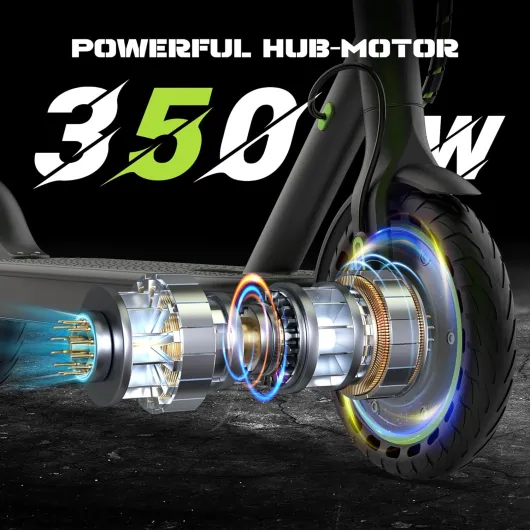
The 350W motor does a decent job for city use. On flat ground, in Sport mode, I hit around 17–18 mph on the display, which probably means closer to 16–17 mph in reality. I didn’t quite reach the advertised 19 mph, but it’s close enough that I don’t really care. Acceleration from a standstill is smooth, not jerky, which I prefer in traffic. It’s not going to launch you forward, but it gets up to cruising speed in a reasonable time.
On hills, you notice the limits. On small inclines, it keeps speed fine. On moderate hills, speed drops to around 8–12 mph depending on how steep and how long the climb is. On really steep stuff, you’re either crawling or stepping off and walking. That’s normal for a 350W scooter at this price, so I’m not shocked, but if you live in a very hilly area, I’d look at a more powerful model or be ready to help it with your foot now and then.
The three speed modes are actually useful. Eco is slow but good for crowded areas or if you’re lending it to someone who’s nervous. Drive is what I use most of the time – good balance between speed and range. Sport is for when you’re late or on a clear path. You can also turn on cruise control through the app, which kicks in after holding a steady speed for a few seconds. It works, but I use it rarely because I stop and start a lot in the city.
Overall, performance is “good enough” for daily commuting on flat or slightly hilly routes. It’s not a powerhouse, but it doesn’t feel weak either. If you’re expecting fast acceleration and hill performance like the heavier rental scooters or high-end brands, you’ll be a bit disappointed. If you just want to cruise at around 15–17 mph to work or school, it does the job without drama.
What you actually get with the WERHY H5
On paper, this version is the 8.5" wheel, 350W motor, 19 mph top speed model in green. In real life, that description is mostly accurate, with a few things to keep in mind. The scooter comes almost fully assembled: frame, deck, wheels, and electronics are all set. You attach the handlebar with four screws (tool included), plug in the brake/display cable, and you’re ready. No weird alignment issues on mine, which is always my fear with budget stuff.
The specs say max range around 15 miles with the 36V/5.2Ah battery. In practice, I’m getting closer to 9–11 miles per charge at my weight (185 lbs), riding mostly in the middle speed mode with some short bursts in sport. That’s normal; all brands exaggerate range. If you’re lighter, stay in Eco mode, and ride on flat ground, you might get closer to the claimed numbers, but I wouldn’t plan anything over 10 miles one way without a charger.
The controls are simple: one main button on the display for power and mode changes, a thumb throttle on the right, and a brake lever on the left for the rear drum brake. There’s also the electronic front brake (EABS) that kicks in when you use the lever, so you get a mix of regen and mechanical braking. Lights are basic but functional: headlight up front, brake light at the back that flashes when you slow down, plus a bell.
In short, this isn’t some fancy feature-packed scooter. It’s a straightforward commuter with a few nice extras like the app and three speed modes. What you see on the listing is pretty much what you get, just adjust your expectations on range and hill climbing, because those are always optimistic in product descriptions.
Pros
- Decent real-world speed (around 16–17 mph) and smooth acceleration for city use
- Solid tires and aluminum frame mean low maintenance and no flats
- Quick folding mechanism and relatively light package, easy to store and carry short distances
Cons
- No suspension and solid 8.5" tires make the ride quite stiff on rough roads
- Real-world range closer to 9–11 miles, well below the advertised 15 for many riders
Conclusion
Editor's rating
After using the WERHY H5 8.5" 350W scooter regularly, my take is pretty straightforward: it’s a solid everyday commuter for short to medium city rides, as long as you’re not expecting miracles in speed, comfort, or range. It does the basics well: it gets up to around 16–17 mph on flats, it folds quickly, it has a decent dual braking system, and the solid tires mean you’re not constantly worrying about punctures. For daily trips under 8–10 miles total, it fits the job nicely.
Where it’s weaker is comfort and tougher terrain. No suspension plus solid 8.5" tires means you feel every bad patch of road. The 350W motor is fine on flats and small hills but slows down on steeper climbs, so if your area is very hilly, you might want something stronger. The real-world range is closer to 9–11 miles than the marketed 15, which is normal but worth knowing before you buy.
I’d recommend this scooter to students, office workers, or teens/adults who need a practical, low-maintenance way to move around a city or campus and don’t mind a firm ride. It’s also a decent first scooter if you’re not sure you’ll use one enough to justify a high-end model. On the other hand, if you want long-range rides, very smooth comfort, or serious hill performance, you should look at larger batteries, air tires, or higher power motors – and be ready to pay more. This one is more “does the job without fuss” than anything fancy, and that’s fine if that’s what you’re after.